wayground logo

Free Printable Worksheets

NEW

Font size

S
M
L
XL
Worksheets

Unit #6 Meteorology

Total questions: 73

Worksheet time: 1hrs 14mins

Name
Class
Date
1.

A high pressure system will cause what kind of weather?

a)

a hurricane

b)

a tornado

c)

dry, clear skies

d)

humid day with overcast skies

2.

What type of weather goes with this symbol?

a)

Clear, sunny skies

b)

Cloudy skies

c)

Hot temperature

d)

Thunderstorms

3.

In _______ pressure systems, air rises

a)

high

b)

low

c)

medium

d)

none

4.

What kind of pressure predicts good weather?

a)

high

b)

low

c)

cold

d)

stationary

5.

Which system results in rainy or stormy weather?

a)

high pressure

b)

low pressure

c)

hurricane

d)

weather system

6.

Why is there a low pressure zone at the equator?

a)

because it is always warm, which causes the air to warm and rise

b)

because it is always warm, which causes the air to cool and sink

c)

because it is always cool, which causes the air to warm and rise

d)

because it is always cool, which causes the air to cool and sink

7.

Which system brings in precipitation?

a)

low-pressure system

b)

high-pressure system

c)

positive-pressure system

d)

negative-pressure system

8.

What causes differences in air pressure around earth ?

a)

Warm air rises at the equator, and cold air sinks at the poles.

b)

Equator gets over heated

c)

Poles get over heated

d)

Differences in salinity levels in the ocean

9.

Warm air rising at the equator and cold air sinking at the poles is an example of what?

a)

hurricanes

b)

Coriolis Effect

c)

Earth's rotation

d)

convection

10.

Where are high-pressure belts located?

a)

0 degrees

b)

30 degrees north and south

c)

60 degrees north and south

d)

the equator

11.
___________is the result of the weight of a column of air pushing on an area.
a)
air pressure
b)
density
c)
volume
d)
none of the above
12.
What does the air consist of?
a)
molecules
b)
helium
c)
density
d)
weather
13.
What direction do the molecules go in the air?
a)
everywhere
b)
no where
c)
there are no molecules
d)
downward
14.
________is the instrument used to measure air pressure.
a)
barometer
b)
thermometer
c)
mercury
d)
watch
15.
What is another word for altitude?
a)
elevation
b)
barometer
c)
circumference
d)
weight
16.
As you climb up a mountain what happens to the air pressure?
a)
decreases
b)
increases
c)
stays the same
17.
What happens to the oxygen molecules as altitude increases?
a)
fewer molecules
b)
more molecules
c)
same amount of molecules
d)
nothing happens to the molecules
18.
Heat transfer between two substances that are in contact with each other is called
a)
conduction
b)
convention
c)
convection
d)
radiation
19.
Convection takes place because
a)
warm air is more dense than humid air
b)
warm and cold air have the same density
c)
cold air is less dense than warm air
d)
cold air is more dense than warm air
20.
Winds are caused by differences in
a)
precipitation
b)
humidity
c)
air pressure
d)
turbulence
21.
The __, or elevation of a mountaintop is its distance above sea level.
a)
greenhouse effect
b)
altitude
c)
convection
d)
weather
22.
At the seashore late in the afternoon on a hot, sunny day, a person often feels a strong breeze coming in from the ocean.  Which of the following is the reason for the breeze?
a)
pounding waves generate air currents
b)
warm air over the ocean rushes in to replace the cool air that rises over land
c)
there are no clouds to block wind coming in
d)
heavy cool air over the ocean rushes in to replace warm air that rises over the land
23.
Global winds generally
a)
are unpredictable
b)
change directions day to day
c)
blow from specific directions over long distances
24.
The name of the global winds that move from west to east across the United States is called
a)
Trade Winds
b)
Prevailing Westerlies
c)
Polar Easterlies
d)
Doldrums
25.
At night,  the denser cool air over the land moves in and replaces the less dense, warmer air that rises over the ocean.  This is called 
a)
sea breeze
b)
land breeze
c)
trade winds 
26.
High pressure will usually bring what kind of weather?
a)
clear and dry
b)
cloudy and wet
27.
Based on the information in the table, in which city will it most likely rain?
a)
City W
b)
City X
c)
 City Y
d)
City Z
28.
Which weather condition will most likely occur when the atmospheric pressure in an area begins falling?
a)
dry
b)
cold
c)
rainy
d)
sunny
29.
Which kind of weather change will occur with an increase in air pressure?
a)
cooler and dryer
b)
colder and rainier
c)
hotter and stormier
d)
warmer and moister
30.
On a cold, cloudy day, the local weather forecaster predicts that a high-pressure system will be moving into the area in the next 24 hours. Which weather conditions will this system most likely bring to the area?
a)
stormy
b)
sunny
c)
snowy
d)
hot
31.
Michael observes the air pressure daily. Over the last couple of days the air pressure has been dropping. What weather will Michael most likely observe as a result?
a)
increasingly clear skies and more wind
b)
increasingly clear skies and dry weather
c)
increasingly cloudy skies and possible storms
32.
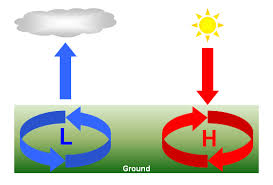
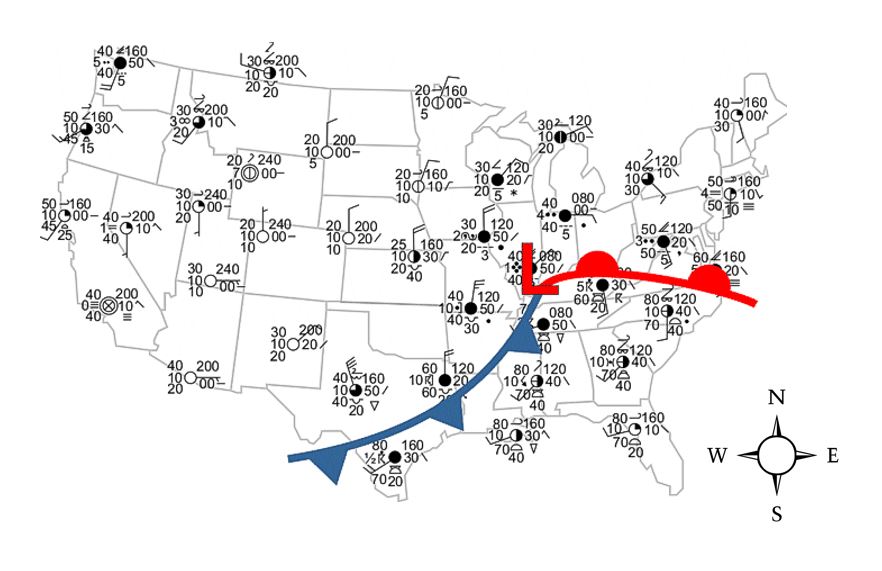
What type of air pressure is present?
a)
High 
b)
Low
33.
What are the yearly conditions of temperature, precipitation and humidity?
a)
weather
b)
climate
34.

As you move towards the poles, what happens to temperature?

a)

temperature becomes hotter

b)

temperature becomes colder

35.
Which climate zone gets the least amount of direct sunlight and is the coldest?
a)
tropical
b)
temperate
c)
polar
36.
Which climate zone has moderate temperatures and rainfall year round?
a)
tropical
b)
temperate
c)
polar
37.
Which climate zone gets the most amount of direct sunlight and rainfall and is the warmest?
a)
tropical
b)
temperate
c)
polar
38.

As altitude increases, what happens to temperature?

a)

temperature gets hotter

b)

temperature gets colder

39.
What part of the water cycle includes rain, sleet and snow?
a)
condensation
b)
precipitation
40.
True or false?  Places near the ocean have less extreme weather conditions.
a)
True
b)
False
41.
True or False?  Warm and cold ocean currents affect the land nearby.
a)
false
b)
true
42.
Which factor does not affect climate?
a)
longitude
b)
distance from large bodies of water
c)
latitude
d)
altitude
43.
What are the daily conditions of temperature, humidity and precipitation?
a)
weather
b)
climate
44.

The number one thing hurricanes need is...

a)

warm water

b)

cold air from cold fronts

c)

cold water

d)

strong warm front

45.

What causes global convection currents

a)

Forests

b)

greenhouse gases

c)

more land forms

d)

uneven heating of the Earth's surface

46.

Where do warm ocean currents come from

a)

the poles

b)

near the land

c)

the equator

d)

middle of the oceans

47.

How to oceans form hurricanes?

a)

warm air over the equator rises and faster than cold air from the poles

b)

warm waters provide the energy for hurricanes

c)

cold water provides the energy for hurricanes

d)

cold air at the poles is more dense and falls faster than warm air from the equator

48.

How to warm waters contribute to hurricane development

a)

evaporating water adds heat to the atmosphere

b)

rising tides cause the ocean level to rise

c)

waves cause the hurricane to develope

d)

currents carry the warm water to the hurricane

49.

What city will experience decreasing temperatures in the next day?

a)

Denver

b)

El Paso

c)

Memphis

d)

Los Angeles

50.

What city is most likely going to see temperatures rise?

a)

San Jose

b)

El Paso

c)

Jacksonville

d)

Chicago

51.

Where do the most violent storms form

a)

The poles

b)

Tropic of Cancer

c)

The Equator

d)

Tropic of capricorn

52.

Where do cold ocean currents come from?

a)

cold ocean currents come from the southern hemisphere

b)

cold ocean currents come from the equator

c)

cold ocean currents come from the poles

d)

cold ocean currents come from the beach

53.

What does this symbol represent?

a)

Cold Front

b)

Warm Front

c)

Stationary Front

d)

Occluded Front

54.

What does this symbol represent?

a)

Cold Front

b)

Warm Front

c)

Stationary Front

d)

Occluded Front

55.

What does this symbol represent?

a)

Cold Front

b)

Warm Front

c)

Stationary Front

d)

Occluded Front

56.

What does this symbol represent?

a)

Cold Front

b)

Warm Front

c)

Stationary Front

d)

Occluded Front

57.

hurricanes are

a)

extreme low pressures

b)

extreme high pressures

c)

small rain storms

d)

formed over land

58.

Warm Fronts bring

a)

rain followed by cool dry air

b)

hurricanes

c)

rain followed by hot humid air

d)

fair weather

59.

cold Fronts bring

a)

rain followed by cool dry air

b)

hurricanes

c)

rain followed by hot humid air

d)

fair weather

60.
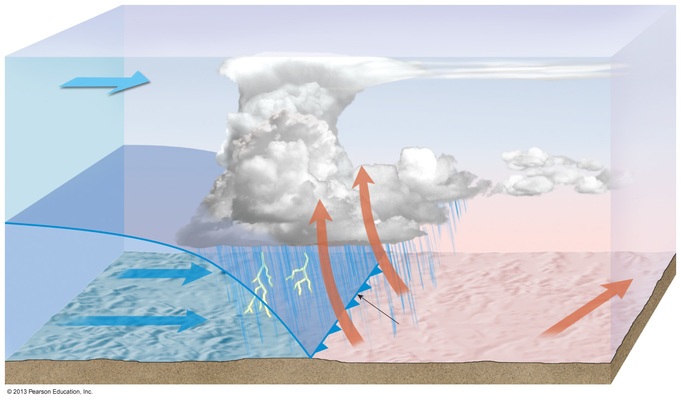
What type of storm front is this? 
a)
warm front
b)
cold front
c)
stationary front
d)
occluded front
61.
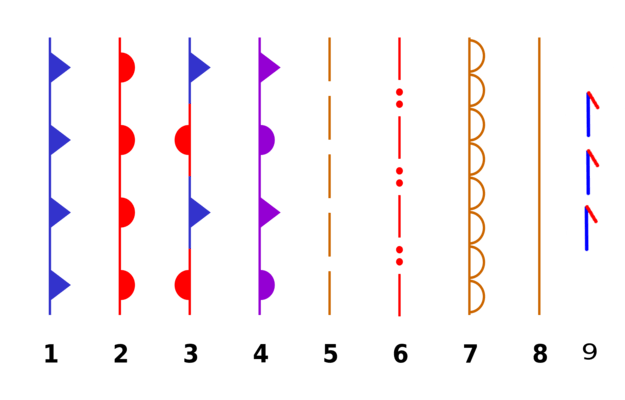
What does symbol # 3 mean?
a)
stationary front
b)
occluded front
c)
warm front
d)
cold front
62.
A front is
a)
where warm air is cooling at earth's surface
b)
a line where hot and cold air are separating
c)
a line where two different air masses meet
d)
where cold air is rising and forming rain clouds
63.
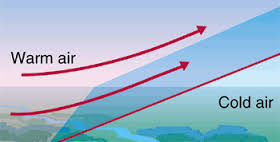
Which type of front is pictured?
a)
Cold front
b)
Warm front
c)
Occluded front
d)
Stationary front
64.
Which system results in drier, fairer weather?
a)
high pressure
b)
low pressure
c)
hurricane
d)
weather system
65.
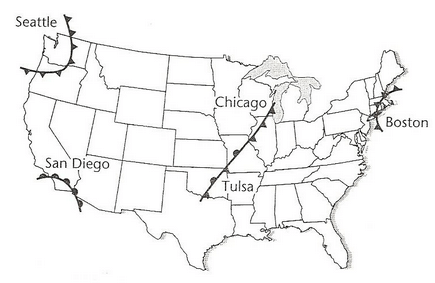
Which type of front is near Seattle?
a)
cold front
b)
warm front
c)
occluded front
d)
stationary front
66.
Which type of front is located near Boston?
a)
warm front
b)
cold front
c)
stationary front
d)
occluded front
67.
What direction is the warm front moving on the map? 
a)
North
b)
South
c)
East
d)
West
68.
What direction is the cold front moving on the map? 
a)
Southwest
b)
Northwest
c)
Southeast
d)
Northeast
69.
A tornado is a violent rotating column of air extending from a thunderstorm 
a)
True
b)
False
70.
Form over warm waters of the Pacific, Atlantic, and Indian Oceans
a)
Tornado
b)
Hurricane
71.
A tsunami is caused by______
a)
lots of rain
b)
a meteorite 
c)
a tornado
d)
an earthquake
72.
Which word correctly describes large, round pieces of ice?
a)
HALE
b)
HAIL
73.
A heavy snowstorm with strong winds and extremely cold temperatures is known as a....
a)
Flood
b)
Drought
c)
Blizzard
d)
Heat Wave