
 Worksheets
Unit 5 Test
Total questions: 20
Worksheet time: 40mins
Name
Class
Date
1.
Which body of water connects Europe to Africa and the Middle East?
a)
Baltic Sea
b)
Black Sea
c)
Mediterranean Sea
d)
North Sea
2.
Which three factors most affect the population distribution (where people live) in Europe?
a)
Climate, population size, government
b)
Location, natural resources, climate
c)
Economy, culture, history
d)
Technology, agriculture, climate
3.
What form of government originated in Ancient Greece?
a)
Monarchy
b)
Democracy
c)
Republic
d)
Oligarchy
4.
What economic and social system dominated Europe during the Middle Ages?
a)
Democracy
b)
Feudalism
c)
Capitalism
d)
Socialism
5.
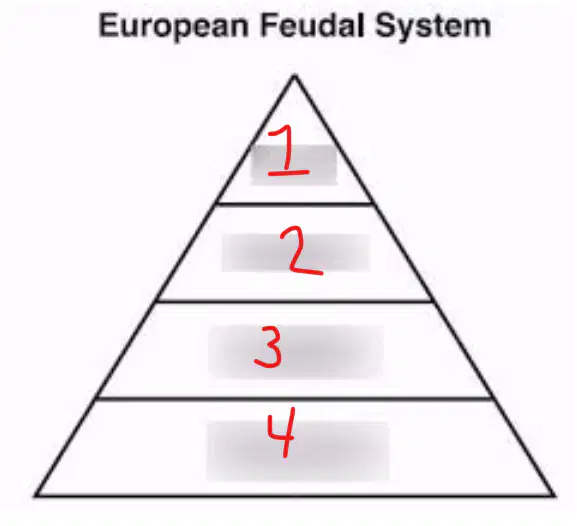
Fill in the Feudalism pyramid below. Number your answers 1-4.
(a)
6.
What type of climate is most commonly found in southern Europe?
a)
Tropical
b)
Continental
c)
Tundra
d)
Mediterranean
7.
Which of the following physical features acts as a natural border between France and Spain?
a)
The Carpathian Mountains
b)
The Alps
c)
The Pyrenees Mountains
d)
The Ural Mountains
8.
Which European river is important for trade and flows through multiple countries, including Germany and the Netherlands?
a)
The Seine
b)
The Thames
c)
The Danube
d)
The Rhine
9.
The Renaissance is best described as a:
a)
Time of religious wars
b)
Rebirth of art, science, and culture
c)
Period of agricultural expansion
d)
Military-focused era
10.
Why are rivers such as the Danube and Rhine important to Europe?
a)
They provide natural barriers between countries.
b)
They are key transportation routes for trade and travel.
c)
They prevent flooding in coastal areas.
d)
They are the primary sources of energy in Europe.
11.
What mountain range is located in central Europe and span across countries like Switzerland, Austria, and Italy.
a)
The Alps
b)
The Pyrenees
c)
The Carpathian Mountains
d)
The Ural Mountains
12.
Which of the following is a lasting contribution of Ancient Rome to modern society?
a)
The development of the printing press
b)
The creation of democratic government
c)
The use of legal systems and engineering innovations like aqueducts
d)
The invention of the compass for navigation
13.
How did European exploration during the Age of Exploration impact global geography?
a)
It led to the development of more accurate maps and a better understanding of the world’s size and continents.
b)
It caused the physical geography of Europe to change significantly due to colonization.
c)
It created new continents through human expansion.
d)
It replaced natural landforms with man-made structures.
14.
How did the end of World War I affect the borders of Europe?
a)
New borders were drawn, creating new countries, and empires were broke apart.
b)
There was no significant change in the borders of European countries after the war.
c)
European countries gained more colonies in Africa and Asia.
d)
The borders were redrawn to give all European nations equal territory.
15.
How did the Industrial Revolution impact geography and society in Europe?
a)
It led to the decline of cities and a return to agricultural-based economies.
b)
It resulted in the growth of urban areas as people moved from rural farms to work in factories.
c)
It caused the closure of trade routes and the decline of international trade.
d)
It made Europe more isolated by reducing the need for communication and transportation.
16.
Which of the following is the most densely populated region in Europe?
a)
Northern Europe
b)
Central and Western Europe
c)
Eastern Europe
d)
Southern Europe
17.
What was one of the major global consequences of World War II?
a)
The rise of the Soviet Union as a global superpower and the beginning of the Cold War.
b)
The disappearance of the United States as a world power.
c)
The creation of democracy in all European countries.
d)
The complete end of all dictator governments in the world.
18.
How many languages are spoken across Europe?
a)
About 50
b)
About 100
c)
Over 200
d)
Exactly 500
19.
Which of the following religions is most commonly practiced in Europe?
a)
Hinduism
b)
Christianity
c)
Buddhism
d)
Islam
20.
What does the European Union (EU) primarily help European countries with?
a)
Shared military alliances
b)
Shared trade policies and economic cooperation
c)
Shared religious practices
d)
Shared political ideologies
100 %

