
 Worksheets
AP Chem 5.5,5.6,5.7 Review
Total questions: 43
Worksheet time: 1hrs 6mins
What is required for two molecules to react according to collision theory?
They must be in the same state of matter.
They must have enough energy to disrupt existing bonds.
They must be of the same size.
They must be in a vacuum.
What is the main focus of collision theory in chemistry?
The speed of light
The interaction of molecules
The color of compounds
The weight of atoms
According to collision theory, what must reacting particles do for a chemical reaction to occur?
Absorb light
Collide with one another
Change color
Emit sound
What is the role of activation energy in a chemical reaction?
It slows down the reaction
It provides the necessary energy for the reaction to occur
It changes the color of the reactants
It emits light during the reaction
Which of the following is a condition for a successful reaction according to the theory?
High temperature with molecules moving in circles.
Sufficient energy and proper orientation
Low energy and heavy molecules.
molecules that are friendly
What is the likelihood of bond breakage upon collision when temperature increases?
It decreases.
It remains the same.
It greatly increases.
It becomes impossible.

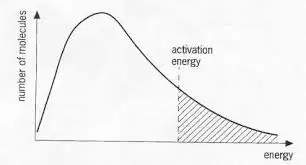
What does the shaded area under the Maxwell Boltzmann Curve represent?
Molecules with insufficient energy to react
Molecules with enough energy to react
Molecules at equilibrium
Molecules with zero energy
What is the effect of temperature on the number of collisions according to the Maxwell Boltzmann Curve?
Temperature has no effect
Temperature decreases the number of collisions
Temperature increases the number of collisions
Temperature stabilizes the number of collisions

Which curve in the diagram above represents the reaction occurring at the lowest temperature?
blue curve
green curve
purple curve
What effect will increasing [H⁺] at constant temperature have on the reaction below? Cl⁻(aq) + ClO⁻(aq) + 2H⁺(aq) → Cl₂(g) + H₂O(l)
The activation energy of the reaction will increase.
The activation energy of the reaction will decrease.
The frequency of collisions between H⁺(aq) ions and ClO⁻(aq) ions will increase.
The value of the rate constant will increase.
What did the principal say when oxygen, hydrogen, sulfur, sodium, and phosphorous walked into the school?
Take off your hat please.
Go Clippers!
Where is your ID?
OH SNaP
Which one of the following is NOT a key concept of the collision theory:
particles must collide in order to react
particles must move slowly when they collide, otherwise they simply “bounce off” one another
particles must collide with the proper orientation
particles must collide with sufficient energy to reach the activated complex in order to react
Which species in the mechanism below is the intermediate?
A + B → C + D Fast
D + E → F + B Slow
A
B
C
D

How many intermediates are in the following rate mechanism?
0
1
2
3
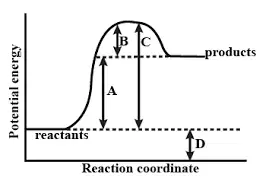
The reaction represented by this energy profile is _____________
because the ____________________ have more energy than the __________________.
exothermic, reactants, products
endothermic, reactants, products
exothermic, products, reactants
endothermic, products, reactants
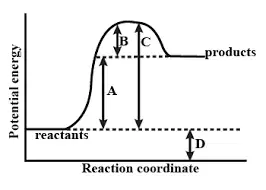
Which vertial line represents activation energy Ea?
A
B
C
D

When temperature is increased, the reaction increases due to ....
fewer collisions of particles.
moleclues moving faster causing more successful collisions.
molecules moving slower and having more time to collide.
a greater concentration of reactants.
What is activation energy?
The change in energy between reactants and products
The minimum amount of energy required for a reaction to start
The energy of the reactants
The energy possessed by the products

For all reactions, which letter represents the REACTANTS?
A
B
C
D
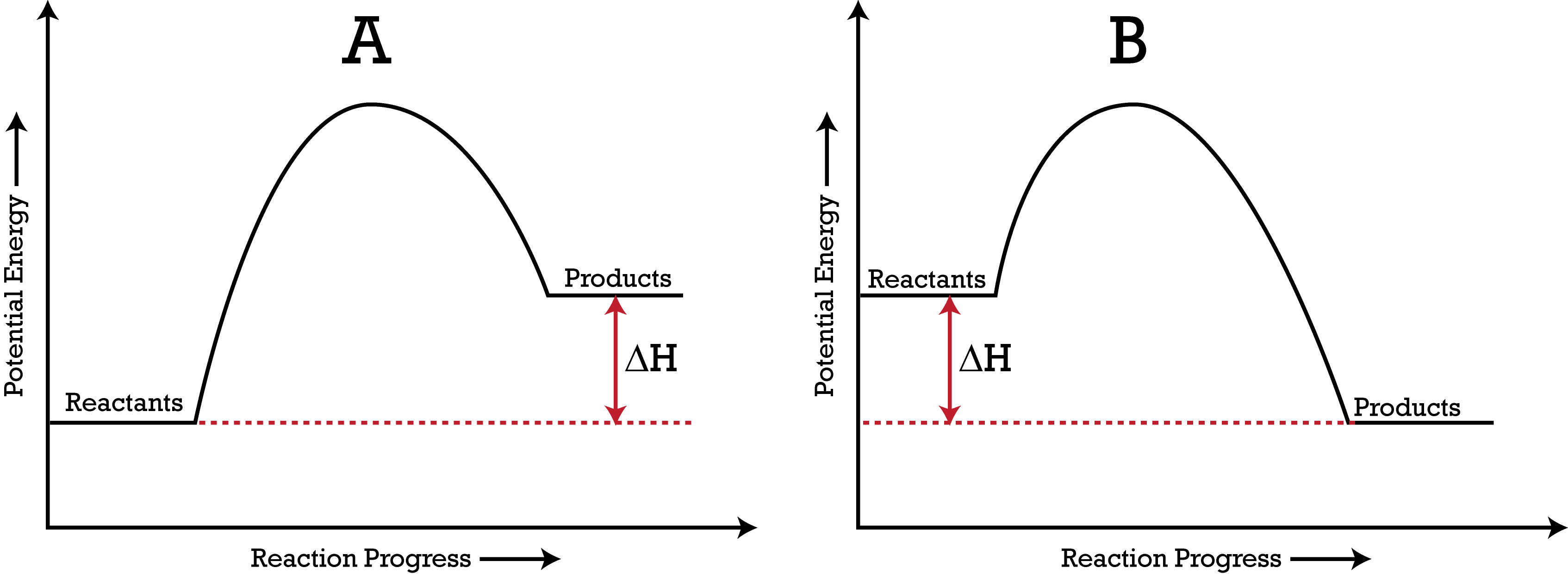
Which PE Diagram represents an endothermic reaction?
A
B
Decreasing the concentration of a substance will usually........
Slow down the reaction
Speed up the reaction
Have no affect on the reaction

Which one of the following provides the correct values of the activation energy (in kJ mol-1) and the ΔH (in kJ mol-1) for the reaction

Which letter represents the transition state?
A
B
C
D
E

Which letter corresponds to the activation energy of the forward reaction?
A
B
C
D
Which of the following best describes activation energy?
The energy released during a reaction
The energy required to start a reaction
The energy absorbed during a reaction
The energy at the end of a reaction
In an endothermic reaction, the energy profile diagram shows:
Products having higher energy than reactants
Reactants having higher energy than products
No change in energy between reactants and products
Energy being released to the surroundings

Which of the following is true for an exothermic reaction?
The energy of the products is higher than the energy of the reactants
The energy of the reactants is higher than the energy of the products
The energy of the reactants and products are equal
The reaction absorbs energy from the surroundings

Which curve shown here represents N2O at a higher temperature?
TA
TB
Neither curve
Which gas molecule has the highest average velocity at a constant temperature? Hint: Lighter particles move faster.
O2
H2O
H2
Xe

Which temperature has the highest average particle speed?
- 100 C
100 C
500 C
The particle speed is constant
How would a catalyst affect the diagram below?
The hill would be smaller.
The activation energy live would shift to the right.
The activiation energy line would shift to the left.
Nothing would change.
In this reaction mechanism, what is the catalyst?
NO + O3 → NO2 + O2
O3 → O2 + O
NO2 + O → NO + O2
NO
O3
NO2
O
In this reaction mechanism, what are
the intermediate(s)?
NO + O3 → NO2 + O2
O3 → O2 + O
NO2 + O → NO + O2
NO and O3
O and O3
NO2 and O2
NO2 and O
NO and O
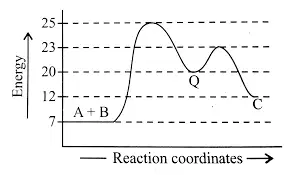
What is the overall change in enthalpy for this reacton energy profile?
-60 kJ
+25 kJ
+5 kJ
-8 kJ
+20 kJ

Which letter represents the change in enthalpy of this reaction?
A
B
C
D
E
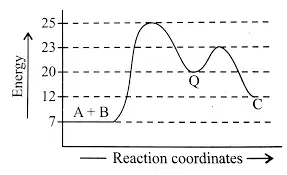
In this two step reaction, is the second step exothermic or endothermic?
exotheromic
endothermic
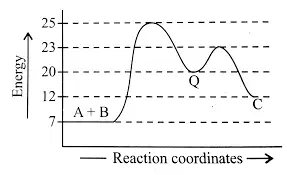
What is the activation energy of the first step in this reaction energy profile?
-18 kJ
+18 kJ
+13 kJ
-5 kJ
Why did the bear dissolve in water?
It was a grizzle bear.
It was a panda bear.
It was a polar bear.

If a reaction energy profile has a taller ‘hill’ (or activation energy) then this step in the reaction reaction is ____________________?
Faster
Slower

What does the dashed curve represent in this diagram?
the moles of reactants
the presence of an intermediate
the Δ H of the overall reaction
the presence of a catalyst
One more from the 9.2 Edpuzzle!
Which equation would be used to find the change in entropy?



