
 Worksheets
Unit 6: Reproduction Summative Review
Total questions: 50
Worksheet time: 44mins
Which events occur during interphase?
The cytoplasm divides
The cell grows and prepares for mitosis
The nucleus divides
The cell grows and divides
What does mitosis result in?
1 identical daughter cell
2 identical daughter cells
1 unique daughter cell
2 unique daughter cells
What occurs in the S phase of the cell cycle?
DNA replication
Cell growth, the cell increases in size and new proteins are synthesized.
Cell division
Preparing for cell division, many molecules and organelles are produced.
During normal mitotic cell division, a parent cell having eight chromosomes will produce two daughter cells, each containing
2 chromosomes
4 chromosomes
8 chromosomes
16 chromosomes
Two identical copies of a chromosome, held together by a centromere are called
sister chromatids
sister chromatin
haploid
homologous pairs

Sea turtles have 56 chromosome in their somatic cells. How many chromosomes are in their gametes?
28
56
112
46
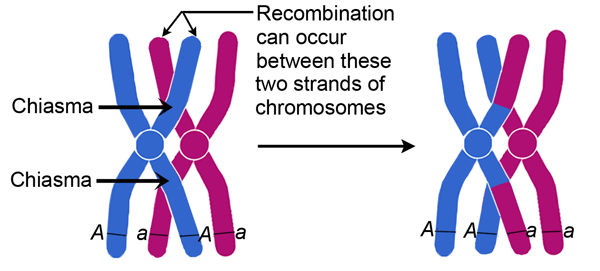
Which of the following are true of meiosis? Select THREE that best apply!
It results in four cells
It results in two cells
The daughter cells are genetically identical
The daughter cells are genetically unique
The daughter cells are haploid
A cell containing 20 chromosomes (diploid) at the beginning of meiosis would, at its completion, produce cells containing how many chromosomes?
10
5
40
20

Hydras are organisms that can reproduce sexually or asexually. A particular population of hydra are widely distributed in a large, stable environment. In this situation it is more advantageous for the hydra to reproduce–
asexually, so that only a small number of offspring will be produced
asexually, so individuals don’t have to spend energy looking for mates
sexually, so the genetic variation of the population will increase.
sexually, so offspring can move more easily into a new environment.
An organism is living in a rapidly changing environment. Sexual reproduction is advantageous to an organism in this situation because–
sexual reproduction produces more offspring than asexual reproduction within a given time period.
sexual reproduction produces offspring with more variation, some of which may be better adapted to a new environment.
sexual reproduction requires more time to complete, allowing the environment to become more stable.
offspring produced by sexual reproduction grows to maturity more rapidly
Which of the following is a characteristic of asexual reproduction?
It involves male and female gametes.
It produces genetically identical offspring.
It produces small number of offspring.
It is most common in humans
Which examples demonstrate the growth of an organism as a result of mitosis? Select all that apply
a seed becoming a plant
a plant withering in the sunlight
skin flaking off your arm in the winter
None of these

SB1b. A diagram of meiosis is provided below. The diagram clearly represents meiosis because of which of the following items?
The process happens in exactly three steps.
The number of chromosomes remains constant throughout.
The end result is cells with half the genetic material.
There is a representation of genetic mutation.

A diagram of mitosis is provided. The diagram demonstrates which of the following?
Mitosis produces cells that contain one half of the genetic material of the parent cells.
Mitosis produces cells that contain twice the amount of genetic material as the parent cells.
Mitosis produces cells with genetic material not found in the parent cell.
Mitosis produces cells that are genetically identical to their parents.
While providing many advantages, sexual reproduction presents which of the following disadvantages for sexually reproducing organisms? Sexual reproduction–
requires the expenditure of energy to find mates.
fails to provide new genetic combinations.
always results in overpopulation and limited resources
leads to an increase in the appearance of harmful mutations.

What condition results from a cell going through the cell cycle repeatedly and without regulation?
influenza
cancer
diabetes

In which stage of the cell cycle does the amount of DNA in the cell double?
G1
S
M

Is this person a male or female?
Male
Female
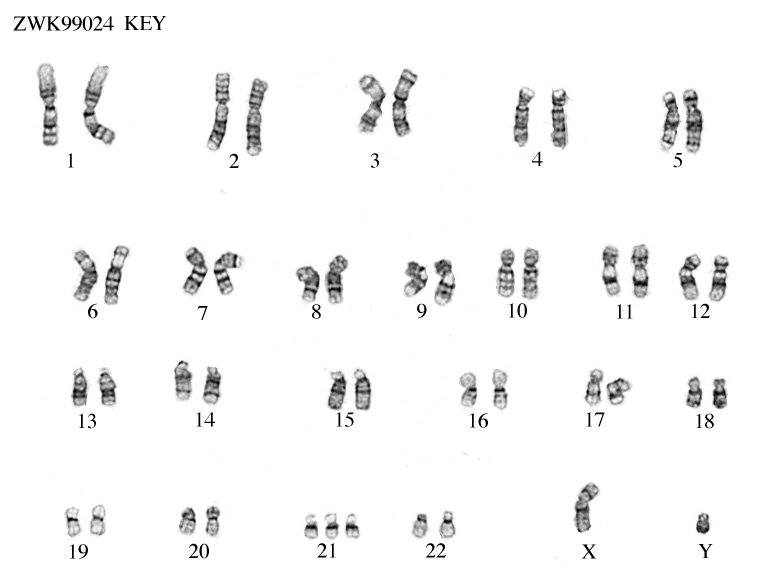
What is the mutation in this persons chromosomes?
There is only one X
7 is shaped like a hockey stick
There's an extra 21
1 is too curved
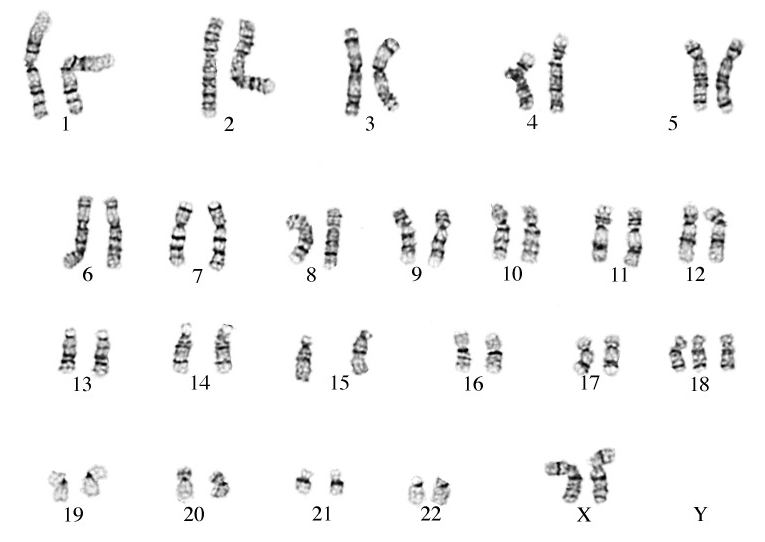
This is known as Edwards Syndrome, can you identify the chromosomal mutation?
Chromosomes 1 and 2 are bent
There is no Y chromosome
This persons chromosomes are normal
There are 3 of chromosomes 18

Does this person have a genetic disorder? If so, which chromosome is responsible?
Yes, there is a missing Y chromosome
Yes, there is an chromosome 21
No, there is nothing wrong with this karyotype

What are homologous chromosomes?
gene pair where each allele in the pair is the same version
the physical expression of a set of genes for a particular trait
chromosome pairs (one from each parent) that are similar size and carry genes for the same trait

Homologous pairs:
Have the same genes on them
May have different alleles (forms of a gene)
Each comes from one parent
All of these are correct
When an egg and sperm combine, the process is called ______ to form a ______.
zygote...fertilization
fertilization...zygote
meiosis...mitosis
mitosis...meiosis
Meiosis makes sure that all daughter cells are _____.
genetically identical, diploid
genetically identical, haploid
genetically diverse, diploid
genetically diverse, haploid

If an intestinal (body) cell in a butterfly contains 24 chromosomes (diploid), a butterfly egg (haploid) cell would contain ___________
3 chromosomes
6 chromosomes
12 chromosomes
24 chromosomes
What process occurs during meiosis that can result in too many chromosomes or fewer chromosomes?
crossing over
non-disjunction
anaphase I
prophase II
Why is meiosis important for sexual reproduction?
It allows the zygote formed from fertilization to have triple the chromosome number of the organism.
It allows gametes to have twice the original number of chromosomes of the organism.
It allows gametes to have half the original number of chromosomes of the organism.
It allows the zygote formed from fertilization to have half the original number of chromosomes of the organism.
How are mitosis and meiosis similar?
both have two cell divisions
both require DNA replication
both produce gametes
both involved crossing over

The type of asexual reproduction shown in the picture is called
regeneration
binary fission
vegetative propagation
budding
Which describes cells that have only ONE copy of each chromosome?
diploid
haploid
homologous
zygote


Table 1 shows the stage and number of cells and chromosomes per cell at the end of the stage in a 2n=24 organism. Which of the following statements correctly describes the chromosomes in each daughter cell at the end of meiosis I ?
Each daughter cell contains 12 chromatids. Each chromatid is one of two from a single chromosome with the other one of the pair found in the other daughter cell.
Each daughter cell contains 12 chromosomes, each composed of two chromatids. Since the chromosomes were randomly divided, one daughter cell may contain both of a pair of homologous chromosomes, while the other cell contains both of another pair of homologous chromosomes.
Each daughter cell contains 12 chromosomes, each composed of two chromatids. Each chromosome is one of a pair of homologous chromosomes from the parent cell, with the other homologue found in the other daughter cell.
Each daughter cell contains 24 separate chromatids. Since every two chromatids were originally joined, forming one homologous chromosome, the number of chromatids is divided by two to determine the number of chromosomes.
Both mitosis and meiosis begin with a parent cell that is diploid. Which of the following best describes how mitosis and meiosis result in daughter cells with different numbers of chromosomes?
In mitosis, the chromosomes consist of a single chromatid, which is passed to two haploid daughter cells. In meiosis, the chromosomes consist of two chromatids during the first round of division and one chromatid during the second round of division, resulting in two haploid daughter cells.
In mitosis, synapsis of homologous chromosomes results in four haploid daughter cells after one division. In meiosis, synapsis of homologous chromosomes occurs during the second division and results in four diploid daughter cells.
Mitosis produces one identical daughter cell after one round of division. Meiosis has two rounds of division and doubles the number of chromosomes in the second round of division, producing four diploid cells.
Mitosis produces two identical diploid daughter cells after one round of division. Meiosis produces four haploid daughter cells after two rounds of division.

Figure 1 illustrates the X and Y chromosomes during meiosis I and meiosis II of normal spermatogenesis in a mammal species. If the normal spermatogenesis is disrupted, the gametes can have different chromosomes than expected. Which of the following is the most likely cause of one of the four gametes having two X chromosomes and one having neither an X nor a Y chromosome?
Nondisjunction of the chromosomes during meiosis I
Nondisjunction of both the X and Y chromosomes during meiosis II
Nondisjunction of the Y chromosome during meiosis II
Nondisjunction of the X chromosome during meiosis II
Which of the following are CORRECT observations about the differences between MITOSIS and MEIOSIS? (Check all that apply.)
Mitosis produces cells that identical to the parent cell.
Meiosis produces cells that have half the number of chromosomes as the parent cell.
All cells go through INTERPHASE as part of the cell cycle, whether it goes to mitosis or meiosis next.
In both types of cell division, the chromosomes are only duplicated once.
Only in Mitosis, do you see chromosomes pair up to form a tetrad.

Which of the following processes best describes what happens in body cells NOT gametes?
Sexual
Binary fission
Mitosis
Meiosis

The process on the right is:
Right: meiosis
Right: cloning
Right: meiosis
Right: mitosis
How does binary fission differ from mitosis in terms of genetic material?
Binary fission involves the division of genetic material without the division of the cytoplasm and other cellular components, while mitosis involves the division of genetic material along with the cytoplasm and other cellular components.
Mitosis involves the division of genetic material without the division of cytoplasm.
Binary fission involves the division of genetic material without the division of the cytoplasm.
Binary fission involves the division of cytoplasm without the division of genetic material.
What is the purpose of Mitosis?
Growth of an organism and Repair of damaged tissue
To help the body get rid of extra cells
To increase the amount of classwork you have to do
To get rid of the nucleus
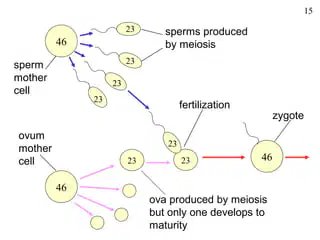
How does the model demonstrate the role of meiosis in sexual reproduction?
The model shows the process of inheriting dominant traits.
The model shows the process of cloning identical offspring.
The model shows the process of producing large numbers of gametes.
The model shows the process of combining genetic information in offspring.
The --------------------- cells undergo Mitosis while the --------- undergo Meiosis
(A) Somatic or body ; Gametes
(B) Gametes; Somatic or body cells
(C) Gametes; Gametes
(D) Somatic or Body cells; Somatic or Body cells
Meiosis results in ------------ While Mitosis resuls in ---------
(A) 2 haploid daughter cells and 2 haploid daughter cells
(B) 4 haploid daughter cells and 2 diploid daughter cells
(C) 2 diploid daughter cells and 4 haploid daughter cells
(D) 4 diploid daugther cells and 2 haloid daughter cells
Timmy fell off his skateboard and scraped his knee. Which cell process is going to be used to heal the wound?
Mitosis
Meiosis
The wound would not heal
Cell diffusion

