
NEW
Font size
 Worksheets
Waves Review SC.7.P.10.3
Total questions: 62
Worksheet time: 2hrs 56mins
The pitch of a sound wave describes how low or high it sounds to the human ear. Pitch and frequency are
related. Which of the following best describes this relationship?
The lower the frequency, the higher the pitch of sound.
The lower the frequency, the slower the speed of sound.
The higher the frequency, the lower the pitch of the sound.
The higher the frequency, the higher the pitch of the sound.
Sound waves can move at different speeds. What can affect the speed at which sound waves travel?
the amplitude of sound wave
the material through which sound waves travel
the distance over which sound waves travel
the frequency of sound waves
Sound waves travel at different speeds through different materials. Through which of the following materials
will sound waves travel the fastest?
copper pipe
swimming pool
air on a cold day
sauna filled with steam
Sound waves and light waves behave differently in different materials. How are sound waves different from light waves?
Sound waves cannot travel through a vacuum.
Light waves cannot travel through a vacuum.
Only sound waves can pass through a material.
Only light waves can pass through a material.
What happens to the speed of a sound wave as it passes from the air into the ground?
it decreases
it increases
it remains constant
it immediately stops
A wave has an amplitude of 6 m, a wavelength of 12 m and frequency of 2 Hz. Calculate the speed of the wave
3 m/s
6 m/s
12 m/s
24 m/s

Observe the graphic above. Which of the following statements is true of the angle of incidence and the angle of reflection?
The angle of incidence is greater than the angle of reflection.
The angle of reflection is greater than the angle of incidence.
They are both equal.
They always add up to 90°.

The diagram above shows light as it travels toward matter. Based on the arrows, which of the following BEST describes the way that light interacts with the matter?
light is absorbed
light is transmitted
light is reflected
light is scattered

There is only one fish in the fishbowl below. When Joseph looks down at the fish, the image he observes is closer to the surface than the actual location of the fish.
Which wave characteristic does Joseph’s observation demonstrate?
amplitude
diffraction
reflection
refraction
Which choice identifies a property of sound waves?
They travel fastest through liquids and gases, not through solids.
They will travel at the same speed through every type of material.
They travel Slowest through solids and liquids, not through gases.
They will travel faster through Solid materials and get progressively slower through liquids and gases
A wave has a frequency of 4 hertz. Calculate the period of the wave.
4 sec
1 sec
.25 sec
Cannot be calculated
A flashlight uses three different forms of energy. Which of the following is the correct order of the energy transformation to power the flashlight?
Mechanical — Thermal — Light/Heat
Electrical — Chemical - Light/Heat
Chemical — Electrical —Light/Heat
Light/Heat — Electrical — Chemical
When two waves identical waves, moving in opposite directions, interact and the result is the amplitude of the wave increases. This is
Constructive Interference
Destructive Inference
Standing Wave
Resonance
If two nerby objects vibrate a the same frequency it is said to have ______
Standing wave
Resonance
Constructive inference
Destructive inference
Observe the graphic above. This is a model of ________
Law of incidence
Law of reflection
Law of rarefaction
Law of refraction
What does a wave carry from place to place?
energy
matter
people
The highest point on a transverse wave is the
compression
crest
rest position
trough
The lowest point on a transverse wave is the
compression
crest
rest position
trough
The number of waves that pass somewhere in a second is:
amplitude
frequency
wavelength

What kind of wave is this?
electromagnetic
longitudinal
transverse
Waves that require a material to travel though are called
electromagnetic waves
mechanical waves
ocean waves
transverse waves
I do not know and do not wish to answer.

#1 refers to the
wavelength
amplitude
crest
trough
#2 refers to the
wavelength
amplitude
crest
trough
#3 refers to the
wavelength
amplitude
crest
trough
Which of the following is not an example of a mechanical wave?
Light wave
Sound wave
Water wave
Seismic wave


Between waves B and D, which is louder?
Wave B
Wave D

When you yell in a canyon, you hear an echo of your voice. Why is this?
The sound waves are absorbed by the walls of the mountains.
The sound waves are reflected by the walls of the mountians.
The sound waves are transmitted through the walls of the mountains.
What do we call a material that light can travel through?
air
water
medium
pathway
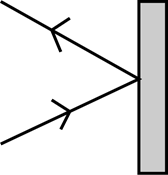
In the illustration, the light ray striking the object is-
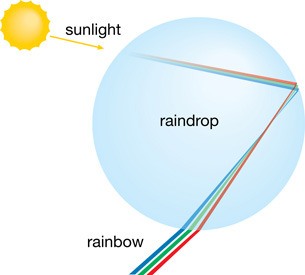
Reflection is when light...
Bends
Bounces
Absorbs
transmits

What is happening in this picture?
Reflection
Refraction

The speed of sound in the air at 20°C (68°F) is about 343 meters/second. The speed of sound in water at 20°C is about 1,482 meters/second. What can you conclude from this information?
At 20°C, sound travels at a constant speed.
Sound waves travel faster in liquids than they do in gases.
Sound waves travel farther in air than they do in liquids.
At 25°C (77°F), the speed of sound in the air will be faster than in water.
Different waves travel at different speeds in different materials. However, all waves have something in common. What property do all waves share?
They transmit energy.
They travel through all forms of matter.
They can travel through the vacuum of empty space.
They have the same frequency.
Sound waves travel at different speeds through different materials. Through which of the following materials will sound waves travel the fastest?
air on a cold day
swimming pool
copper pipe
sauna filled with steam
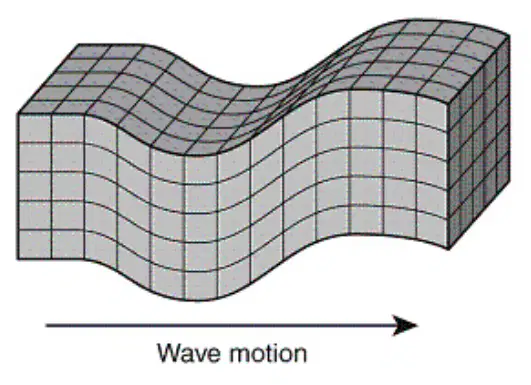
The drawing below illustrates a wave in motion. What is the name given to the substance through which a wave travels?
A frequency
a state
a crest
a medium
At higher altitudes, air is less dense. In other words, the number of particles in a given volume of air at sea level is greater than the number of particles in the same volume of air at a higher altitude. What will happen to a sound at higher altitudes?
The speed of the sound waves will be faster at high altitudes.
The sound waves will travel slower at a higher altitude.
The speed of the sound waves will be the same at sea level and at higher altitudes.
The sound waves will have a smaller amplitude.
Sound moves at different speeds through different materials. Through which of the following will sound move the fastest?
a liquid
a solid
a vapor
a vacuum
Sound waves move at different speeds in different materials. The speed of a sound wave in air will change with which of the following?
temperature of the air
frequency of the sound
wavelength of the sound
distance the wave travels
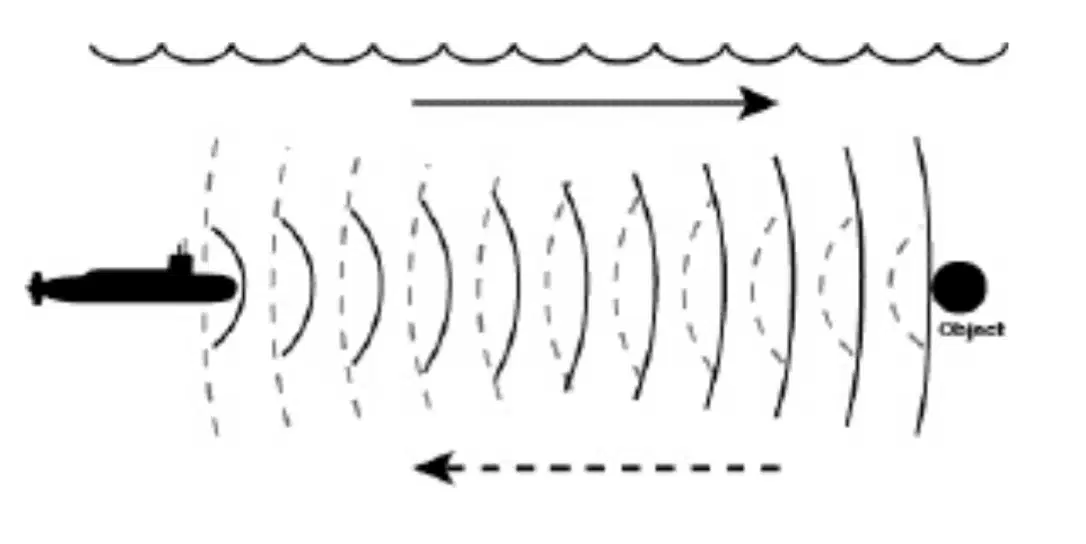
Submarines use sonar or sound waves to locate underwater objects as shown in the drawing below. What does sonar depend upon to locate an underwater object?
the pitch of the sound waves traveling through the water
the speed of the sound waves moving through the water
the frequency of the sound waves traveling through the water
the amplitude of the sound waves traveling through the water
The pitch of a sound wave describes how low or high it sounds to the human ear. Pitch and frequency are related. Which of the following best describes this relationship?
The higher the frequency, the lower the pitch of the sound.
The lower the frequency, the slower the speed of sound.
The higher the frequency, the higher the pitch of the sound.
The lower the frequency, the higher the pitch of sound.
The properties of a wave can change when it passes from one material into another material and also within a material. What will vary if the wavelength of a sound changes in a material?
the wave's medium
the wave's amplitude
the wave's speed
the wave's frequency
What happens when light is refracted?
It changes direction
It becomes invisible
It releases heat
It moves faster
What happens to the speed of light as it exits the air and enters a glass of water?
It speeds up
It remains constant
It slows down
It first slows down and then speeds up
How do the sound waves of the higher pitch notes compare to the sound waves of the lower pitch notes?
The sound waves of notes with higher pitches have higher amplitudes.
The sound waves of notes with higher pitches travel at higher speed.
The sound waves of notes with higher pitches have higher wavelengths.
The sound waves of notes with higher pitches have figher frequencies.
Which of the following has the greatest effect on refraction?
The length of the light wave as it approaches the medium
the speed of the light wave as it travels through the medium
the width of the light wave as it exits the medium
the reflection of the light wave off the medium's surface
Which of the following statements about how light waves travel is correct?
light waves travel the fastest through liquids and slowest through the air
light waves travel faster through solids than through air
light waves travel the fastest through solids and slowest through liquids
light waves travel faster through the air than through solids
Why can human ears hear dolphins' vocalizations while under the water but cannot hear them well on land?
The waves in the water travel faster and at a higher frequency than they travel on land.
The waves in the water travel faster and at a lower frequency than they travel on land.
The waves in the water travel slower and at a higher frequency than they travel on land.
The waves in the water travel slower and at a lower frequency than they travel on land.
Why can't you hear through a transparent window?
sound travels much faster through glass
sound does not travel in a straight line
there was a vacuum between the layers of the window pane
The door was blocking the sound
Sound waves travel at different speeds through different materials. Through which of the following materials
will sound waves travel the fastest?
copper pipe
swimming pool
air on a cold day
sauna filled with steam
Sound waves and light waves behave differently in different materials. How are sound waves different from light waves?
Sound waves cannot travel through a vacuum.
Light waves cannot travel through a vacuum.
Only sound waves can pass through a material.
Only light waves can pass through a material.
What happens to the speed of a sound wave as it passes from the air into the ground?
it decreases
it increases
it remains constant
it immediately stops
Which choice identifies a property of sound waves?
They travel fastest through liquids and gases, not through solids.
They will travel at the same speed through every type of material.
They travel Slowest through solids and liquids, not through gases.
They will travel faster through Solid materials and get progressively slower through liquids and gases

