
 Worksheets
Final Exam Review
Total questions: 63
Worksheet time: 3hrs 25mins
Sierra is trying to determine if a substance is ionic or molecular. Which of the following properties would indicate it could be an ionic compound?
high melting point
Poor electrical conductivity in aqueous state
High solubility in non-polar solvents
Weak intermolecular forces
Which substances exhibit Dipole-Dipole Forces?
Ionic compounds
Non-polar molecules
Polar molecules
Metallic compounds
Rank the intermolecular forces (IMFs) from strongest to weakest.
Hydrogen bonding, dipole-dipole, London dispersion
London dispersion, dipole-dipole, hydrogen bonding
Dipole-dipole, hydrogen bonding, London dispersion
London dispersion, hydrogen bonding, dipole-dipole
Sadie read that the melting point of a certain metal is 987 K. What would that be in °C?
714°C
715°C
716°C
717°C
What would be the volume of 3.52 mg of chlorine gas at 21.0°C under 99.2 kPa of pressure?
1.2 L
2.4 L
3.6 L
4.8 L
Nitrogen triiodide decomposes into nitrogen gas and iodine. Calculate the volume of the gas produced at STP when 395 mg of NI₃ (g) decomposes.
0.050 L
0.075 L
0.0112 L
0.125 L
Logan and Marcusz are working as chemists at Methanex. They need to determine the volume of carbon dioxide that will be produced when 15 L of methane gas undergoes complete combustion. What will be the correct answer?
10 L
15 L
20 L
25 L
Carter and Herous are preparing a solution for their chemistry experiment. They need to calculate the mass of solute required to prepare 500 ml of a 0.800 mol/L solution of potassium chromate. Can you help them find the correct mass?
58.0 g
78.0 g
98.0 g
68.0 g
Kendall is using AI on her phone to try and find out the dominant intermolecular force in CH4. Her phone says it is covalent bonds, but she knows that is wrong because that would be an intramolecular force. What would the correct answer actually be?
dipole-dipole forces
london forces
ion-dipole forces
hydrogen bonding
To form a hydrogen bonding, Hydrogen needs to attract to the highly electronegative elements such us _____, _____, and ____
chlorine, fluorine, and oxygen
fluorine, oxygen, and sulfur
fluorine, bromine, and oxygen
fluorine, oxygen, and nitrogen
Identify the dominant intermolecular force in HBr
london dispersion forces
hydrogen bonding
dipole-dipole forces
ion-dipole forces
Janessa has four substances and she is trying to identify them based on their boiling points. Which of the substances should have the lowest boiling point?
PH3
H2O
SiH4
NH3
What explains the very high melting and boiling point of water
Strong dipole-dipole bonds between water molecules
Strong hydrogen bonds between water molecules
Dispersion forces which are present in all molecules
Asymmetrical shape of the polar bonds.
Hudson and Jackson are arguing over which is stronger. Hudson says intermolecular forces since they affect the boiling point but Jackson disagrees and says intramolecular forces are stronger. Who is right?
Hudson, intermolecular forces are stronger
Jackson, intramolecular forces are stronger
Does CH3F have hydrogen bonding?
Yes
No
Addison is conducting an experiment to find out which substance would dissolve in polar water. Which one should she choose?
NH3
CH4
CO2
CH3CH2CH2CH3

Choose the correct shape for this molecule:
Trigonal planar
Trigonal pyramidal
Bent
Tetrahedral
What molecular geometry would PH3 have?
Trigonal Pyramidal
Trigonal Planar
Bent
Linear
These bonds represent the strongest bonds and are limited to a few hard substances like glass and diamonds. There is no free movement of electrons. Uses include semiconductors and ceramics
covalent network Bonds
ionic bonds
metallic bonds
covalent bonds
Elements in group 15 will have ____ bonding electrons.
2
3
5
15
Elements in group 17 have ____ lone pairs.
1
2
3
0
Dylan gave Myla a helium balloon for her birthday with an initial pressure and volume of 120 kPa and 5.00L at 20 ⁰C. They take the balloon on an airplane and the stewardess places it in the plane’s wheel compartment. If the balloon has a volume of 5.50 L and a pressure of 94.2 kPa while it is travelling in wheel compartment, what is the temperature of the wheel compartment?
- 20 ⁰C
- 17 ⁰C
17 ⁰C
20 ⁰C
What would be the volume of 3.25 moles of butane gas under SATP conditions?
80.6 L
72.8 L
0.145 L
0.131 L
Convert -23 ⁰C into a temperature in Kelvin.
23 K
250 K
296 K
323 K
Magnesium reacts with hydrochloric acid to produce hydrogen gas. What mass of HCl(aq) is required to produce 2.00 mol of hydrogen gas?
146 g
99.2 g
72.9 g
49.6 g
What would be the mass of 10.0 L of CH4(g) under STP conditions?
6.47 g
7.17 g
14.0 g
360 g
Calculate the volume that a 0.323-mol sample of a gas will occupy at 265 K and a pressure of 0.900 atm.
7.18 L
7.81 L
4.63 L
4.36 L
Are the following properties of acids or bases?
bitter
neutralize HCl
corrode metals
Will burn skin.
Conduct Electricity
feel slippery
turn red litmus blue
have a pH less than 7
produce hydronium ions in solution
taste sour
Aaron and Tegin are conducting an experiment in their chemistry class and measure the pH of a solution to be 3.75. What is the concentration of hydroxide ions [OH⁻(aq)] in the solution?
5.6 x 10⁻¹¹ mol/L
2.5 x 10⁻⁴ mol/L
1.8 x 10⁻³ mol/L
2.5 x 10⁻¹¹ mol/L
A change in pH from 2 to 5 means the hydronium ion concentration
decreased to 1/1000th
increased 1000 times
increased 3 times
decreased to 1/30th
What is the pH of a 5.0 x 10⁻⁴ mol/L Ca(OH)2 solution?
3.30
11.00
3.00
12.70
Match each of the following to their description:
High Conductivity
Red Litmus turns blue
strong base
Low conductivity, reacts slowly with metals
weak acid
Blue litmus stays blue
slippery
low conductivity
weak base
no litmus change, not cunductive
molecular solution
No litmus change,
conductive
ionic solution
During a chemistry lab, Noah Squared tested the pH of a solution using different indicators. The results were as follows:
thymol blue is yellow
methyl red is red
bromocresol green is green
What is the approximate pH of the solution?
3.8
4.3
4.8
5.4
What colour is chlorophenol red at a pH of 6.0?
yellow
orange
red
rainbow
Match the chemical to its type?
H2CO3
Weak Acid
HNO3
Strong Acid
Ca(OH)2
Strong Base
NaSO4
weak base
CH3OH
neutral
You add NaHCO3 to water and it turns litmus paper blue. What are the products of the reaction of NaHCO3 with water? Select all that apply.
H3O+(aq)
OH-(aq)
CO32-(aq)
H2CO3(aq)
Jayla added NaHSO4 to water and it turned bromothymol blue indicator yellow. What were the products of the reaction of NaHSO4 with water? Select all that apply.
H3O+(aq)
OH-(aq)
SO42-(aq)
H2SO4(aq)
A solution that is able to conduct electricity is _____________, and an example is ____________
an electrolyte, HCl
a non-electrolyte, glucose (C6H12O6)
an electrolyte, glucose (C6H12O6)
a non-electrolyte, HCl
Aqueous solutions that do not break apart into ions are
electrolytes
non-electrolytes
solutions
conductive
What mass of calcium carbonate is needed to make 0.300 L of a 0.075 mol/L solution?
3.00 g
1.53 g
0.153 g
2.25 g


What mass of calcium chloride would dissolve in 500 mL of water at 22°C ?
80g
0g
400g
40g

At what temperature will the solubility of potassium dichromate be 20% ?
10°C
25°C
35°C
50°C
Under which conditions of temperature and pressure does carbon dioxide behave most like an ideal gas?
A) Low temperature and low pressure
B) Low temperature and high pressure
C) High temperature and low pressure
D) High temperature and high pressure
What volume, in milliliters, of 10.0 M NaOH is needed to prepare 300.0 mL of 2.00 M NaOH by dilution?
0.067 mL
60.0 mL
100 mL
125 mL
A 2.0 L solution of magnesium nitrate has a nitrate ion concentration of 0.250 mol/L. How many moles of magnesium nitrate were dissolved to make the solution?
0.125 mol
0.250 mol
0.500 mol
0.0625
Match the laboratory equipment to its proper name

graduated cylinder

Erlenmeyer Flask

volumetric Flask

volumetric pipette

burette
Alayna mixed up her chemicals and is trying to remember which one was cobalt(II) nitrate. What would the colour of this solution?
Blue
Green
Yellow
Red
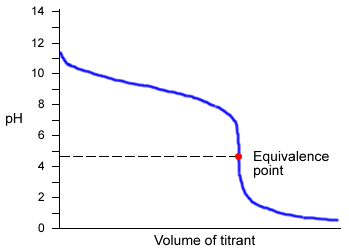
Jazmin and Abby are titrating a strong acid with a strong base. What is the pH at the equivalence point of this titration usually?
acidic 3.9
acidic 4.5
neutral 7.0
basic 8.2

What volume (in mL) of NaOH solution is required to reach the equivalence point?
22.00
20.00
11.00
10.00
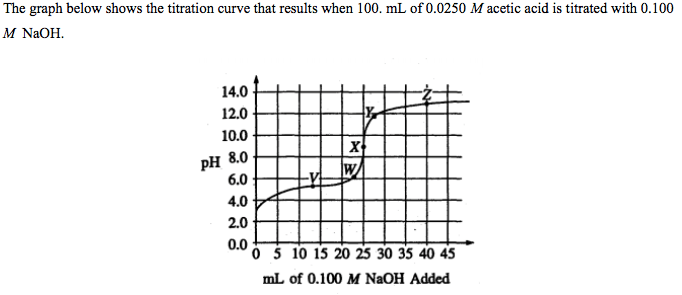
Colton and Tyler are performing a titration where 0.025 mol/L acetic acid is titrated with NaOH. Which of the following indicators should they use for this titration?
Methyl orange (pH range of color change is 3.2 - 4.4)
Methyl red (pH range of color change is 4.8 - 6.0)
Bromothymol blue (pH range of color change is 6.1 - 7.6)
Phenolphthalein (pH range of color change is 8.2 - 10.0)
Keaton and Ethan are conducting an experiment where they combines 6.00 g of hydrochloric acid (HCl) with 5.00 g of magnesium (Mg) to form magnesium chloride (MgCl2). Identify the limiting reagent in this reaction.
Mg + 2HCl --> MgCl2 + H2
Mg
H2
MgCl2
HCl
Order the following from most to least accurate.
Volumetric Pipette
Volumetric Flask
Graduated Pipette
Graduated Cylinder

This data was collected by Herous and Andy in a titration lab.
What is the concentration of ammonia?
2.09 mol/L
1.06 mol/L
2.07 mol/L
1.04 mol/L
This data was collected by Quinn in a titration lab.
Which substance was the titrant?
ammonia
hydrochloric acid
bromothymol blue
chloric acid
Ayuen is trying to teach Cristina how to solve a question using stoichiometry. What is the order of the steps she needs to take?
Balanced chemical equation.
Find moles of given.
Find moles of required.
Find amount of required.
What precipitate will form in the following two reactions?
LiCl(aq) + KF(aq) -->
MgSO4(aq) + Ca(NO3)2(aq) -->
LiF and Mg(NO3)2
KCl and Mg(NO3)2
LiF and CaSO4
KCl and CaSO4
A molecule with two lone pairs and two bonding pairs on the central atom will have which shape?
linear
angular
tetrahedral
pyramidal
Match each description to its shape.
2 bonding pair and no lone pairs
linear
shape of methane
tetrahedral
shape of PH3
pyramidal
shape of water
angular
three bonding pairs, no lone pairs
trigonal planar
Who was your Chemistry teacher?
Mrs. Ning
Mr. Ning
Sensei Ning
Master Ning

