
 Worksheets
Work Power & Energy
Total questions: 97
Worksheet time: 9hrs 25mins

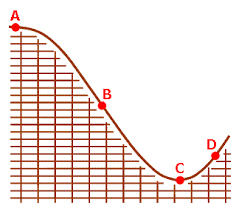
Where does the pendulum have the greatest kinetic energy?
A
B
C
D
E

A cheetah can run briefly with a speed of 31 m/s. Suppose a cheetah with a mass of 47 kg runs at this speed. What is the cheetah’s kinetic energy?
1457 J
728.5 J
45,167 J
22,583.5 J
Which of the is the equation for calculating work?
W = Fd
W = ma
W = mv
W = mc2
The sum of the kinetic and potential energy in a system is known as the system's _____________________ energy.
mechanical
chemical
thermal
combined

At which point in the picture must the cart have the most MECHANICAL energy?
Point 1
Point 2
Point 3
They would all be the same
How much power is used when 9000 J of work are done in 0.5 seconds?
4,500 W
18000 W
9453 W
917.4 W
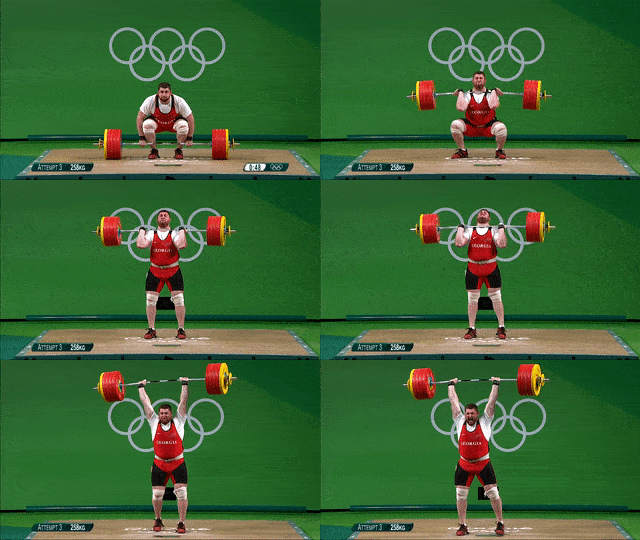
This weight lifter raised 105 kg to a height of approximately 2.31 m in 9 seconds. How much power did he developed?
264 Watts
1029 Watts
2,377 Watts
4,009 Watts

Two movers applied a total force of 350 N to push chest up a ramp into a truck. If the work that they did 1,400 J, calculate the height of the ramp?
4 m
3 m
2 m
1 m

Two people are lifting the same weight as shown in the animation. If they both do 10 reps, who will supply the most power?
Bro A
Bro B
They both will do the same work
Can't tell without knowing the weight they are lifting
An object of 2.03 kg is thrown vertically upwards at an initial speed of 10.41 m/s. What is the kinetic energy at the moment it is thrown?
110 J
1200 J
2.03 J
10.41 J
An object of mass 0.328 kg moves along a straight path at a constant velocity. If the kinetic energy is 14.7 J, determine the speed of the object.
12.34 m/s
0 m/s
9.47 m/s
5.16 m/s
A 4.3 kg box on a platform has a potential energy of 349 J. Determine the height of the platform.
0 m
8.27 m
9.81 m
2.43 m
A 0.050 kg stone is dropped from a height of 15.67 m. What is the potential energy at the instant of release?
3.44 J
0 J
5.98 J
7.68 J
An object held at a height of 3.7 m has a potential energy of 209 J. What is the mass of the object?
5.76 kg
8.97 kg
4.32 kg
11.98 kg
Which of the following is the best example of work being done.
doing homework
lifting a box
pushing a stationary box
holding a box
The SI unit of work
Joules
Watts
Newtons
meters
The SI unit for power
Watts
Joules
Newtons
Meters
Gravitational potential energy depends on the ________ and ________ of the object.
Height and mass
Spring constant and Distance away from equilibrium
Mass and Velocity
Height and Friction
A student with a mass of 62.0 kg walks up a flight of stairs with a height of 3.40 meters. If it takes him 7.00 seconds to get to the top, how much power did he generate?
295 W
2070 W
86.8 W
295.12 W
John and Bob weigh the same and both run up a flight of stairs. John reaches the top in 8 seconds while Bob follows in 10 seconds. Who has exhibited more power ?
John
Bob
they both have the same amount of power
not enough info is given to determine who has more power
A student needs 10 Newtons of force to lift a box to the top of a 2 meter shelf. How much work do they do?
12 J
8 J
20 J
5 J

Which two forces do NO work on the gold block?
Fa
Fg
Ff
Fn

A 1000N force pulls a car for 300m to the left. What is the work done by the truck?
-300,000 J
-150,000 J
0 J
150,000 J

The moon orbits Earth with a circumference of 2.4 * 109m, a constant speed of about 1,000 m/s, and a gravitational attraction of 2*1020 N. What is the work done on the moon by the Earth?
0 J
2.4 * 106 J
2*1023 J
4.8*1029 J

Three blocks are each pushed from rest for 10 meters with forces shown. Which block has the most kinetic energy after 10m of travel?
A
B
C
not enough information

A force changes over time. During which section does that force do the largest magnitude of work?
A
B
C
D

A car travelling 10m/s to the right makes a U-turn and now travels -10m/s to the left. Determine the work done on the car during the turn?
-20 J
0 J
20 J
Depends on the mass of the car
Elastic potential energy is at it's greatest when
a rubber band is stretched all the way
a rubber band is at it's smallest
a rubber band is stretched half way
the elastic in the waist of pants is stretched a small amount
A 8.6 kg box is pushed across a floor 3.2 m with a force of 5.5 N. How much work is done on the box?
17.6 J
8.7 J
1.72 J
No work is done.
An object of mass 6.8 kg is lifted to a height of 1.3 m. How much work is done on the object?
86 J
8.1 J
5.23 J
No work is done.
How much power is required to do 40.2 J of work in 3.3 s?
12.18 W
132.66 W
43.5 W
0.08 W
A force of 4.6 N moves a 2.7 kg box a distance of 3.3 m in 6.8 s. How much power is exerted?
2.23 W
6.03 W
17.4 W
278.7 W
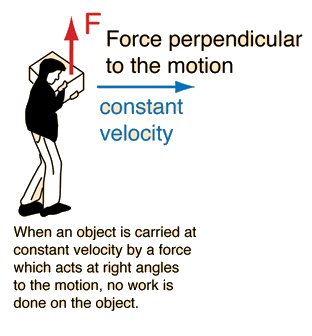
If you carry a 5 kg box across the room at a constant velocity
you do no work.
you do some work.
you do negative work.
Cannot be determined.

On a work vs time graph, you can calculate the power by
the area.
the y-axis.
the y-intercept.
the slope.
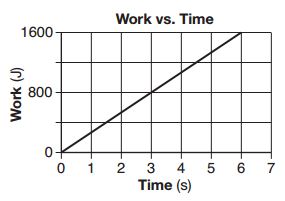
How much power was generated from 0-4 seconds?
1100 W
4 W
267 W
1600 W

How much work is done?
9 J
18 J
27 J
36 J

If it took 9 seconds for the object to move 6 meters, what's the power?
81 W
27 W
3 W
6 W
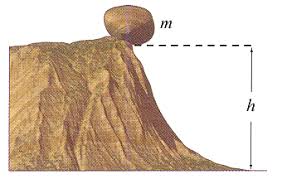
What is the mass of an object with 1200 J of PE when it is 5 meters above the ground?
10 kg
24 kg
100 kg
240 kg

What kind of energy(ies) does the car have at position A? The ground is h=0.
KE
KE + PE
PE
KE - PE
If a system is isolated, the total energy of the system
Increases constantly.
Decreases constantly.
Is constant.
Depends on the work done on the system.
Depends on the work done by the system.

Each of the boxes shown is pulled for 10 m across a level, frictionless floor by the force given. Which box experiences the greatest change in its kinetic energy?
A
B
C
D
E
A worker climbs a ladder and does 8 J of work on a 2 N object. What is the distance they lift the object?
18 m
4 m
10 m
6 m
Which list includes 3 vector quantities?
energy, work, distance
velocity, force, power
acceleration, speed, work
displacement, acceleration, force

What does the work on a spring?
an applied force
the spring constant
the kinetic energy

What is deformation?
gravitational potential energy
change in the spring's length
change in the force applied
Which type of springs have low spring constants?
stiff springs
weak springs

According to the data table, what variable is unchanged for each type of spring?
the spring constant value
the applied force
the elastic potential energy
the deformation
If a spring stretches easily, it has a high spring constant.
True
False
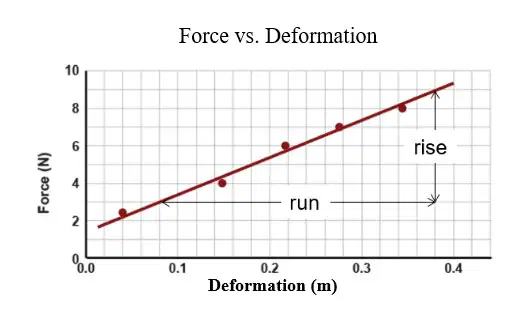
What does the slope of this graph represent?
the spring constant, k
the applied force, F
the change in mass, m
the negative displacement, x

How is the force measured?
Use a meter stick to measure length of displacement.
Use a meter stick to measure mass.
Use a spring scale and read the quantity in Newtons.
Use a triple beam balance and read the quantity in grams.
A rock sitting still at the top of a hill is an example of what type of energy?
Potential
Mechanical
Kinetic
Chemical
Thermal
When no friction or external applied forces are present, the total mechanical energy of a system will
Increase
Decrease
Remain Constant
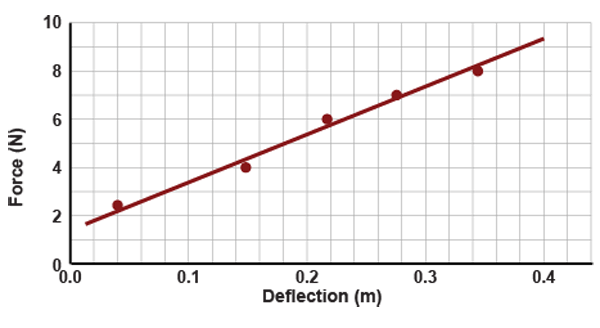
Spring constant is measured in
N
N/m
m
What is the correct equation for Hooke's Law?
F=mgk
F=ma
F=kΔx
F=Δxk


What is the spring constant for the system shown above?
0.1 N
10 N
200 N/m
50 N/m
Which of the following would have a large spring constant?
A spring that is stretched to its maximum displacement
A spring that is at its equilibrium position
A spring that is very thin and stretchy
A spring that is very stiff and strong



