
 Worksheets
Rock Dating and Fossils Review
Total questions: 36
Worksheet time: 31mins
Fossils usually occur in metamorphic rocks
TRUE
FALSE
Footprints and trails are examples of trace fossils
TRUE
FALSE
Generally, only the soft parts of organisms become fossils
TRUE
FALSE
Small amounts of what materials in rocks can act as natural clocks for absolute dating?
sedimentary rocks
intrusive materials
radioactive materials
igneous materials
The original radioactive isotope in a rock is called
parent isotope
daughter isotope
breakdown isotope
clock isotope
Why are mummified remains found in very dry places?
most bacteria thrive in dry environments
bacteria do not cause decay in dry environments
fewer animals live in dry environments
most bacteria cannot survive in dry environments
The study of fossils
paleontology
meteorology
ancient biology
geology
A principle that geological processes that occurred in the past can be explained by current geologic process
theory of evolution
uniformitarianism
law of superposition
unconformity
The age of an object in relation to the ages of other objects
law of superposition
relative age
absolute age
principle of original horizontality
Fossilized waste materials from ancient animals
mold
coprolites
imprints
petrification
Scientist have determined that the approximate age of Earth is
4.6 million years old
a little over 2000 years old
20,000 years old
4.6 billion years old
Father of Geology is
James Hutton
Jarrell Florence
Charles Darwin
Mary Anning
A banded layer of sand and silt that is deposited annually in a lake that can be used to determine absolute age
varve
crosscut
graded layers
unconformities
Which of the following is used in absolute dating?
rates of deposition
crosscutting
Principle of Original Horizontality
ripple marks
The numeric age of an object or event, often stated in years before the present
absolute age
relative age
stone age
ice age
How can scientist find an absolute age for a stream bed?
measure the crosscutting layers
measure the half life of rocks in the stream
measure the rates of erosion
measure the tree growth around the stream
The time it takes half the mass of a given amount of a radioactive isotope to decay into its daughter isotope
isotope erosion
crosscut
isotope deposition
half-life
What is amber?
a hard shell
hardened tree sap
insect's body
wet, sticky tree sap
Which of the following is an example of mineral replacement?
La Brea tar pits
a frozen mammoth
hardened tree sap
petrified wood
If a hard-shelled organism was buried by ocean sediment, it would leave a cavity. This cavity is called a(n)
trace fossil
mold
cast
index fossil
What did marine fossils discovered on a Canadian mountaintop tell scientists?
Marine species once lived on land.
The rocks on the mountaintop were once below the ocean’s surface.
The rocks had probably been moved.
The rocks had probably eroded.
What can animal tracks tell about the animal that left them?
what the animal ate
how big it was
its color
its mating habits
What can a scientist learn from studying the relationships between fossils?
how paleontology has changed
how science has changed
how the geologic column has changed
how life has changed
Why is the fossil record incomplete?
Most organisms never became fossils.
Scientists don’t like to work on it.
Most organisms have soft body parts.
There isn’t enough amber.
Which of the following environments would most likely NOT contain fossils?
sediment deposited in a riverbed
a thick deposit of dried mud
layers of sand that accumulate over thousands of years
intrusive rock formed from cooled magma
What determines the type of fossil that is formed?
the conditions under which the organism was metamorphosed and how it was buried
the conditions under which the organism died and how it lived
the conditions under which the organism died and how it was buried
the conditions under which the organism lived and how it was buried
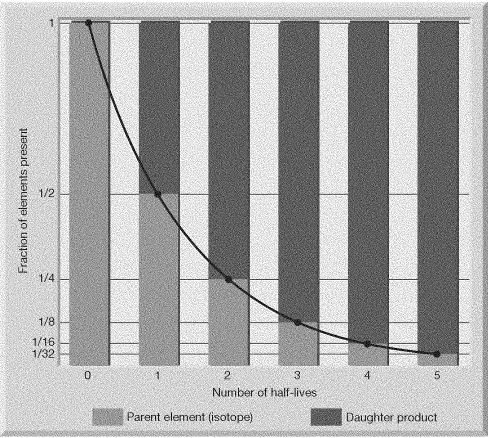
What fraction of the original parent isotope still exists after 4 half-lives have passed?
1/2
1/4
1/8
1/16
The idea that geologic change happens suddenly
paleontology
uniformitarianism
catastrophism
modern geology
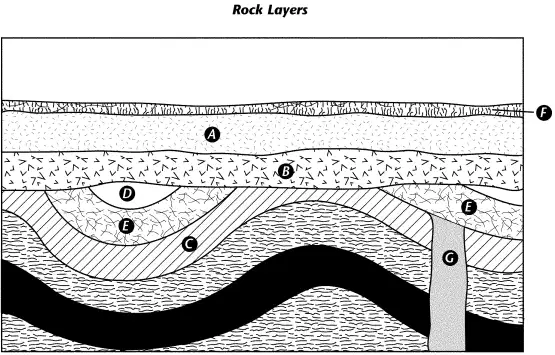
Which sedimentary rock layer is older, A or B?
A
B
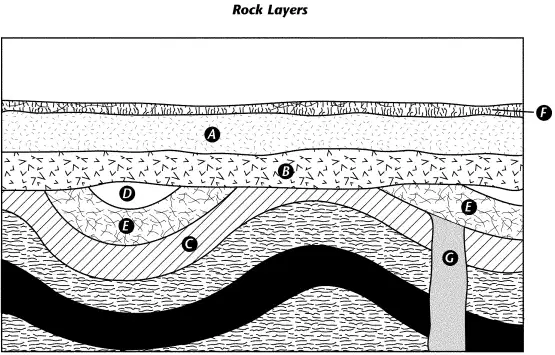
Which of the following lists layers E, D, and C in order from oldest to youngest.
E, D, C
D, C, E
C, E, D
E, C, D
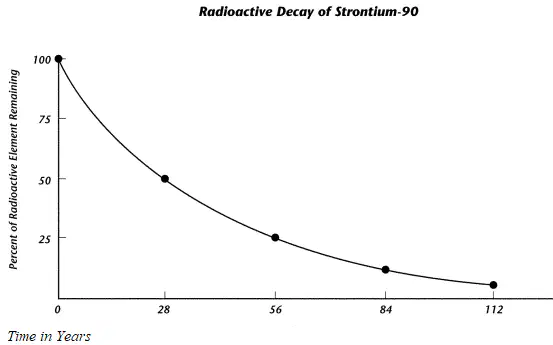
Strontium-90 is a radioactive form of the element strontium that undergoes radioactive decay. The graph shows the decay of strontium-90 over time. What is the half-life of strontium-90?
28 years
56 years
84 years
112 years

Using this formula, calculate the following question:
A 375cm thick sediment core was deposited in a glacial lake where the deposition rate is 6cm/year. Calculate the total number of years represented in the core.

Using this formula, calculate the following:
A sediment core is 370cm thick and represents 1800 years of deposition. Calculate the average annual deposition rate in cm/year.
Using this formula, calculate the following:
The Gulf of Mexico’s shoreline has been receding for the last 25 million years. The erosion rate is 8km per million years. Calculate how far the shoreline has receded.

Use this formula, to calculate the following:
Mrs. Monroe collects a 144g sample of Carbon-14. After doing some research, she determines the half-life of Carbon-14 is 5730 years. Calculate the number of half-lives if the sample is left for 17,190 years.
Calculate the following:
I was given a 144g sample of Carbon-14. This sample has a total number of half-lives of 4 years. How much of my sample will be left over?

