wayground logo

Free Printable Worksheets

NEW

Font size

S
M
L
XL
Worksheets

Q4 IA Final Review

Total questions: 42

Worksheet time: 50mins

Name
Class
Date
1.

How are metamorphic rocks formed?

a)

Heating and cooling

b)

Deposition

c)

Heating and pressure

d)

Materials gathering and pressing together

2.
This rock was another type of rock that was heated and compressed over time. What type of rock is this?
a)
Sedimentary
b)
Igneous
c)
Metamorphic
3.
This rock was formed by smaller pieces of rock that settled at the bottom of a lake millions of years ago. What type of rock is this?
a)
Sedimentary
b)
Igneous
c)
Metamorphic
4.

Which layer of the atmosphere contains the ozone layer?

a)

thermosphere

b)

exosphere

c)

stratosphere

d)

troposphere

5.
Which layer of the atmosphere is the hottest?
a)
Troposphere
b)
Stratosphere
c)
Mesosphere
d)
Thermosphere
6.
The weight of the atmosphere is ...
a)
temperature
b)
humidity
c)
air pressure
d)
weather
7.
Which of the following is the super-continent from 300 million years ago?
a)
Continental drift
b)
Pangaea
c)
Giganto continent
d)
Euromerica Asia
8.
What is the name of the plate boundary that pushes together?
a)
Divergent
b)
Convergent
c)
Transform
d)
A Chest Bump
9.
What is the name of the plate boundary that pulls apart?
a)
Divergent
b)
Convergent
c)
Transform
d)
Tug Of War
10.
What geologic feature/event would you most likely to find at a divergent boundary between two pieces of continental crust?
a)
Mid-Ocean Ridge
b)
Mountain
c)
Rift Valley
d)
Island Arc
11.

P waves are

a)

compression waves

b)

transverse waves

12.

S waves are

a)

compression waves

b)

transverse waves

13.

p waves can travel through

a)

liquid and solid

b)

solid

c)

liquid

14.

s waves can travel through

a)

solid and liquid

b)

liquid

c)

solid

15.
The process of plants losing water through their leaves is called ____.
a)
condensation
b)
evaporation
c)
transpiration
d)
exhaling
16.
What is the only process that removes carbon from the atmosphere?
a)
combustion
b)
cellular respiration
c)
photosynthesis
d)
decomposition
17.
What converts nitrogen into a useable form for plants and animals?
a)
bacteria
b)
fungi
c)
rain
18.
Which nutrient is not cycled through the atmosphere?
a)
carbon
b)
nitrogen
c)
phosphorous
d)
water
19.

What cycle are fossil fuels part of ?

a)

carbon

b)

oxygen

c)

nitrogen

d)

phosphorus

20.

Where is the largest reservoir for the phosphorus cycle?

a)

rocks and minerals

b)

the ocean

c)

the atmopshere

d)

fossil fuels

21.

The carbon in coal, oil, and natural gas came from

a)

the combustion of fossil fuels

b)

the remains of dead organisms

c)

carbon-fixing bacteria in swamp soil

d)

carbon dioxide dissolved in ocean water

22.

A community with a high species diversity would have which of the following characteristics?

a)

High richness and high evenness

b)

High richness and low evenness

c)

Low richness and high evenness

23.

Which habitat has the lowest evenness or least species diversity?

a)

A

b)

B

c)

C

d)

B and C

24.

What is the species richness of habitat A?

a)

2

b)

3

c)

4

d)

5

25.
Which of the following describes a population that is distributed evenly across an area?
a)
random
b)
uniform
c)
clumped
d)
crowded
26.
The type of population distribution that occurs when there is plenty of resources that the organism needs within a given area and there are no other strong influences on where organisms settle. 
a)
Uniform distribution 
b)
Clumped distribution
c)
Random distribution
d)
Crowded distribution
27.
What type of distribution is shown here?
a)
Crowded distribution
b)
Random distribution
c)
Uniform distribution
d)
Clumped distribution
28.
When we discuss greenhouse gases what is the main one we discuss?
a)
Methane (CH4)
b)
Carbon Dioxide (CO2)
c)
Nitrous oxide (N2O)
d)
Flourinated gases
29.
The warming of the atmosphere by the trapping of heat being radiated to space is called
a)
evaporation
b)
condensation
c)
the greenhouse effect
d)
radiation
30.

What are trade winds?

a)

Winds that blow from south to north

b)

Winds that blow from north to south

c)

Winds that blow from east to west

d)

Winds that blow from west to east

31.

What happens during El Niño?

a)

Trade winds strengthen and warm surface water moves eastward

b)

Trade winds weaken and warm surface water moves westward

c)

Trade winds strengthen and warm surface water moves westward

d)

Trade winds weaken and warm surface water moves eastward

32.

What happens during La Niña?

a)

Trade winds weaken and warm surface water moves eastward

b)

Trade winds strengthen and warm surface water moves westward

c)

Trade winds strengthen and warm surface water moves eastward

d)

Trade winds weaken and warm surface water moves westward

33.

A lion that eats a zebra that ate grass is a ...

a)

primary producer

b)

primary consumer

c)

secondary consumer

d)

tertiary consumer

34.
If 25,000 kg of vegetation is planted in this ecosystem, how would the lion population change?
a)
Decrease by 2,500 kg
b)
Decrease by 25,000 kg
c)
Increase by 250 kg
d)
Increase by 250,000
35.

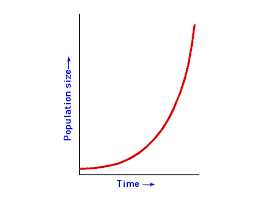
What type of growth is shown in the diagram?

a)

exponential growth

b)

logistic growth

c)

predator-prey cycle

d)

boom-bust curve

36.

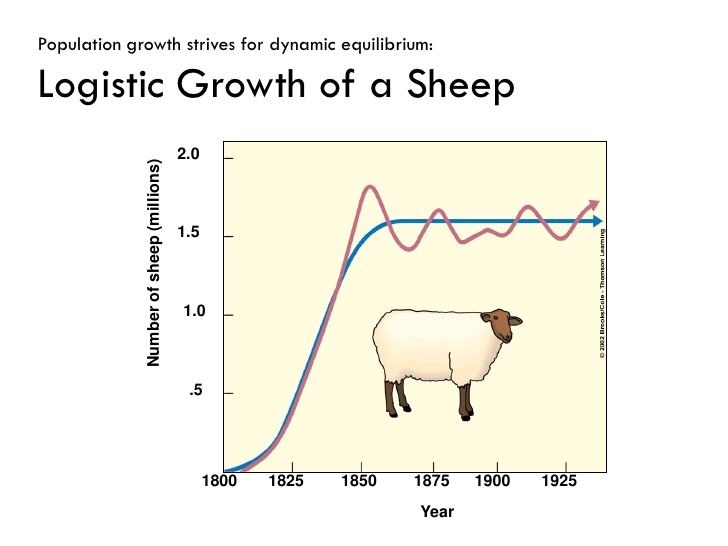
What is the carrying capacity for this sheep population?

a)

2.0 million

b)

1.0 million

c)

1.6 million

d)

0.5 million

37.

What point on the graph represents the carrying capacity?

a)

A

b)

B

c)

C

d)

D

38.

What process starts with bare/barren rock followed by lichen?

a)

primary succession

b)

secondary succession

c)

both types of succession

39.

What type of succession occurs after an event like a forest fire?

a)

primary succession

b)

secondary succession

c)

both

40.

Kepler's 1st Law says this about the orbits of planets

a)

they are elliptical.

b)

they are perfect circles.

c)

they are always perfect polygons (square, pentagon, hexagon, etc.,)

d)

they are parabolic.

41.

If a planet's eccentricity is closer to zero it more like a(n)

a)

circle

b)

highly eccentric ellipse

42.

The diagram below shows a moon revolving around a planet in an elliptical orbit. Using your knowledge of Kepler's Law, at which position is the moon traveling fastest?

a)

location 1

b)

location 2

c)

location 3

d)

location 4