
 Worksheets
Populations Species Interactions Review
Total questions: 45
Worksheet time: 23mins
In a mountain we can find foxes, rabbits, owls, pine trees, bamboo trees and pandas. This is an example of
Community
Population
Ecosystem
Biome
A snake uses the abandoned hole of a badger for a home. This is an example of:
Mutualism
Commensalism
Predation
Competition
When a species decreases the number of offspring per pregnancy, the reproductive potential…
Increases
Decreases
Stays the same
Is negative
If a species overpowers another and takes over the area.
Competitive Exclusion
Fundamental niche
Niche Restriction
Niche Competition
The most common distribution in human agriculture is
Random
Even
Clumped
Community
The most common distribution in poor environments is
Random
Even
Clumped
Community
The most common distribution in rich environments is
Random
Even
Clumped
Community
The most common distribution for social organisms is
Random
Even
Clumped
Community
The most common distribution for organisms without control of their location.
Random
Even
Clumped
Community
Bats use eco-location to capture moths. This is an example of:
Mutualism
Commensalism
Predation
Competition
A common example of adaptations of predators to predation is:
Camouflage
Protective cover
Parasitism
Warning coloration
Species that avoid extinction because they have high reproductive rates
h-species
r-species
K-species
Specialists
Species capable of occupying many niches.
h-species
r-species
K-species
n-species
Species that suffer the most from density dependent regulations.
h-species
r-species
K-species
n-species
When a species increases the proportion of males versus females, the reproductive potential
Increases
Decreases
Stays the same
Duplicates
The most common distribution.
Random
Even
Clumped
Community
The least common distribution.
Random
Even
Clumped
Community
When a population grows without any limit, faster and faster, its called?
Growth unlimited
Unlimiting growth
Carrying capacity
Exponential growth
When one species is alone and lives without any control.
Realized Niche
Fundamental niche
Restrictive niche
Exponential niche
When a species decreases the maturity age, the reproductive potential
Increases
Decreases
Stays the same
Is negative
A species interaction in which both species are negatively affected.
Competition
Commensalism
Amensalism
Predation
A species interaction in which both species are positively affected.
Competition
Commensalism
Mutualism
Predation
A species interaction in which one kills the prey
Predation
Commensalism
Mutualism
Parasitism
A species interaction in which one feeds without killing the host
Predation
Commensalism
Mutualism
Parasitism
When do species reach their carrying capacity?
When their reproductive potential is high.
When their ecosystem is in climax
When there is competition in the same species
When the resources become limiting
Species that only use few niches.
h-species
r-species
K-species
n-species
Species with low reproductive potential
h-species
r-species
K-species
n-species
Species that favor quality over quantity
h-species
r-species
K-species
n-species
Species that mature quickly
h-species
r-species
K-species
n-species
Species with long lives
h-species
r-species
K-species
n-species
In a mountain we can find foxes, rabbits, water, oxygen, bamboo trees and pandas. This is an example of
Community
Population
Ecosystem
Biome
A hawk uses the top of an oak tree to make his nest. This is an example of:
Mutualism
Commensalism
Predation
Competition
When a species increases the number of offspring per pregnancy, the reproductive potential…
Increases
Decreases
Stays the same
Is negative
When a population has no limitation, the organisms in it can live in their...
Realized Niche
Fundamental niche
Restrictive niche
Absolute niche
Moths use hearing to avoid bats from eating them. This is an example of:
Predation
Commensalism
Mutualism
Competition
As a population grows, it will most likely stop growing at what size?
Growth limit
Limiting factor
Carrying capacity
Exponential limit
When do organisms of the same species start to compete?
When they live in the same place.
When resources are limiting.
When there are predators
When they are clumped.

What type of species interaction do snowshoe rabbit and Canada lynx have?
Predation
Commensalism
Mutualism
Competition
Parasitism
What is the population of the snowshoe rabbit in 1920?
25
75
125
150
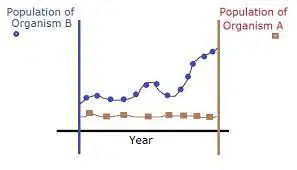
What type of species interaction do population A and B have?
Predation
Commensalism
Mutualism
Competition
Parasitism
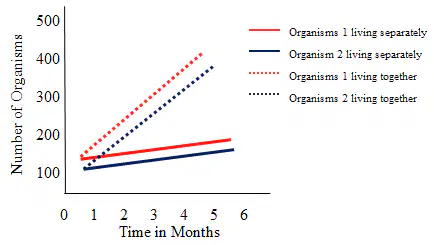
What type of species interaction do the populations show?
Predation
Commensalism
Mutualism
Competition
Parasitism
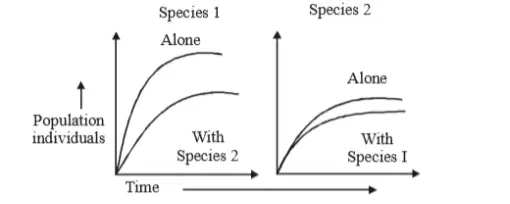
What type of species interaction do the species show?
Predation
Commensalism
Mutualism
Competition
Parasitism
What species interaction causes the carrying capacity to increase for both?
Predation
Commensalism
Mutualism
Competition
Parasitism
What species interaction causes the carrying capacity to decrease for both?
Predation
Commensalism
Mutualism
Competition
Parasitism
What species interaction causes the carrying capacity to decrease for the host?
Predation
Commensalism
Mutualism
Competition
Parasitism

