
 Worksheets
Human Populations
Total questions: 45
Worksheet time: 27mins

The average number of children a female member of a population has during her lifetime
total fertility rate
replacement fertility rate
growth rate
death rate

Which of the following leads to a decrease in birthrates among women?
Higher Education
High Infant Mortality Rate
No Prenatal Care
No contraceptives

The human population is now about
less than 6 billion
6-8 billion
over 8 billion
over 10 billion
The average number of years an individual is expected to live.
life expectancy
infant mortality
death rate
growth rate
How a population changes in size during a specific period of time
growth rate
infant mortality
life expectancy
death rate

A person that moves into another country.
Emigrant
Immigrant
Religious Persecution Escapee
Citizen

Give one factor that empowers women and reduces growth rates
family planning
access to contraceptives
all the choices are correct
better education
Between 1880 and 1930, human population doubled due to:
a combination of high birth rates and low death rates
improvements in societal infrastructure and services
all of the choices are correct
industrial revolution
Although China and India have similar populations sizes, which one is considered a developing nation?
China
India
Neither, they are both developed
Both are still developing
What is the replacement level for a population?
slightly less than 2
2
slightly more than 2
5
If a population grows larger than its environmental carrying capacity, then
death rate may rise.
death rate may fall significantly.
birth rate may rise significantly.
immigration rate may increase.
The average number of years an individual is expected to live.
life expectancy
infant mortality
death rate
growth rate
highest birth rates are found in which of the following conditions?
most developed countries
least developed countries
little contacted countries
all over the world
What factors cause lower death rates?
sanitation, competition, high birthrates
advances in nutrition, sanitation, medicine
global warming
high birthrates
Where would you expect the life expectancy of a population to be low?
developed country
all over the world
developing country
transitional country
Which of the following represents a country that has good healthcare and plenty of jobs?
developed country
transitional country
developing country
conflicting country

Which correctly describes the term demographic transition?
The transition from low birth rates and death rates to high birth rates and death rates as a country develops.
The transition from high birth rates and death rates to low birth rates and death rates as a country develops.
The transition from high birth rates to low death rates as a country develops.
The transition from low birth rates to high death rates as a country develops.

Which of the following is NOT a Pronatalist policy?
Free Birth Control
Free child care
Free College tuition
Free parenting classes

What are two density-dependent factors that most affected human population BEFORE the industrial revolution?
availability of food & lack of space
availability of food & high death rate from disease
high death rate from disease & lack of space
frequent natural disasters & availability of food
An island has 120 people living on it. During the year, 10 people immigrated, while 20 emigrated. The birth rate was 15 and the death rate was 10. What is the new population of the island?
No change, the population is still 120
115
135
105
Which of the following is an antinatalist pressure?
feeling of pride from having children
high infant mortality rates
the importance of having children to support the family
women playing a more prominent role in planning family size

Which line represents growth prior to the industrial revolution?
A
B
C
D

In Stage 1, the birth rate is...
High
Falling
Low

In Stage 1, the death rate is...
High
Falling
Low

In Stage 2, the birth rate is...
High
Falling
Low

In Stage 2, the Death rate is...
High
Falling Quickly
Low

In Stage 3, the Total Population is...
Growing quickly
Slowing down
Decreasing

In Stage 4, the Total Population is...
Growing Quickly
Leveling Out
Decreasing Quickly
When humans first developed agriculture, they did so in the Fertile Crescent. Where is this region located?
North America
Africa
Middle East
Australia

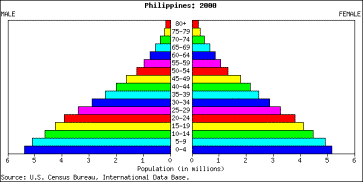
Is this country Developed or Developing?
Developed
Developing

Predict the future population growth of this country.
Negative Growth (the population will shrink)
Slow/No Growth (the population will stay about the same)
Growth (the population will definitely grow)
Fast Growth (the population will explode)

