
Font size
 Worksheets
Australia and Oceania
Total questions: 100
Worksheet time: 1hrs 18mins

Name the country shown in red
Solomon Islands
Papua New Guinea
Vanuatu
Kiribati

What country is shown in red?
Australia
New Zealand
Antarctica
Tasmania

Name the country circled in red
Papua New Guinea
Marshall Islands
Fiji
Tonga

Name the territory circled in yellow

Name the country circled in yellow
Papua New Guinea
Australia is both a continent and a country
True
False
The Outback in Australia is mostly ________________
wetlands
mountains
desert
populated
Very few people live in the Australian Outback because it has...
a rugged and mountainous terrain
many wetlands and poor soil
dense rain forests and high humidity
high temperatures and little rain
Which is the correct description of New Zealand?
two large islands southeast of Australia
one large island southeast of Australia
the world's largest island
two large islands north of Australia
What is the largest coral reef system in the world, which is located of the northeast coast of Australia?
Polynesian Reef
Papua New Guinea is the only country in Oceania that shares a land border, which it does with Indonesia.
True
False
What year did Britain begin to colonize Australia, using it as a place to send prisoners?
1778
1788
1798
1808
What ancient tradition do Aboriginal people in Australia have?
They create digital art
They perform street theater
They paint human and animal figures on rock walls
They write detailed historical texts
Which two languages are official in New Zealand?
English and French
Maori and Spanish
English and Maori
French and German
What is the main religion in New Zealand?
Buddhism
Islam
Christianity
Hinduism

___?___ are the indigenous Polynesian people of mainland New Zealand.
Tonga
Aboriginal
Maori
Japanese

A horseshoe shaped area that is known for its volcanic activity and frequent earthquakes.
Peninsula of Fire
Ring of Fire
Volcano Alley
Bermuda Triangle

When the British colonized Australia they encountered the Aboriginal people, these were people native to Australia.
What did the British government do to these indigenous people?
Befriended them and taught them the English language.
Established a co-existing partnership with them.
Started the Emu War
Forced the Aboriginal people off their lands and built farms over them.

Why did England colonize Australia in the first place?
Served as a place to send prisoners due to overcrowding in England.
Part of the British conquest for power.
To develop a naval base in Australia.
Served as a colony for the wealthy.
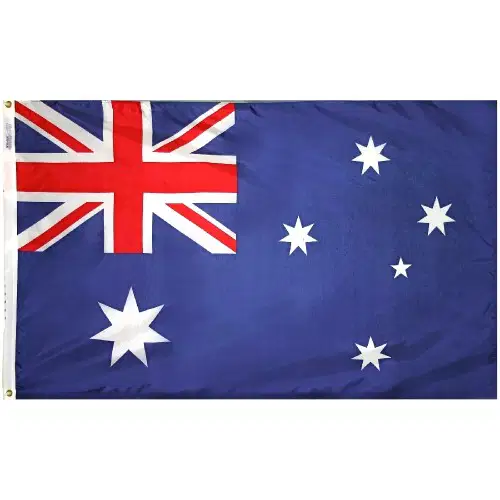
What other nation is featured in Australia's flag?
United States
The United Kingdom
Scotland
Canada
Australia's geographic location in the "Ring of Fire" makes it vulnerable to _______.
Tornados
Acid Rain
Earthquakes
Strong winds
What is the name of the worlds largest reef system located off the coast of Australia ?
The Great Diving Range
Ayer's rock
Th Outback
The Great Barrier Reef
What is an important economic activity for Australia ?
Ranching
Mining
Fishing
Retail
Why does New Zealand have frequent earthquakes ?
it is apart of the ring of fire , with active tectonic plates
it is located in the Northern Hemisphere and has more earthquakes
Volcanic activity within the region
Everyone is doing the Haka dance shaking the earth .
What statement about Polynesia is most accurate ?
Polynesia is located in the central Pacific.
Guam is apart of the Polynesian islands.
Most of the islands in Polynesia are low islands .
Polynesia contains Ocieanias largest island.
How do aboriginal people pass on their history and culture ?
storytelling
fishing
music
dance
What caused the formation of the islands in the Pacific islands ?
Erosin
Flood deposits
Tectonic activity
Landslides
Maintaining elements of traditional culture is important to the people of Oceania ? True or False ?
True
False
How are the Wake islands and Guam similar ?
Agriculture is the main economic activity on both islands
They are both home to US military bases
Mining is an important industry for both Island nations
They are both independent nations

What kind of infrastructure is this photo ?
Dam
Irrigation system
Airport
Terraced farm
What is most likely to damage the economy of Oceania ?
population increase
the discovery of precious metals
regional pollution and natural disasters
the cultivation of cash crops
What regions are included in the discussion of climate change impacts in Oceania according to the article?
Australia, New Zealand, and Micronesia
Australia, New Zealand, Melanesia, Polynesia, and Micronesia
Australia, New Zealand, and Polynesia
Australia, Melanesia, and Micronesia
According to the article, what is one of the negative impacts of a rapid temperature increase on the marine ecosystem?
Increase in fish population
Coral bleaching and ocean acidification
Improvement in coral health
Decrease in ocean surface temperature
What is the main reason for the Pacific countries being especially disadvantaged by climate change impacts?
They have a high carbon footprint
They are mostly inland countries
They are mostly coastal cities
They have a strong economy
What is causing atolls in low-lying areas such as Tuvalu to be abandoned?
Overfishing
Coastal erosions
Pollution
Increased tourism

Level 1
The cutting down or clearing of trees within a few years
deforestation
reforestation
aquaculture
islet
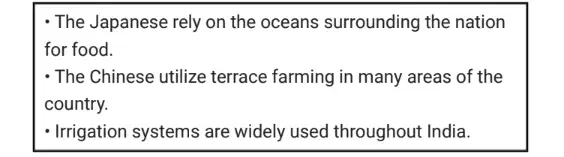
what can you infer about this statement
people adapt to their environment
Farming is best source of food
fishing is best source of food
Irrigation in necessary to sustain life
What climate zone is the most prominent in Australia? (The one you see the most)
tropical wet
marine west coast
arid
Mediterranean

The Western Plateau is found in which country?
Australia
New Zealand
Antarctica
Papua New Guinea
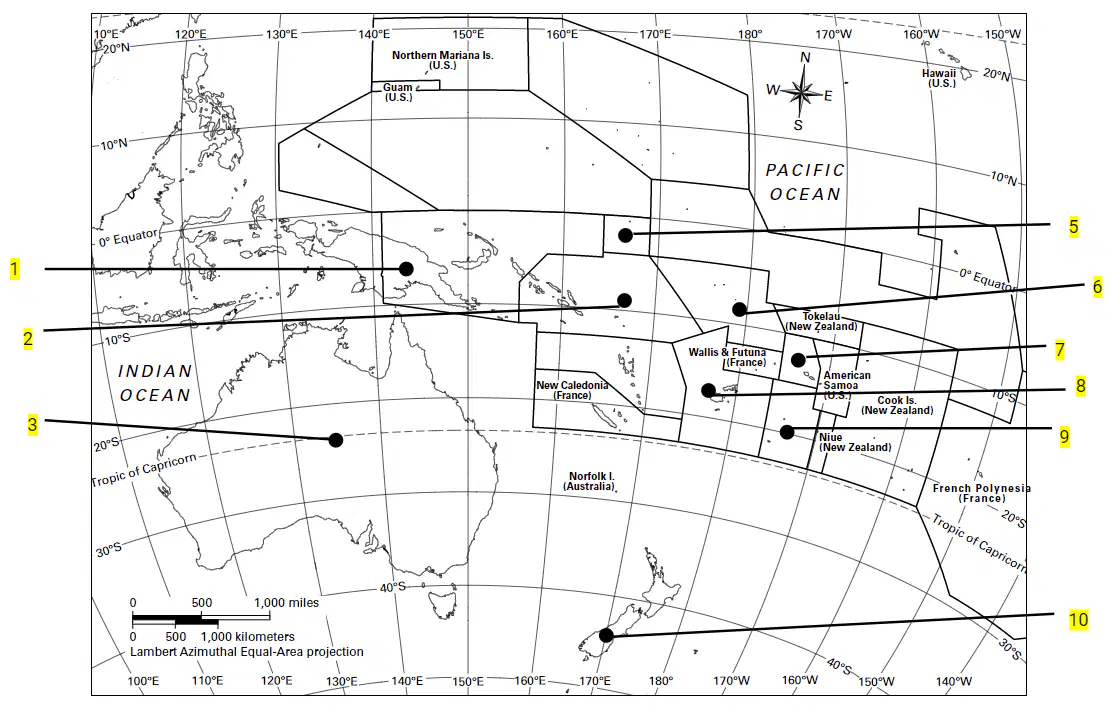
What country is number 10?
New Zealand
Australia
Tonga
Papua New Guinea

Which country is this
Australia
Austria
Down Under
New Zealand

Which country is this
Fiji
Samoa
Tonga
Tuvalu

Which country is this
Micronesia
Marshall Islands
Kiribati
Tuvalu

Which country is this
Fiji
Samoa
Nauru
Palau

Which country is this
Marshall Islands
Palau
Micronesia
Papua New Guinea

Which country is this
Papua New Guinea
Solomon Islands
Tuvalu
Vanuatu

Which country is this
Samoa
Fiji
Tonga
Palau

Which country is this
Fiji
Tonga
Palau
Samoa
What are the main countries of Oceania?
Australia
New Zealand
Papua New Guinea
China
France

Which subregion is NOT in Oceania?
Southeast Asia
Polynesia
Melanesia
Micronesia
The boundaries created by the mountainous landscapes of high islands led to ________________.
cultural diversity
large lagoons
volcanoes
uniform cultures
What is a growing economy in Oceania?
agriculture
government jobs
fishing
tourism
European nations and the United States competed for food sources in Oceania.
True
False
European nations and the United States competed for raw materials in Oceania.
True
False
The developing economies of Oceania
are helped by the abundance of fishing.
make it difficult for programs to prtoect the environment.
are governed by foreign powers.
What causes the warming of oceans, overgrowth of plankton and destruction of coral reefs.
Colonization
Nuclear testing
Climate change
What causes the warming of oceans, overgrowth of plankton and destruction of coral reefs.
Colonization
Nuclear testing
Climate change
How will climate change affect the cultures of Oceania?
Rising sea levels will force island peoples to move to other countries.
Increased storms will lead to higher number of deaths.
Higher temperatures will limited socialization by forcing people to stay indoors.
Which subregion is NOT in Oceania?
Southeast Asia
Polynesia
Melanesia
Micronesia

Kiribati
Samoa
Palau
Nauru

Solomon Islands
Guam
Northern Mariana Islands
Marshall Islands

Solomon Islands
Guam
Northern Mariana Islands
Marshall Islands

Solomon Islands
Guam
Northern Mariana Islands
Marshall Islands
Which of the following island groups make up Oceania?
Melanesia
Micronesia
Paranesisa
Polynesia
In which of the following way are humans impacting the Great Barrier Reef?
coral bleaching caused by rising ocean temps
damage to reefs caused by increased tourism
acidification of the oceans
The majority of Australia's population is located __________________.
In Australia's interior
Along rivers in the Outback
Along the coasts
On the Great Barrier Reef
The indigenous people in Australia are called _______________
Maori
Polynesians
Hutus
Aborigines
Why did Great Britain colonize Australia?
To establish a penal colony to send prisoners
To send religious refugees
To establish cities in the Outback
To form close relationships with indigenous groups
What are some additional reasons that Great Britain colonized Australia?
Natural resources
Room for ranching and farming
To learn more about Aboriginal culture
Strategic location in the South Pacific
Which of the following happened to Aboriginal populations as a result of colonization?
They lost significant land
Their standard of living increased
Many were killed by disease and warfare
Their culture was restricted
Who does the "Stolen Generation" refer to?
Aboriginal children who were taken from their parents
British prisoners who were exiled from Europe
Polynesian fire dancers who told ancient stories
European colonizers who were kidnapped by haka warriors


Who owns Antarctica?
USA, Russia, China
USA, England, Africa
Russia, China, Australia
No One Owns it

This type of ice breaks off and floats in the water, with 20% of the top showing.
Ice Sheet
Ice Shelf
Glacier
Iceberg
What are the names of the glowing lights that “dance” in the night sky of Antarctica?
Northern Lights
Southern Lights
Eastern Lights
Western Lights

What significant challenge does the Australian Outback present?
Flooding
Overpopulation
Lack of water
Urbanization
These animals are native to Australia:
(Choose 3)
Koala
Kiwi
Dingo
Platypus

What is the capital of Australia?
Auckland
Sydney
Canberra
Wellington

This is ___________'s flag.
Australia
Polynesia
New Zealand
Maori

This is ___________'s flag.
Australia
Polynesia
New Zealand
Maori

How many sub-regions are in Oceania?
1
2
3
4

Which ocean surrounds New Zealand?
Indian Ocean
Atlantic Ocean
Pacific Ocean
Arctic Ocean
The Aborigines fought against the British, but could not win because of the ________ and _______ the British brought with them.
horses and gold
gifts and armor
weapons and diseases
religion

Great Britain founded Sydney, Australia, as a penal colony What is a penal colony?
a place to send prisoners.
a place to send children.
a place to send women.

Palau
Guam
Micronesia
A common animal you can spot on New Zealand farms is...
The bison
The penguin
The cow
The sheep
What is a favorite sport in Oceania?
Soccer
Rugby
Football
Boomerang Golf
How are Low Islands formed?
Coral Reefs getting above the water
People make them
Sand
Volcanoes
An example of a continental island is...
Samoa
Hawaii
Australia
Japan
Many people who live in the Pacific today are faced with what primary threat?
Rampaging emus
Sharks
Nuclear testing
Sea level rise
Brazil and New Guinea are similar in that they both have extensive tropical rainforests facing what issue?
Invading cows
Indigenous Peoples threatened
Mining
Deforestation

