
 Worksheets
Sustainability PPT 3 Quiz
Total questions: 68
Worksheet time: 34mins
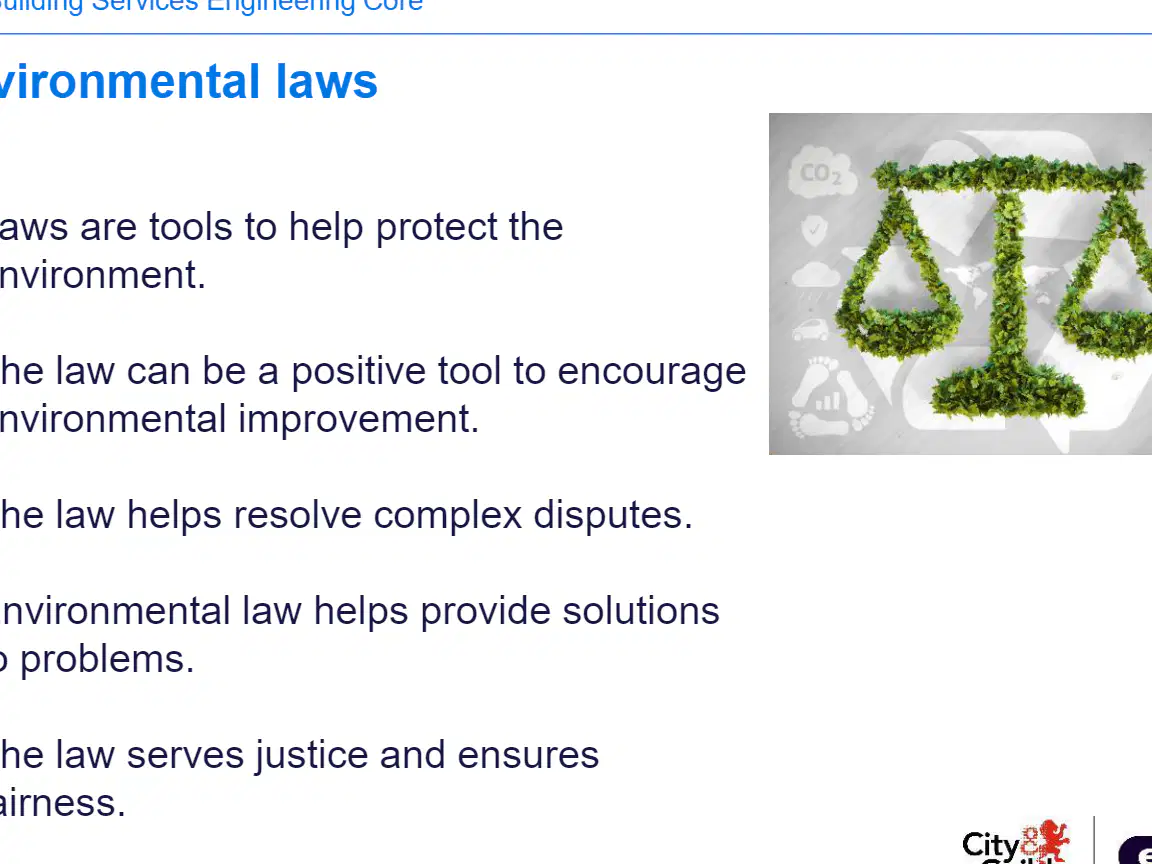
What is one of the main purposes of environmental laws?
To increase industrial production
To protect the environment
To reduce taxes
To promote urbanization
How can laws be used in relation to the environment?
As a tool to encourage environmental improvement
As a means to increase pollution
As a way to reduce biodiversity
As a method to eliminate regulations
What role do environmental laws play in disputes?
They create more disputes
They help resolve complex disputes
They ignore disputes
They complicate disputes further
What is one benefit of environmental law mentioned in the text?
It increases legal costs
It provides solutions to problems
It reduces government intervention
It limits public participation
What does the law ensure according to the text?
Inequality
Fairness
Injustice
Corruption
Which UK Act of Parliament was established in 1995?
Environmental Protection Act
Climate Change Act
Environment Act
Controlled Waste Act
What is the year of enactment for the Climate Change Act?
1990
2008
1999
1981
Which Act focuses on pollution prevention and control?
Wildlife and Countryside Act
Countryside Rights of Way Act
Pollution Prevention and Control Act
Environment Act
In which year was the Environmental Protection Act enacted?
1992
1990
2000
1995
Which UK Act of Parliament was enacted in 1991 to address water resources?
Energy Act 2013
Waste Regulations 2011
Water Resources Act 1991
Clean Air Act 1990
What is the focus of the Environmental Permitting Regulations enacted in 2010?
Land drainage
Energy conservation
Environmental permitting
Air quality
In which year was the Clean Air Act enacted?
1990
1991
2013
2015
Which Act focuses on the well-being of future generations in Wales?
Waste Regulations 2011
Well-being of future generations (Wales) Act 2015
Land Drainage Act 1991
Energy Act 2013
What is the primary purpose of the Environmental Protection Act in the UK?
To increase construction costs
To protect and improve the environment
To promote industrial growth
To reduce taxes
What must all construction contractors demonstrate according to the Environmental Protection Act?
Increasing project timelines
Reducing labor costs
Preserving and not harming the environment
Expanding urban areas
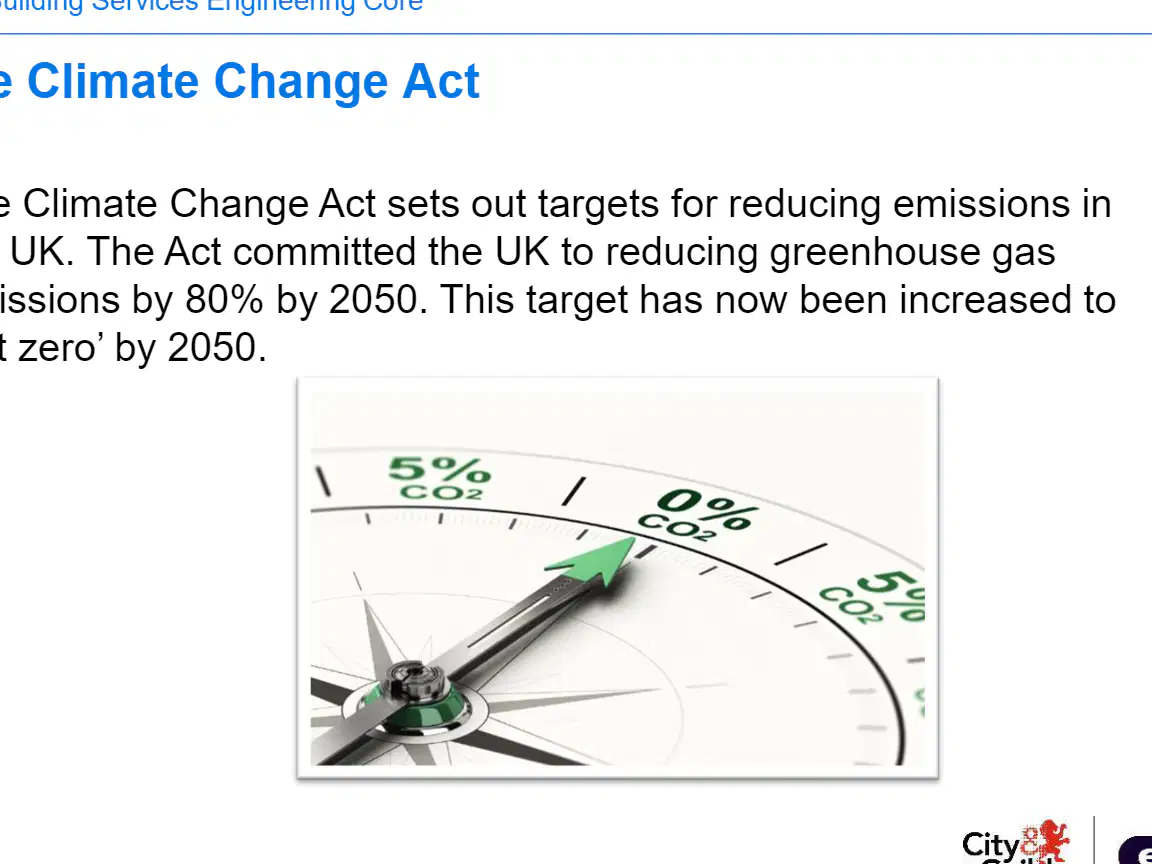
What is the main goal of the Climate Change Act in the UK by 2050?
Reduce greenhouse gas emissions by 50%
Achieve 'net zero' emissions
Increase emissions by 20%
Maintain current emission levels
By what percentage did the Climate Change Act initially aim to reduce greenhouse gas emissions by 2050?
50%
60%
80%
100%
What year was the Clean Air Act introduced?
1993
1985
2000
1978
What does the Clean Air Act 1993 regulate?
Smoke emissions, chimney height, and motor fuel composition
Water pollution, waste management, and recycling
Noise pollution, traffic control, and urban planning
Wildlife protection, forest conservation, and land use
What is considered an offence under the Clean Air Act 1993?
Emitting dark smoke from a chimney in an industrial business
Using solar panels for energy in a residential area
Recycling waste materials in a commercial business
Planting trees in an urban area
Where are smoke controlled areas intended to control pollution?
Areas where coal is the predominant fuel for domestic heating
Areas with high levels of traffic congestion
Areas with large industrial factories
Areas with significant agricultural activity
What did the Water Act 2014 amend?
The Water Industry Act 1991
The Environmental Protection Act 1990
The Clean Water Act 1989
The Water Resources Act 1992
What is one of the aims of the Water Act 2014?
To reform the water industry to make it more innovative and responsive to customers
To reduce water prices for consumers
To privatize the water industry
To eliminate all water-related taxes
How does the Water Act 2014 aim to increase the resilience of water supplies?
By increasing the resilience to natural hazards such as droughts and floods
By reducing water usage in households
By promoting the use of bottled water
By banning the use of water in industrial processes
What does the Water Act 2014 enable developers to do?
Connect new building developments to the water mains and sewage systems
Build without any water supply considerations
Use any water source without regulation
Ignore environmental impact assessments
What does the Water Act 2014 encourage the use of?
Sustainable drainage systems (SuDS)
Traditional drainage systems
Imported water systems
Non-renewable water sources
What does COSHH stand for?
Control of Substances Harmful to Health
Control of Substances Hazardous to Health
Control of Substances Helpful to Health
Control of Substances Hazardous to Humans
What is a consequence of breaching COSHH regulations?
A warning letter
A small fine
An unlimited fine
A temporary suspension
Which of the following is NOT ensured by COSHH regulations?
Protection against illness caused by hazardous substances
Prevention, control, and monitoring of exposure
Risk assessment of working practices
Increased production speed
What is one of the key purposes of COSHH regulations?
To increase company profits
To protect workers from ill health
To reduce material costs
To enhance product quality
What is a statutory requirement under the COSHH regulations for manufacturers?
To produce data sheets
To conduct weekly safety meetings
To hire safety officers
To install fire alarms
What do data sheets assist with according to the COSHH regulations?
Marketing strategies
Compliance and risk assessments
Employee training programs
Financial audits
Which of the following is included in the implementation of appropriate control measures under COSHH regulations?
Use of PPE and ventilation apparatus
Installation of security cameras
Regular team-building exercises
Development of new products
What is the main purpose of the Waste Electrical and Electronic Equipment Regulations 2013 (WEEE)?
To increase the production of electronic goods
To reduce the amount of waste electrical and electronic equipment
To promote the incineration of electronic waste
To encourage the export of electronic waste
Which of the following is NOT a measure encouraged by the WEEE regulations?
Recovery of products
Reuse of components
Recycling of products
Incineration of waste
What type of legislation is the Waste Electrical and Electronic Equipment Regulations 2013 considered?
International law
UK legislation
European Union directive
Local ordinance
Which of the following items is covered under the WEEE regulations for disposal?
Plastic bottles
Small electrical goods like kettles
Paper waste
Organic waste
What is the purpose of the Hazardous Waste Regulations 2005?
To increase the production of hazardous waste
To set out the regime for the control and tracking of hazardous waste
To eliminate all hazardous waste
To promote the use of hazardous waste in construction
What must be completed before hazardous waste can be removed from premises according to the regulations?
A recycling certificate
A consignment note
A safety inspection
A waste disposal fee
What does the documentation system control under the Hazardous Waste Regulations 2005?
The production of hazardous waste
The movement of waste
The recycling of waste
The disposal of non-hazardous waste
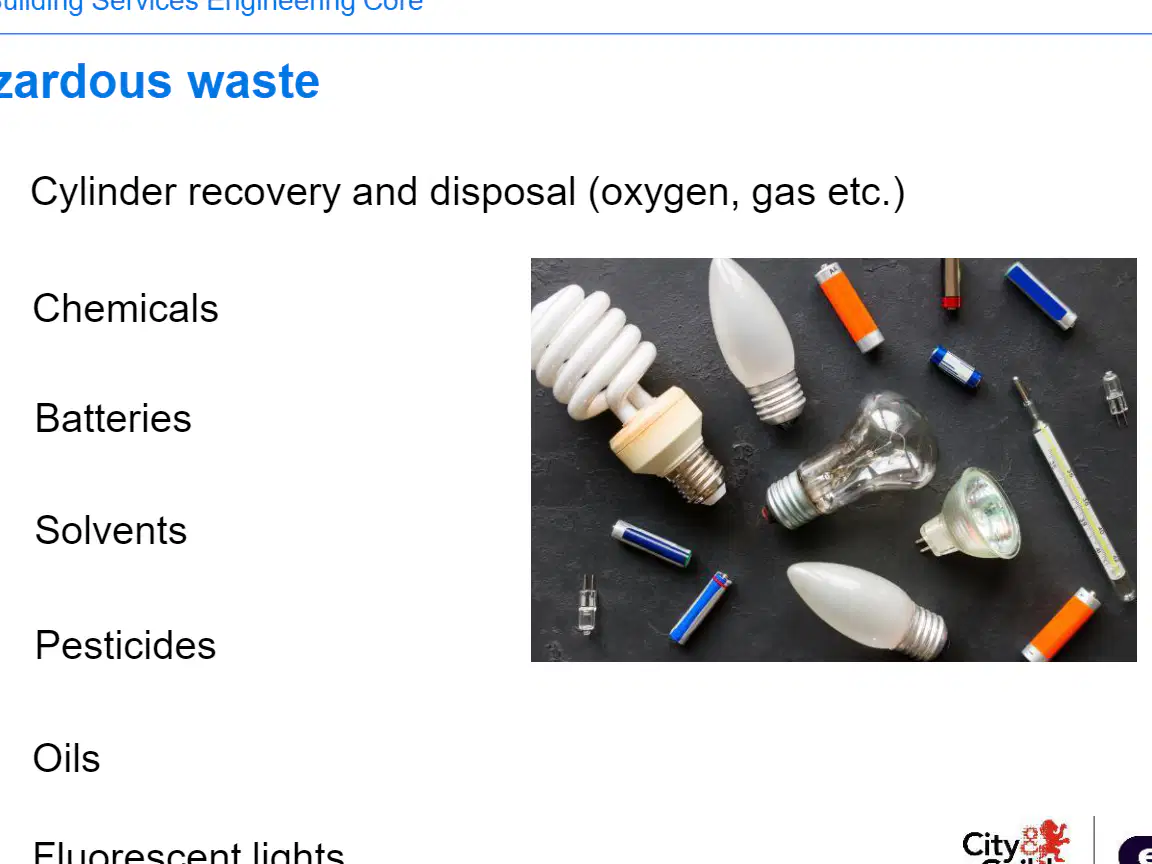
Which of the following is considered hazardous waste?
Paper
Batteries
Wood
Plastic
What type of waste involves cylinder recovery and disposal?
Plastic waste
Food waste
Oxygen and gas cylinders
Electronic waste
Which of the following is NOT listed as hazardous waste in the document?
Chemicals
Oils
Glass
Solvents
Fluorescent lights are categorized under which type of waste?
Recyclable waste
Hazardous waste
Organic waste
Non-hazardous waste
What is the minimum capacity of an oil storage container that requires compliance with the Control of Pollution (Oil Storage) Regulations 2001?
100 litres
150 litres
201 litres
250 litres
Which types of oil are covered by the Control of Pollution (Oil Storage) Regulations 2001?
Petrol, diesel, biofuels, and kerosene
Only petrol and diesel
Only biofuels and kerosene
All types of oil except petrol
What is one of the main purposes of the regulations regarding oil storage?
To increase oil production
To minimize the risk of oil being damaged by an impact
To promote the use of biofuels
To reduce oil prices
What factor might some clients consider when awarding a company a contract?
The company's location
The company's reputation and attitude towards sustainability
The company's size
The company's profit margin
What might a project team need to do for clients with less understanding of sustainability?
Ignore their concerns
Work with them to educate and raise awareness
Offer discounts
Change the project entirely
How can companies ensure their staff understand sustainability?
By reducing their salaries
By investing in training and development
By hiring more staff
By outsourcing work
What should construction companies advertise on their website?
Their latest projects
Sustainability as a core value or mission statement
Their annual revenue
Their office locations
What should companies in the construction industry do to promote sustainability?
Work independently
Share good practice collaboratively
Avoid professional bodies
Ignore local authorities
How can companies enhance the sharing of practice in the construction industry?
By avoiding competitions
By ignoring practice guides
By participating in competitions
By not liaising with local authorities
What role does social media play for construction companies?
It is irrelevant
It is a leading platform for showcasing work
It is only for personal use
It is used to avoid advertising
What activities can individuals attend to improve sustainability in the industry?
Ignore seminars
Attend online meetings and events
Avoid professional gatherings
Skip all industry events
What type of evidence might companies be asked to provide when tendering for work to demonstrate sustainability?
Financial statements
Declaration of environmental prosecutions
Marketing strategies
Employee satisfaction surveys
Which of the following is NOT typically requested as information for securing contracts?
Copies of environmental policies and procedures
Evidence of monitoring and performance management
Proposals for adding social value
Personal employee records
Why might companies need to demonstrate sustainable methods in building design and maintenance?
To reduce construction costs
To comply with legal requirements
To secure contracts
To increase building height
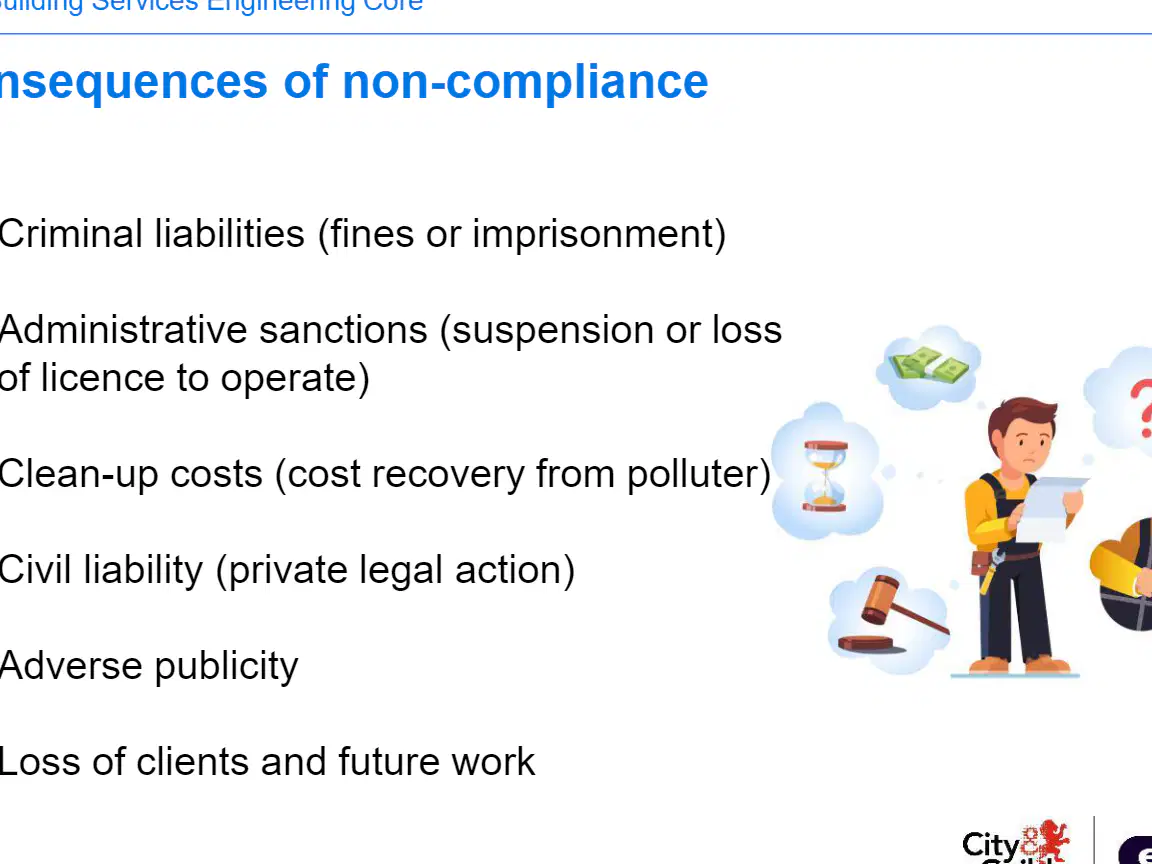
Which of the following is a consequence of non-compliance in Building Services Engineering?
Increased client trust
Criminal liabilities
Improved public image
Enhanced operational efficiency
What can result from administrative sanctions due to non-compliance?
Award of new contracts
Suspension or loss of license to operate
Increase in market share
Reduction in operational costs
Which of the following is NOT a consequence of non-compliance?
Clean-up costs
Civil liability
Adverse publicity
Increased profitability
What is a potential impact of adverse publicity due to non-compliance?
Gain of new clients
Loss of clients and future work
Increase in stock prices
Expansion into new markets
What is the highest level of enforcement in the enforcement pyramid?
License suspension
Criminal penalty
License revocation
Civil penalty
Which of the following is the first step in the enforcement pyramid?
Warning letter
Persuasion
Civil penalty
Criminal penalty
Which of the following is a main control body for environmental law?
Environmental Protection Officers
Department for Transport
Health and Safety Executive
Food Standards Agency
What is the role of regulatory bodies mentioned in the document?
To create new laws
To enforce and implement relevant laws and policies
To provide legal advice
To conduct scientific research
Which organization is responsible for marine management according to the document?
Marine Management Organisation
Natural England
Local Authorities
Office for Nuclear Regulation
Which agency is involved in the regulation of nuclear activities?
Office for Nuclear Regulation
The Environment Agency
Maritime and Coastguard Agency
Natural England

