
 Worksheets
Food Chains and Webs Quiz
Total questions: 40
Worksheet time: 23mins

The shrew provides energy for the _______?
cricket
grasshopper
frog
snake

Polar Bears eat mostly seals and harp (a type of fish). Polar Bears are _____________.
herbivores
carnivores
omnivores
decomposers

Which animal is higher on the food chain?
grass
antelope

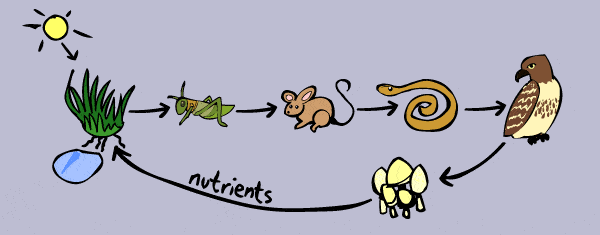
Who is at the top of this food chain?
grass
grasshopper
mouse
owl

What kind of organisms are usually at the top of the food chain?
producers
herbivores
omnivores
carnivores
What is a food chain?
A complex network of interconnected food webs.
A linear sequence of organisms where each is eaten by the next one in the chain.
A group of organisms that share the same habitat.
A cycle of energy flow in an ecosystem.
Which of the following best describes a food web?
A single path of energy flow in an ecosystem.
A network of interconnected food chains in an ecosystem.
A diagram showing the number of organisms at each trophic level.
A list of all the producers in an ecosystem.
What is meant by "trophic level" in an ecosystem?
The position an organism occupies in a food chain.
The number of organisms in a food web.
The amount of energy lost at each level of a food chain.
The total biomass of an ecosystem.
In a typical food chain, which trophic level do primary consumers occupy?
First trophic level
Second trophic level
Third trophic level
Fourth trophic level
Which of the following organisms is most likely to be at the top of a food chain?
Grass
Rabbit
Deer
Lion
Label this food chain

Look at the food chain. How do foxes get energy?
from eating rabbits
from eating grass
from the sun
from eating other foxes


Click on the image to make it larger--The rabbit gets energy from the ....
hawk
mouse
wildflowers
grass


True/False
Food webs show you everything an animal eats. Food chains show you one thing.
True
False

Which of the following organisms is correctly paired with its role in the food chain?
Grass-primary producer
Snake-secondary consumer
Hawk-Quaternary consumer
Mouse-Tertiary Consumer

Click on the image to make it larger-- Choose all that apply: The hawk gets energy from...
mouse
rabbit
wildflowers
snake
What role do decomposers play in a food chain?
They are primary consumers.
They are at the top of the food chain.
They break down dead organisms and recycle nutrients.
They produce energy from sunlight.
Which of the following is an example of a primary consumer?
Hawk
Grass
Fox
Rabbit
In a food web, what happens if a producer is removed?
Secondary consumers become primary producers.
Primary consumers increase in number.
The energy flow in the ecosystem is disrupted.
Nothing changes
In a food web, what role do producers play?
They consume other organisms.
They convert solar energy into chemical energy.
They are at the top of the food chain.
They decompose organic matter.
Which of the following best describes a secondary consumer in a food chain?
An organism that produces its own food
An organism that feeds on primary consumers
An organism that decomposes organic matter
An organism that is at the top of the food chain
In a food web, what is the role of herbivores?
They are primary producers.
They consume plants and are primary consumers.
They decompose organic matter.
They are at the top of the food chain.
Which of the following organisms is a decomposer in a food web?
Fungi
Rabbit
Grass
Hawk
What is the primary source of energy in most ecosystems?
Sunlight
Water
Soil
Wind
Which of the following organisms is a primary consumer?
Deer
Grass
Wolf
Fungi
In a food web, which organisms are responsible for recycling nutrients back into the ecosystem?
Secondary consumers
Producers
Decomposers
Primary consumers
What is the primary role of producers in a food chain?
To consume other organisms
To convert solar energy into chemical energy
To be at the top of the food chain
To decompose organic matter
In a food web, what happens if a secondary consumer is removed?
The entire ecosystem remains unaffected
The energy flow in the ecosystem is enhanced
Primary producers become secondary consumers
Primary consumers increase in number
What is the role of carnivores in a food chain?
They consume primary producers.
They decompose organic matter.
They feed on herbivores and other consumers.
They produce energy from sunlight.
In an ecosystem, what happens if a top predator is removed?
Primary producers will increase in number.
Secondary consumers will decrease in number.
The balance of the ecosystem may be disrupted.
Decomposers will become primary consumers.
What do the arrows represent in a food chain/web?
The amount of energy available
The flow of energy from one organism to another.
The movement of different types of organisms.
The direction the organisms are moving
What is the role of herbivores in a food chain?
They are primary producers.
They are secondary consumers.
They are decomposers.
They are primary consumers.
In a food chain, what happens to the energy that is not transferred to the next trophic level?
It is converted into water.
It is stored in the body of the organism.
It is lost as heat.
It is used for photosynthesis.
What is the role of omnivores in a food chain?
They produce energy from sunlight.
They decompose organic matter.
They consume both plants and animals.
They only consume plants.
In a food web, what is the consequence of removing a primary consumer?
Secondary consumers will increase in number.
The energy flow in the ecosystem will be disrupted.
Producers will decrease in number.
Decomposers will become primary consumers.
Which of the following best describes a tertiary consumer in a food chain?
An organism that is at the bottom of the food chain.
An organism that decomposes organic matter.
An organism that produces its own food.
An organism that feeds on secondary consumers.

