
 Worksheets
Ecology Midterm Review
Total questions: 173
Worksheet time: 3hrs 11mins
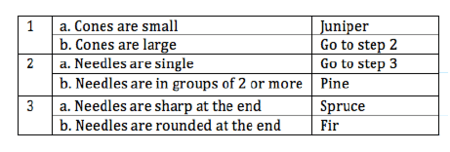


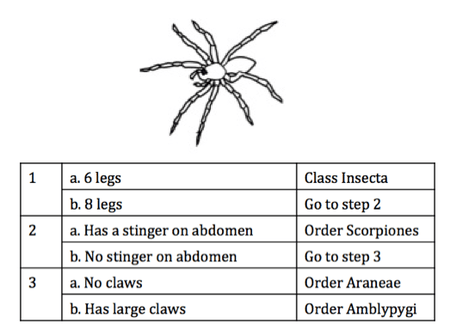
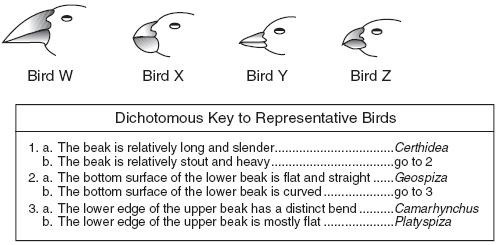

following observations of the plant’s characteristics would be useful in determining its identity with a dichotomous key?
A student discovers an arachnid without a segmented abdomen, and legs longer than its body. The student uses the dichotomous key below to identify it. Which arachnid has the student found?
Whip Scorpion
Wind Scorpion
Daddy long legs
Scorpion
A student discovers an arachnid with a segmented abdomen, long legs, and a tail with no stinger.
The student uses the dichotomous key below to identify it.
1. a) Abdomen segmented.............go to 2
b) Abdomen not segmented ......go to 4
2. a) Abdomen with tail....................go to 3
b) Abdomen without tail...............go to 5
3. a) Tail with stinger..........................Scorpion
b) Tail without stinger.....................Whip scorpion
4. a) Legs longer than body.............Daddy Long Legs
b) Legs not longer than body……….Wind scorpion
5. a) Covered with spines .......................Mite
b) Few spines.....................................Tick
Whip Scorpion
Daddy Long Legs
Mite
Tick

Which leaf is shown in the drawing?
Magnolia
Redbud
Sweetgum
None of the above

What species of tree is the fruit from?
Fraxinus americana
Franinux negundo
Acer platanoides
Acer negundo

Use the dichotomous key to identify this white wildflower
Starflower
Chickweed
Common Strawberry
Bowman's root

Which animal made this track?
Skunk
Coyote
Squirrel
Rabbit

Which animal made this track?
Rabbit
Deer
Deer Mouse
Coyote

Which animal made this track?
Opossum
Squirrel
Coyote
Raccoon

Which animal made this track?
Skunk
Rabbit
Coyote
Deer

Which animal made this track?
Elk
Wolf
Raccoon
Deer Mouse

Horse
Duck
Turkey

Turkey
Duck
Beaver
Wolf

Beaver
Raccoon
Squirrell
Pheasant
What are 3 things that make a mammal?
Live babies who they make milk for
Fur or hair
Walk
Warm blooded
Cold Blooded
These are places where a bat might roost.
Trees
Caves
Lakes
Under bridges
Old buildings

What are some of the things bats like to eat?
Nuts
Fruit
Mosquitos
People
A place where a bat lives is called .........
Roost
Nest
Tree
Hole
What kind of animal is a bat?
Bird
Rat
Mammal

Bats main predators are
other bats
man
owls
snakes

Most bats are
insectivores
frugivores
nectarivores
sngivores

There are about ___________ species of bats.
100
90
1000
10,000
When Bats pollinate flowers, they help them to
fall asleep
grow
die
'These bats pollinate plants that give us some of our favorite foods, including bananas, avocados, peaches, and cocoa beans, the source of chocolate."
False
True
"Bats are also excellent _________. In rainforests, bats eat fruit and seeds and drop some of the seeds as they fly away"
Running
Flying
Planters
What is causing the bat populations to decrease?
Cold
white-nose syndrome
Flu
A bat is different than a bird because a bird is awake...
during the day
all day and all night
during the night
it never sleeps

Bats are beneficial to us as they eat pests, pollinate fruits and flowers and disperse seeds.
true
false
What are two pest that bats eat?
bees and hornets
ladybugs and spiders
mosquitoes and termites
wasps and hornets
Which of the following are not benefits of bats to mankind?
Insect control
Pollination
Medical Research
Agriculture
All answers are benefits
What are the hibernation sites of bats called?
Hibernacula
Den
Cave
Crevice

Yellow Bellied Sapsucker
Porcupine
Downy Woodpecker
Pileated Woodpecker


Cottontail Rabbit
White Tailed Deer
Elk
Porcupine
What is the significance of riparian zones in wildlife habitat preservation?
They are primarily used for recreational activities
They provide unique habitats and act as natural water filters
They are designated areas for industrial development
They are unsuitable for wildlife and are often cleared
Which animal can wreak havoc on crops and is considered by some to be a wildlife management issue?
White Tailed Deer
Skunk
Red Fox
Coyote
North America's largest rodent
river otter
beaver
groundhog
grey squirrel
What is the purpose of a stop-over habitat in migration?
Rest and refuel during migration
Permanent settlement
Daily feeding
Breeding ground
What can changes in vegetation distributions affect?
Only the color of the habitat.
The amount and connectivity of available habitat.
Only the temperature of the habitat.
The amount of sunlight in the habitat.
What is the purpose of mapping habitat changes using remote sensing?
To confuse wildlife managers.
To track animal diets.
To understand habitat dynamics.
To measure air pollution.
What is a consequence of radical vegetation changes?
Decreased wildlife diversity.
Increased natural fires.
More stable ecosystems.
No impact on wildlife.
Which describes the native people and their relationship with fire?
They purposely set fires to provide better grass.
They feared fire as it often destroyed everything.
Fire was rare as native people could not create it.
Fire was only used as a tool when started by a storm.
Which type of trees lose their leaves in the fall?
Deciduous
Evergreen
Tropical
All trees

Which of the following describes the way tree branches in the picture above?
Compound
Alternate
Opposite
All of the above

This is an example of what type of branching?
Parallel
Opposite
Whorled
Alternate

Is this animal an herbivore, carnivore, or omnivore?
Herbivore
Omnivore
Carnivore

Is this animal an herbivore, omnivore, or carnivore?
Hebivore
Omnivore
Carnivore
________ has caused an increase in endangered plant and animal species.
Venus fly traps
Invasive species
Soil erosion
Wild fires

Which of the following best describes an invasive species?
Native plants or animals which grow at an exceptionally fast rate
Native plants which take up large areas of space and do not allow for other species to spread
Native or non-native species found in nearly every terrestrial area
non-native species introduced to an area ultimately harming the ecosystem or human health

Planting native trees on privately-owned land can help maintain biodiversity and the health of the local eco-system.
True
False
Which of the following is NOT an issue when having an over-abundant species in a population?
spread of diseases
population health
Instances of human conflict
Unstable social order within the population
Which of the following is NOT a technique for monitoring wildlife?
Wildlife camera trapping
Gathering information online
Fecal DNA surveying
Transect counts
____________ is a method of collecting population data for organisms that have limited or no mobility.
Quadrat Sampling
Internet survey
Mark-Recapture
Line-Transect Method
What is the minimum number of quadrat samples you should take?
2
3
4
5
What is the sampling technique Quadrat used for?
The Quadrat technique is used to study the distribution and abundance of plants and stationary or slow-moving animals in uniform eco-systems. eg a grassland
What is the sampling technique Line Transects used for
Line Transects are used where there is a transition of organisms across the ecosystem. example, down a rocky sea shore
What is a Line Transect
A line transect is usually a measuring tape or string that has marks at regular intervals
What is a Quadrat?
A quadrat is a square frame whose area is known.
What is a Belt Transect used for?
What can the results of Quadrats used to obtain?
Results of quadrats can be used to estimate population's
Species density
Total population
Species cover
Species frequency
Which types of sampling methods would be best used for sedentary organisms?
Fogging and Mark and Recapture
Quadrant and Transect
Quadrant and Fogging
Transect and Fogging
Which type of sampling involves breaking an ecosystem into a grid and randomly selecting certain squares to count
Mark and Recapture
Quadrant
Transect
Netting
Which type of sampling involves breaking an ecosystem into a grid and only counting those that fall ON the line
Mark and Recapture
Quadrant
Transect
Netting
What type of sampling involves tagging an individual and releasing them back
Mark and Recapture
Fogging
Netting
Transect
What type of sampling involves collecting individuals in a net and counting them accordingly
Netting
Mark and Recapture
Fogging
Quadrant
When collecting data from the field, what are some important considerations? (select all that apply)
Avoid harming organisms
Identify potential hazards
collecting data is more important than negativly impacting the habitat
scientists do not need permission to work in most natural areas.
A wetland being drained so a housing development can be built is an example of ____________.
habitat destruction
over exploitation
pollution
conservation
Habitat restoration can have a positive impact on biodiversity in an area.
True
False
Which of the following is NOT one of the five major threats to biodiversity?
habitat destruction
invasive species
over exploitation
reclamation
a measure of the species, genetic and ecosystem diversity of different species
population
community
biodiversity
ecosystem
the living organisms and the environment with which they interact
ecosystem
habitat
population
niche
the natural environment where an organism lives
ecosystem
habitat
population
niche
samples are taken at random places within a sample site
random sampling
systematic sampling
continuous sampling
An species that influences the survival of many other species in an ecosystem.
invasive species
keystone species
producers
gemstone species
The benefits humans receive from ecosystems.
ecosystems services
ecological restoration
sustainability
biodiversity
The word "ecosystem" refers to:
the physical environment
living organisms
living organisms and the physical environment
living organisms in the laboratory
A food web shows the flow of _____ through an ecosystem and the cycling of ________ within
matter, energy
energy, matter
food, waste products
waste products, food
The duck population in a local lake are starting to decline. what could be the reason for this decline in the duck population?
The lake habitat is perfect for the ducks.
The fox is a new predator in the area
There is a lot of food available
The lake water is not harmful to the ducks.
Which sampling method is best for studying gradual changes across an ecosystem?
Random sampling
Transect sampling
Quadrat sampling
Systematic sampling
Which method best shows vegetation changes along a hillside?
Random quadrats
Line transect
Systematic grid
Stratified sampling
Why do endangered species matter?
Because they are cute
Biodiversity
Because if they die we cannot have them as pets
Because they cannot be in the zoo

What is reclamation?
The concept that items can be used again.
Nitric and sulfuric acid condensing into clouds and falling to Earth.
The process of restoring a damaged ecosystem.

Which of the following most likely describes the effect of habitat destruction of an ecosystem while increasing a population?
The population will decrease due to lack of space and food.
The population will increase due to lack of shelter and available food.
The population will increase, then decrease due to lack of biotic factors.
What is biodiversity conservation and why is it important for managing ecosystems?
Biodiversity conservation is only important for aesthetic reasons and has no impact on ecosystems
Biodiversity conservation is the protection and management of the variety of life on Earth, including species diversity, genetic diversity, and ecosystem diversity. It is important for managing ecosystems because it helps to maintain the balance of the ecosystem, provides resilience to environmental changes, and supports the overall health of the planet.
Biodiversity conservation is only important for scientific research and has no impact on ecosystems
Biodiversity conservation is only important for protecting large, charismatic animals and has no impact on ecosystems
What are invasive species and how do they impact ecosystem management?
Invasive species are non-native organisms that have no impact on the ecosystem they invade. They coexist peacefully with native species.
Invasive species are non-native organisms that cause harm to the ecosystem they invade. They can outcompete native species, disrupt food chains, and alter habitats.
Invasive species are non-native organisms that only cause harm to humans. They have no impact on the ecosystem.
Invasive species are native organisms that benefit the ecosystem they invade. They help improve biodiversity and restore balance.
Discuss the challenges associated with habitat fragmentation and its effects on biodiversity.
Increase in genetic diversity, larger population size, closer proximity of species, and enhancement of ecological processes.
Decrease in genetic diversity, smaller population size, decreased isolation of species, and improvement of ecological processes.
Loss of genetic diversity, reduced population size, increased isolation of species, and disruption of ecological processes.
No impact on genetic diversity, stable population size, no change in species isolation, and no effect on ecological processes.
How can human activities contribute to ecosystem restoration efforts?
By implementing unsustainable land management practices
By promoting pollution and waste production
By implementing sustainable land management practices, reforestation, habitat restoration, and reducing pollution and waste.
By increasing deforestation and habitat destruction
What are the potential consequences of not managing invasive species in an ecosystem?
Potential consequences include loss of biodiversity, alteration of ecosystem processes, and economic impacts.
Decrease in biodiversity, restoration of ecosystem processes, and positive economic impacts
No impact on biodiversity, no change in ecosystem processes, and no economic consequences
Increase in biodiversity, improvement of ecosystem processes, and positive economic impacts
Explain the concept of habitat fragmentation and its impact on wildlife populations.
Habitat fragmentation leads to increased biodiversity and genetic diversity for wildlife populations.
Habitat fragmentation has no impact on wildlife populations.
Habitat fragmentation only affects large animals, not small ones.
Habitat fragmentation can lead to loss of biodiversity, reduced genetic diversity, and increased vulnerability to extinction for wildlife populations.
Discuss the role of community involvement in managing ecosystems and conserving biodiversity.
Encouraging overfishing
Ignoring the impact of pollution
Cutting down more trees
Promoting sustainable practices, raising awareness, and implementing conservation initiatives
the geographical area within which that species can be found
(a)
a yearly round trip between two areas
(a)
the process of continually checking, observing, recording, or testing the operation of some procedure, or collection and analysis of repeated observations over time to evaluate changes in the condition of a resource.
(a)
Which of the following is a way to modify a habitat to adapt to animal behavior or create a more ideal environment for a population?
Using pesticides to remove a target species
Creating food plots for target species
Reducing populations causing human conflicts
Relocating animals to a unique home range
Which of the following is true about the current research regarding forest fragmentation?
Fragmented forests are the goal of conservation biologists who design wildlife preserves.
The disturbance of timber extraction causes species diversity to increase because of the new habitats created.
Fragmented forests support a lesser biodiversity because the forest-adapted species disappear, and only the edge and open-field species can occupy fragmented forests.
Fragmented forests support a greater biodiversity because they result in the combination of forest-edge species and forest-interior species.
Harvesting timber that results in forest fragmentation results in less soil erosion.
Humans are responsible for many negative changes in the natural environment. Which of the following best describes why humans have a profound impact on their environment?
Humans are able to preserve scarce resources.
Humans have made attempts to preserve the environment.
Humans are able to modify habitats more than any other species.
Humans have encouraged the development of wildlife refuges and parks.
Wildlife in the Florida Everglades has declined over centuries. Which of the following scenarios best describes why wildlife isn't as expansive as it once was?
Climate changes divert water from the Everglades, starving animals and introducing predators that altered dominant food webs.
Human development has no impact on the Everglades. Rather, natural selection has caused invasive species to populate the land and forced the population of the weaker native species to dwindle.
Human development has forced animal populations that were once expansive onto a small portion of land, limiting genetic diversity and also introducing invasive species that prey on the natural inhabitants.
Human development and climate change has created an environment where the water flowing into the Everglades restricts the growth of animal populations regardless of whether or not the animals are invasive.
Researchers notice that animal populations in a wildlife preserve have been decreasing. Which step should the researchers perform to obtain the most valid data about the decreasing animal population?
analyze data about areas of the preserve that require extensive maintenance
count and track the number of guests visiting the preserve on a weekly basis
throughout the year count and record animals throughout the preserve, as well as log animal deaths
interview current and former employees about their favorite animal found in the preserve
Which practice provides the best means of protecting biodiversity in the wild for future generations?
buying vehicles with reduced carbon emissions
initiating recycling programs in neighborhoods
protecting wildlife areas such as national parks
expanding breeding programs for endangered species
How does climate change primarily affect the accuracy of wildlife population monitoring?
It leads to more frequent and severe weather events that can disrupt monitoring efforts.
It does not have a significant impact on the accuracy of wildlife population monitoring.
It increases the availability of natural resources, making animals easier to monitor.
It causes animals to migrate to new areas, making previous monitoring locations obsolete.
How does urban development most directly affect the home ranges of wildlife species?
It increases the size of home ranges due to more available resources.
It decreases the size of home ranges due to habitat fragmentation.
It has no significant effect on the size of home ranges.
It causes home ranges to shift to higher altitudes.
How does reforestation contribute to wildlife conservation?
By increasing the carbon footprint of an area
By reducing the amount of land available for agriculture
By providing habitats and restoring ecosystems for wildlife
By promoting urbanization and infrastructure development
What is a potential consequence of overpopulation of deer in a forest ecosystem?
Decreased biodiversity due to overgrazing
Increased forest cover due to reduced grazing
Decreased instances of Lyme disease
Increased populations of predatory animals
How does overpopulation of a single wildlife species typically affect the ecological balance of their habitat?
It increases genetic diversity within the ecosystem
It leads to a more stable and resilient ecosystem
It can lead to resource depletion and habitat degradation
It promotes the introduction of new species into the ecosystem
Which is not a threat to biodiversity?
habitat destruction
overexploitation
climate change
legal deer season
What do Beavers use their tail for? Select more than one answer.
A brace as they're sawing down trees
A communication tool to ward off predators
A weapon to help protect them
To store their fat for the winter
Beaver's hind feet act as
wheels
engines
paddles
flippers
What does a beaver use its front feet for? Select 3
digging
climbing trees
handling food
building dams
What do Beavers use their tail for? Select more than one answer.
A brace as they're sawing down trees
A communication tool to ward off predators
A weapon to help protect them
To store their fat for the winter
Beavers build (a) to protect them from predators and for organisms to live in.

What is the role of beavers in the ecosystem?
They prey on elk
They build dams and create habitats
They eat plants and trees
They control the wolf population

What animal is this?
Squirrel
Opossum
Beaver
River Otter

What animal is this?
Female White-Tailed Deer
Opossum
Coyote
Skunk

Classify this skull as a herbivore, carnivore, or omnivore.
herbivore
carnivore
omnivore

Classify this skull as a herbivore, carnivore, or omnivore.
herbivore
carnivore
omnivore

Classify this skull as a herbivore, carnivore, or omnivore.
herbivore
carnivore
omnivore

Classify this skull as a herbivore, carnivore, or omnivore.
herbivore
carnivore
omnivore

Canines on a predator are used for
opening up a can lid.
having a great smile.
digging in the ground.
tearing into the prey's meat.

How would you classify this skull?
Herbivore
Carnivore
Omnivore
Eyes on the sides of an organism's head suggest that they should hide because they are typically the __________.
predator
prey
________________ are any behavioral or structural characteristics of an organism that help it to survive in its environment.
Nature
Adaptations
Hibernation
Instincts
A ______________ is something an animal does – how it acts - usually in response to some type of external stimuli.
Body adaptation
Structural adaptation
Instinctual adaptation
Behavioral adaptation
A _____________ is some type of structural modification made to a part of the body.
Structural Adaptation
Behavioral Adaptation
Animal Adaptation
Behaviors of adaptation
Adaptations can be either ______________ or _______________.
Physical, Behavioral
Physical, Useful
Behavioral, Useful
Physical, Adaptive
______________ help to protect animals in diverse environments -- from the land to water, from the arctic to the desert.
Structures
Physical-ness
Body language
Body coverings
Mammals have ______ or _______that helps insulate their bodies. It keeps them warm in winter and can protect specific areas of the body, like eyelashes protecting the eyes.
Hair, fur
Hair, eyes
Fur, awareness
Adaptations, bones
______________ is an inactive period of time for an animal during an extremely cold season.
Camouflage
Migration
Instincts
Hibernation
Animals ________________ when they change their color or pattern to blend in with the environment. This outward coloration helps animals blend in with the plants and surroundings.
Hibernation
Camouflage
Migration
Adaptation

The chart tells us about four animals. Which animal has needs and body parts for a place that is mostly water?
Camel
Rattlesnake
Beaver
Kangaroo Rat
Animals who travel to warmer habitats in the winter to escape the cold are using which behavioral adaptation?
Mimicry
Camouflage
Hibernation
Migration
True or false: All animals have adaptations that help them survive in their habitat.
True
False
Partially true: Not all animals have adaptations
Partially true: adaptations are not for surviving
During the winter, food is hard to find. In order to combat this, grizzly bears will go to sleep during the winter and don't use much energy. When winter is over, they wake up and are ready to eat. What is this called?
Camouflage
Hibernation
Migration
Mimicry
Other than sleep, what else happens during hibernation? (Check all that apply)
Heart rate decreases
Body temperature decreases
Breathing slows down
Body temperature increases
Heart rate increases
What are two reasons that animals migrate?
They travel to where food is available
They travel to places that are colder
They travel to avoid cold winter months
They travel to find a new home and never come back
Why does body temperature typically decrease during hibernation?
A lower body temperature uses less energy
It lowers because it is cold outside
A lower body temperature uses more energy
It lowers because it is hot outside

How are hibernation and migration similar?
They both happen due to seasonal changes
They both are harmful to predators
They both happen as an adult species only
They both use methods to trick the predator into thinking they are a larger and more harmful animal
All of the following are true about migration EXCEPT....
It involves animals going to a place that food is available
It involves animals using the same route year after year
It involves animals going to a place and never returning
It is controlled by changes in weather and/or amount of daylight
Migrating animals usually use the same routes year after year.
True
False
My observations contribute directly to science and decision making through ___________
a. Assisting in making threat predictions
b. Scheduling planting and harvesting times in agriculture and gardening
c. Aligning human activities more closely with nature
d. All of the above
The differences between making plant and animal observations include:
a. The time of day
b. Visiting the same individuals each time you observe
c. The creation of a checklist
d. Both b and c
True or False: After you record your observations on the paper datasheets, you are done for the day.
true
false

Why is biodiversity important?
Food
Medicine
Pest Control
Aesthetics

The study of connections in nature is called:
biosphere
biotic factor
ecology
phenology
How does ecosystem stability contribute to the overall health of an ecosystem?
Ecosystem stability contributes to the overall health of an ecosystem by maintaining biodiversity, nutrient cycling, and resilience to disturbances.
Ecosystem stability contributes to the overall health of an ecosystem by causing species extinction, disrupting nutrient cycling, and increasing vulnerability to disturbances.
What are some common methods used to analyze data about ecosystems?
Weather forecasting, soil analysis, water quality testing
Population surveys, habitat mapping, remote sensing
Biodiversity assessments, population surveys, habitat mapping, remote sensing
Satellite imaging, climate change modeling, species identification
What factors can influence the population size of a species in an ecosystem?
Moon phases
Availability of resources, predation, competition, disease, climate change, human activities
Social media trends
Population control by aliens
Why is it important to study biotic interactions in an ecosystem?
To understand how different organisms interact and impact the ecosystem's health and stability.
To learn about the history of the ecosystem
To study the weather patterns in the ecosystem
To understand the chemical composition of the ecosystem
What role do keystone species play in maintaining ecosystem stability?
Keystone species have no impact on ecosystem stability
Keystone species disrupt the balance of the ecosystem
Keystone species help regulate population dynamics, maintain biodiversity, and preserve ecosystem structure.
Keystone species only benefit a few species in the ecosystem
What are some indicators of ecosystem health that can be derived from data analysis?
Geographic location, elevation, soil type
Species diversity, population size, habitat quality, and nutrient cycling
Soil pH, air quality, water pollution
Temperature, precipitation, wind speed
How can you support conservation efforts?
Collect environmental data
Plant native species in gardens
Join a group that removes invasive plants
All of the above
What is carefully watching something over time?
experimentation
modeling
observation
What can biodiversity influence within an ecosystem?
how well the ecosystem recovers from a disturbance
how well the ecosystem grows after rain
how poorly the ecosystem responds to a drought

Changes to an ecosystem's biodiversity can have a direct effect on humans because humans
inhabit all areas of the Earth's ecosystems
use only minerals from the ground to make things
depend on the Earth's natural resources
rely mostly on solar power for energy
Without plants we would have no animals.
True
False

