
 Worksheets
Unit 2 Test Review: Physical Properties, Atomic, Periodic
Total questions: 76
Worksheet time: 1hrs 24mins
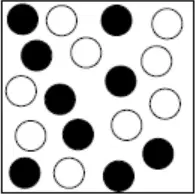
True/False: Does this picture show a mixture?
True
False
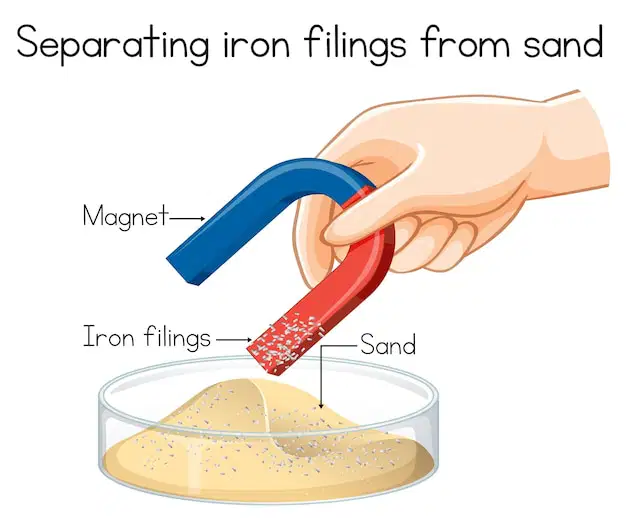
You combined iron filings with sand to create a mixture. How can you separate the iron filings from the sand?
Stir the mixture into hot water to dissolve the sand.
Strain the mixture through a paper filter to collect the sand.
Drag a magnet through the mixture to attract the iron filings.
Shake the mixture to cause the iron filings to settle to the bottom.
True/False: Solids usually become more soluble as temperature increases.
True
False
Which of the following is not a physical property of matter?
Name
Odor
Luster
Texture
Which of the following is a mixture?
Carbon
Glucose
Water
Air
Salt, juice, and water are examples of matter because they -
form the basic needs for human survival
have mass and take up space
are found in abundant quantities in our environment
are common items in daily life
The physical property that means a material can be bent into different shapes or rolled into thin sheets is...
ductile
tactile
metallic
malleable
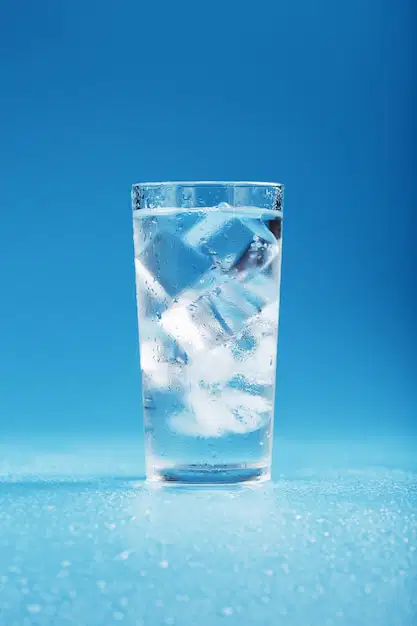
A glass is partially filled with water. Five ice cubes are placed in the glass, causing the level of the water to reach the rim of the glass. Which of the following statements best explains the increase in water level?
The volume of the submerged ice is equal to the volume of water displaced.
The mass of the water in the glass is less than the mass of the ice.
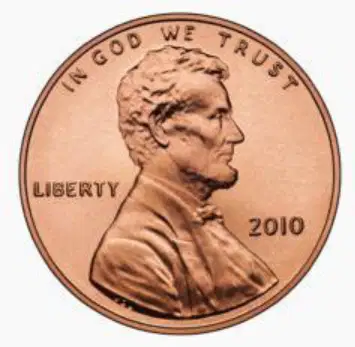
Which of the following is a physical property of the coin?
It has a reddish-brown color.
It has a value of one cent.
It is made in the United States.
It has writing on it.
Shaila wants to calculate the density of wood. First, she places the wood on a triple beam balance; its mass is 63.85 g. Then, she fills a graduated cylinder with 50.0 mL of water. She places the wood in the graduated cylinder with the water and notes that the water level rises to 125.0 mL. Calculate the density of the wood.
Density = Mass / Volume.
0.36 g/mL
0.51 g/mL
0.85 g/mL
1.28 g/mL
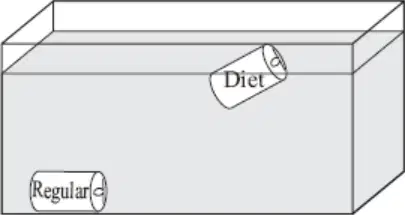
The diagram shows a diet soda and regular soda dropped into water. The regular soda sank to the bottom, but the diet soda floated. Which of the following statements best explains this observation?
The can of regular soda is less dense than the can of diet soda.
The can of regular soda is more dense than the can of diet soda.
The can of regular soda has a larger volume than the can of diet soda.
The can of regular soda has a smaller volume than the can of diet soda.
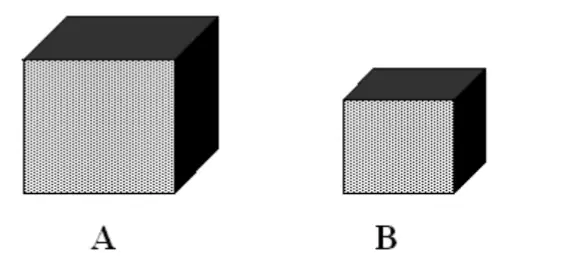
Compare the densities of the two identical iron objects A and B. Do these blocks have the same density?
Yes, because they are made from the same material
Yes, because they are the same shape
No, because they have different masses
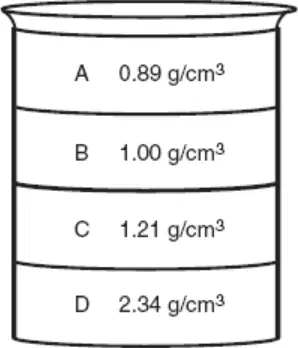
The diagram below shows a tall beaker with four different liquids and their densities. If a ball that has a density of 3.0 g/cm³ is placed in the beaker, where will the ball come to rest?
On top of liquid A
Between liquids B and C
On the bottom of the beaker
If 5 mL of a liquid has a mass of 10 g, what is its density? Density =Mass/Volume
20 g/mL
2 g/mL
0.5 g/mL
0.5 g/cm3

Which of the substances shown in the chart could be SALT?
Substance W
Substance X
Substance Y
Substance Z
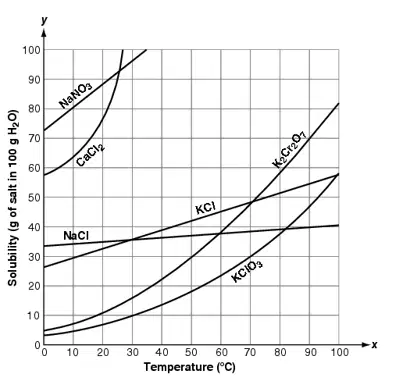
This is a Solubility Curve. Which pair of compounds has the same solubility at 25 °C?
KCl and NaCl
KCl and K₂Cr₂O₇
NaNO3 and CaCl2
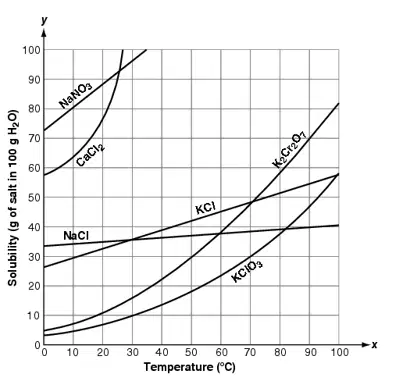
Students dissolved 30 g of KCl in 100 g of water at 60°C. How much more KCl will they need to add to make a saturated solution?
30 g
15 g
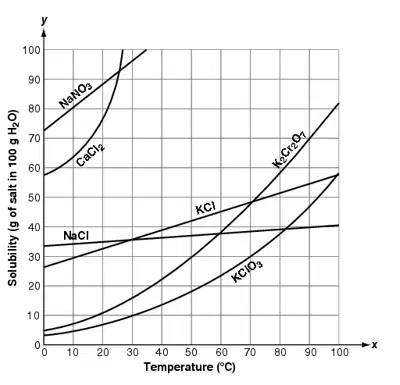
Which compound is most affected (increases the most) by raising the temperature of water?
K₂Cr₂O₇
CaCl2
KCl
Ms. Nomura mixes Kool-Aid powder and water together. This Kool-Aid + water is an example of a...
an atom
an element
a mixture
a compound
The same quantity of sugar and sand are added to a glass of water and stirred. After some time the sugar particles cannot be seen while sand particles settle down. Based on the observations, which of the following statements is TRUE?
Sugar is soluble in water while sand is not.
Sand is soluble in water while sugar is not.
Both sugar and sand are soluble in water.
Both sugar and sand are not soluble in water.
The length of a piece of zinc affects its melting point
True
False
What is the smallest particle of the element Carbon (C) that can still be classified as carbon?
Atom
Molecule
Neutron
Proton
All matter is made up of very small units called -
atoms
cells
molecules
nuclei
Which of the statements below concerning atoms is true?
All atoms are the same.
Atoms are the basic building blocks of matter.
Atoms can be viewed through a light microscope.
Modern science says the atomic structure is a model in which the electrons ---
may stream through a quantum hole
move about in a region known as the electron cloud
are easily seen using an electron microscope
If you took all of the atoms out of a desk, what would be left?
Only a pool of liquid would be left on the floor.
The desk would weigh less.
The desk would be exactly the same as it was before.
There would be nothing left of the desk.
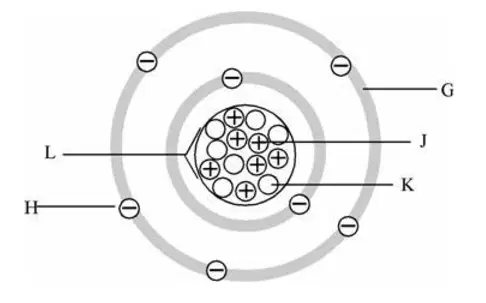
In this atomic model, what is the name of part "L"?
The proton
The electron
The nucleus
The neutron
Most of an atom is made up of -
protons
neutrons
electrons
empty space
In the past, it was thought that electrons in an atom move around the nucleus in circular orbits. This model is now thought to be incorrect because electrons -
move from an inner orbit to an outer orbit when energy is absorbed
move from an outer orbit to an inner orbit when energy is lost
do not move around the nucleus of the atom
do not move around the nucleus in circular orbits
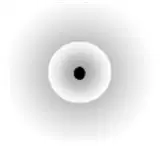
True or False: This picture illustrates our current understanding of the structure of the atom.
True
False
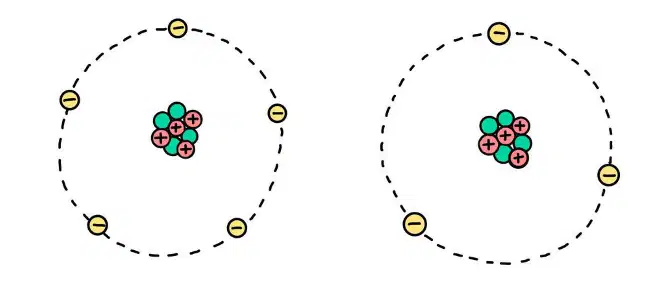
Which conclusion can be made from this image?
They are the same element.
They have the same overall charge (same net charge).
One of the atoms went through nuclear fission.
One atom is much lighter than the other atom.
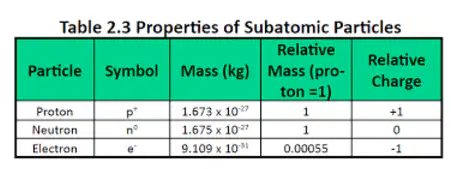
Use the chart to choose the 3 correct statements.
Electrons are much smaller than protons.
Electrons, protons, and neutrons are the same size.
Protons and neutrons have the same charge.
Protons and neutrons are about the same size.
Electrons and protons have opposite charges.
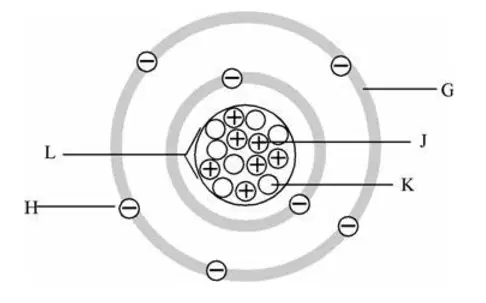
Where is most of the mass in an atom?
L
H
G
Atoms do not have any mass.
Which subatomic particle is found in the nucleus of an atom and has no charge?
Proton
Electron
Neutron
Photon
Which of the following best describes the electron cloud model of the atom?
Electrons are located in the nucleus
Electrons move freely in a region called the electron cloud
Electrons move in fixed circular orbits
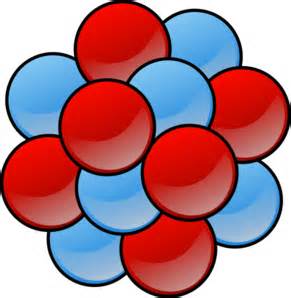


An element is identified by
its number of protons
the atomic mass
the type of charge
its number of isotopes
What is matter?
Anything that has mass and takes up space
Only solids and liquids
Only gases and plasmas
Anything that is visible
Subatomic particles with a positive charge
Electrons
Neutrons
Protons
Subatomic particles with a neutral charge
Electrons
Neutrons
Protons
What is the mass number?
the number of protons in the nucleus
the number of protons and neutrons in the nucleus
the number of neutrons in the nucleus
the number of protons and electrons in the atom
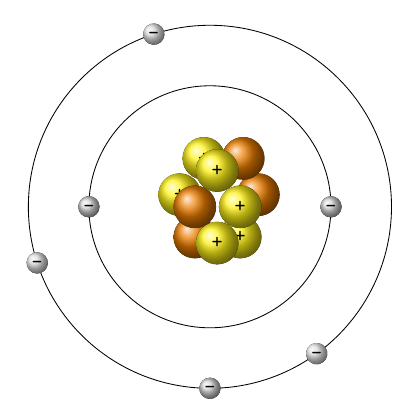
How many electrons does this atom have?
2
4
6
10
This cannot be broken down into any other substance or substances.
Pizza
Molecule
Compound
Element
Which of the following statements explains why nitrogen is classified as a pure substance and air is classified as a mixture?
Nitrogen is only one element, but air contains several elements.
Nitrogen has a higher density than air.
Nitrogen is more reactive than air.
Nitrogen undergoes phase changes, whereas air is always a gas.
Some common substances and their chemical formulas are listed in the table below. Which of these substances is an element?
Water (H2O)
Lead (Pb)
Salt (NaCl)
Sugar (C6H12O6)
When hydrogen (H) gas is burned in the presence of oxygen (O₂), dihydrogen monoxide (H₂O) is produced. The properties of dihydrogen monoxide are different than the individual properties of hydrogen and oxygen because dihydrogen monoxide is -
a compound
a mixture
a solution
an element
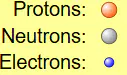
Which two nuclei belong to atoms of the same element?

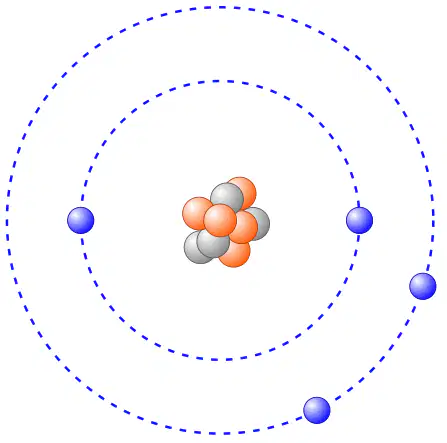
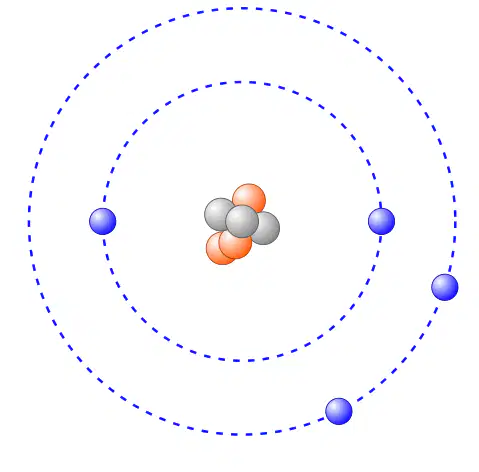
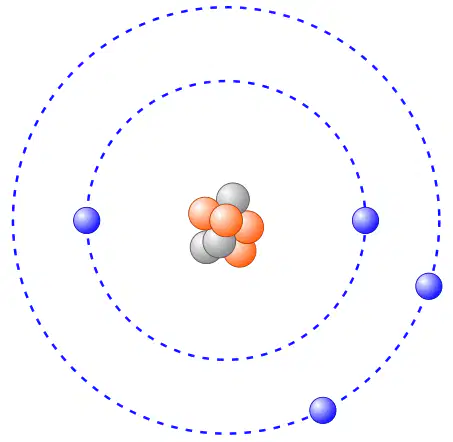
Valence electrons determine...
how an element will combine with other atoms
the charge/ionization of an atom
Its number of protons and neutrons
The total number of electron orbitals in the atom
Elements on the periodic table of elements are listed in a particular order. They are arranged by -
Atomic mass
Number of neutrons
Atomic number
Number of electrons
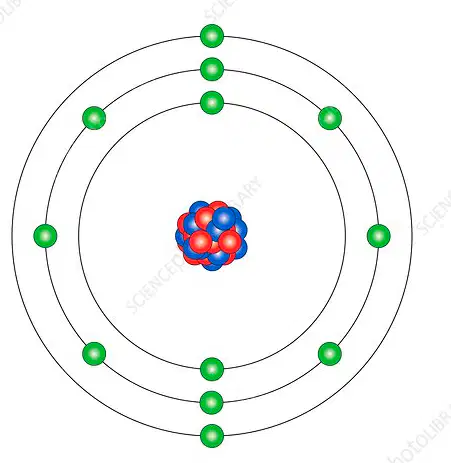
What is the atomic number of this element?
A sample of an element is malleable and can conduct electricity. This element could be -
H
C
Se
Cu
According to the periodic table, which element would be the most active in chemical reactions?
Potassium
Silicon
Gold
Argon
Which of the following Group 13 elements has the least metallic properties?
B
Al
In
Tl

Identify the element.
Ar
Mg
K
Cl
What are the parts of an atom?

The following is a picture of a...
Atom
Compound
Element
None of the abov

What subatomic particle is the arrow pointing towards?
Proton
Neutron
Electron
The columns in the periodic table are called
a metal
a nonmetal
a group/family
a period

Which element has properties similar to Calcium (Ca)?
Sodium
Magnesium
Potassium
Ions are elements with the same number of protons and a different number of neutrons.
True
False
The atomic number of an element increases from left to right across the periodic table.
True
False
Every element has an unique number of _______________.
protons
neutrons
electrons
symbols
An atom that has the same number of protons but different numbers of neutrons is an _______________.
isotope
ion
molecule
awesome atom

What are the yellow "stair-step" elements?
metals
nonmetals
metalloids

What are the blue elements (those on the right)?
metals
nonmetals
metalloids

What are the red elements (those on the left)?
metals
nonmetals
metalloids

13. According to the image, how many valence electrons does fluorine have?
7
9
1
9. Neutrons have a _______ charge.
Positive
Neutral
Negative
2. By examining the periodic table, what can you infer about elements in the same group (vertical column)?
They have similar chemical properties.
They have the same atomic mass.
They belong to the same family.
They are isotopes.
Which of the following represents an element?
H2O
H2
NaCl
CaCO3

This picture represents which of the following?
element
compound
mixture

This picture represents which of the following?
element
compound
mixture

How many DIFFERENT elements are represented in this compound?
3
4
5
6
What cannot be broken down into other substances?
Compound
Mixture
Solids
Element

