
 Worksheets
Yr 8 Chemistry revision KS3
Total questions: 80
Worksheet time: 43mins
Is glass breaking a chemical or physical change?
Boiling Water
Physical Change
Chemical Change
Match the following:
Physical Changes
Changes that change the appearances of the substance, not is identify.
Chemical Changes
changes that cause a substance to change into a new substance
Freezing, Grinding, Chopping, Tearing, Evaporating
Examples of Physical Changes
Combustion, Rusting, Burning, Corroding
Examples of Chemical Changes
where are the products in an equation?
The products are on the right side of the equation
The products are on the left side of the equation
Combining substances to form new substances is called
Chemical reaction
Physical reaction
Exothermic reaction
Endothermic reaction
Galvanizing is a process of:
Applying a Zinc coating to bare steel
Washing the body with the phosphate coating
dipping a body in E-COAT
Chemically etching primer to steel
Which of the following is / are examples of sacrificial protection against rusting?
Iron object coated with tin
Underground iron pipes connected to magnesium bars
Iron railings coated with paint
Which of the following is / are examples of sacrificial protection against rusting?
(1) Iron object coated with tin
(2) Underground iron pipes connected to magnesium bars
(3) Iron railings coated with paint
(1) only
(2) only
(1) and (3) only
(2) and (3) only

What is the chemical nature of rust?
iron (II) oxide
hydrated iron (II) oxide
iron (III) oxide
hydrated iron(III) oxide
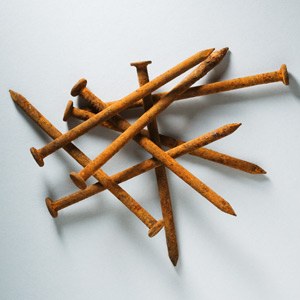
Is this an example of corrosion?
Yes
No
What is an ore?
A combination of carbon and iron
A combination of metal and other elements
A combination of elements and oxide
A combination of metal and carbon
Which of the following methods can prevent rusting?
applying grease on objects made from iron
painting steel objects
cover steel and iron objects with a damp cloth
cover steel objects with non-rusty material

An investigation was carried out by year 5 pupils to study the factors that cause rusting. What is the function of anhydrous calcium chloride in this investigation?
To protect the iron nail
To increase the rate of the rusting process
To absorb the moisture in the air
To supply oxygen in the test tube

Which nail rusts first?
Nail in test tube A
Nail in test tube C
Nail in test tube E
Nail in test tube F

How do you prevent this food can from rusting?
painting
apply oil or grease
coating with plastic
plating with non rusty metal
What element rusts?
carbon
manganese
iron
potassium
What two things cause Iron to Rust ?
Air and Oxygen
Water and Carbon dioxide
Oxygen and Water
Carbon dioxide and Air
Neutralisation is a ------------ change
chemical reversible
chemical irreversible
Physical
Cannot say
Complete the word equation below:
Acid + alkali --> ............... + water
water
salt
gold
metal

The image shows a pH scale. Which option indicates a strong alkali?
a
b
c
d

The image shows a pH scale. Which option indicates a strong acid?
a
b
c
d
What is the substance with a neutral pH of 7?
Milk
Water
Orange Juice
Blood
Which of these substances is an acid?
Ammonia
Oven cleaner
Vinegar
Soap

A purple colour when using universal indicator indicates the solution is _______________.
neutral
acidic
alkali
blackcurrant juice
What is the range of the pH scale?
0 -14
1 - 14
1 - 6
12 - 14
An alkali can react with an acid. This process is known as?
balancing
acidification
combustion
neutralisation
What type of solution has a pH of 12?
Neutral
Acidic
Alkali
What is the percentage of oxygen in the earth's atmosphere?
10%
15%
20%
25%
What is the effect of oxygen on a lighted splint?
Oxygen extinguishes a lighted splint
Oxygen makes a lighted splint burn even more
Oxygen extinguishes a lighted splint with a pop sound
Oxygen does not have any effect on a lighted splint
What is formed when copper reacts with oxygen?
carbon dioxide and water
carbon dioxide
copper (II) oxide
copper dioxide
The percentage of oxygen in the atmosphere is 20%.
How many cm3 of oxygen would you find in 50 cm3 of air?
5 cm3
10 cm3
15 cm3
20 cm3

In the experiment shown above, when should we stop passing the air in the syringe back and forth over the heated copper?
When all the copper turns black
When the volume of air remains the same in the syringes
When the copper glows inside the tube
We just pass it 6 times back and forth
______________ is a combustible gas.
Nitrogen
Oxygen
Argon
Match the chemical symbol to the element...
carbon
C
nitrogen
N
oxygen
O
sulphur
S
magnesium
Mg
Choose correct word equation
Acid + Carbonate ----->
salt + hydrogen
salt + water + carbon dioxide
salt + water
salt + carbon dioxide
How do you know when a reaction between a metal and an acid is complete?
All the metal is dissolved
There is a color change in the acid
Bubbles stop forming!
All the acid evaporates


Which of the following is the simplest form of substance?
solution
compound
element
mixture
When one or more substance is combined it is called __________________.
compound
element
mixture
solution
Which of the following statements describes an element?
It contains only one kind of atom.
It can be decomposed by ordinary chemical means.
It is composed of atoms of two or more elements that bond together.
It has unique properties that are different from the properties of its individual elements.
Which of the following statements describes a compound?
It contains only one kind of atom.
It can be separated by physical means.
It cannot be decomposed into simpler types of substances.
It consists of atoms of two or more different elements bond together.
What are the chemicals required to produce oxygen in the lab?
Water
Hydrogen peroxide
manganese
manganese (IV) Oxide
What type of reaction is used to prepare oxygen in the lab?
Displacment
Decomposition
Precipitation
Synthesis
The catalyst used to prepare oxygen is:
manganese (IV) oxide
Salt
Sugar
Hydrogen peroxide
Which element forms an oxide that produces the most acidic solution
Lithium
Carbon
Magnesium
sulphur
What colour are the oxides of lithium and magnesium
white and black
red and pink
grey and black
grey and white
Metals react with acids to produce a gas
Carbon dioxide
Nitrogen
Hydrogen
Oxygen
Colour of copper sulphate solution is
Green
Blue
Black
White
Colour of iron sulphate is
Blue
Green
Black
None of the above
Red litmus paper turns blue when it is dipped in
Acidic solution
Basic solution
Neutral solution
None of the above
Which test is for carbon dioxide?
Re-lights a glowing splint
Limewater turns cloudy
Squeaky pop
Litmus turns red then whit

Which gas am I testing for?
Carbon dioxide
Chlorine
Hydrogen
Oxygen
In a chemical change, new substances are formed, for example
heating glass and bending it
melting an ice
burning of wood
boil water

What is this a diagram of?
(a)
What does anhydrous mean?
without water
with water
What does hydrated mean?
without water
with water
What colour is anhydrous copper sulphate?
white
blue
what colour is hydrated Copper Sulphate?
White
Blue
What are two reactions that can be used to produce copper sulfate?
Copper Oxide + Sulphuric Acid
Copper Carbonate + Sulphuric Acid
Copper Oxide + Nitric Acid
Sodium Carbonate + Hydrochloric Acid
Copper Carbonate + Hydrochloric Acid
What would be sensible precautions to reduce the risks of this experiment?
Wear goggles
Tie long hair back
Wash hands afterwards
Spray equipment with water to cool it down
Do the experiment standing up with stool pushed under table.
In the thermal decomposition of calcium carbonate:
Calcium carbonate --> Calcium oxide + ?
HINT: gas
oxygen
calcium
carbon monoxide
carbon dioxide
When Magnesium ribbon is ignited using a candle flame, it burns with a __________.
sparkling red light
dull yellow light
bright green light
brilliant white light
Which is not a way to prevent rusting?
oiling the surface of metal
heating the surface of metal
painting the surface of metal
greasing the surface of metal

pure element

pure compound

mixture of elements

mixture of compounds

mixture of elements and compounds
Elements only


A pure substance is made of two or more elements chemically combined is a(n)
element
compound
mixture
Is SULFUR (S) an element or a compound?
ELEMENT
COMPOUND

