
NEW
Font size
 Worksheets
Stirred Tank Reactor Experiment Quiz
Total questions: 20
Worksheet time: 15mins
What is the purpose of the experiment in the stirred tank reactor?
To study the effect of temperature on polymerization
To investigate the reaction kinetics of saponification
To analyze the crystallization of sodium hydroxide
What is the chemical equation for the saponification reaction in the experiment?
CH3COOC2H5 + NaOH → CH3COONa + C2H5OH
NaCl + H2O → NaOH + Cl2
C6H12O6 + O2 → CO2 + H2O
What are the three types of impellers tested in this experiment?
Axial, Radial, Tangential
Paddle, Helical, Propeller
Circular, Blade, Spiral
What is the role of baffles in the reactor?
To prevent vortex formation and enhance mixing
To reduce the power consumption of the impeller
To increase the reaction temperature
Which of the following is used to monitor the progress of the reaction?
Phenolphthalein indicator and titration with HCl
A pH meter
Gas chromatography
How is the effect of stirring speed studied in the experiment?
By varying the solution viscosity
By using speeds such as 100, 150, and 200 rpm
By changing the temperature of reactor
Which parameter is analyzed using the titration data?
Reaction rate constant
Activation energy
Heat transfer coefficient
What is the concentration of sodium hydroxide and ethyl acetate used in the experiment?
0.01 M
0.02 M
0.03 M
What does an unbaffled reactor typically produce during mixing?
Uniform mixing
A central vortex
High turbulence
What is the expected effect of using a baffled reactor?
Increased vortex formation
Enhanced uniformity in mixing
Reduced reaction rate
What type of flow is generated by radial impellers?
Tangential flow
Axial flow
Radial flow
Which type of impeller is most effective for mixing high-viscosity fluids?

Marine propeller

Pitched-blade turbine

Rushton Turbine (Six flat blades)

Helical ribbon impeller
What safety precautions are emphasized in the experiment?
Wearing gloves, goggles, and lab coats
Keeping flammable materials near the reactor
Using open flames for heating
What is the significance of the Reynolds number in this experiment?
It measures the mixing time of reactants
It determines the flow and mixing characteristics
It predicts the temperature of the reactor
What happens if the stirring speed is too high?
Improved reaction efficiency indefinitely
Excessive turbulence with no significant benefits
Reduced reaction rate
What is the purpose of calculating the reaction rate constant?
To determine the speed of the reaction under specific conditions
To find the equilibrium concentration of reactants
To predict the product yield
What tool is used to measure stirring speed in the reactor?
pH meter
Stopwatch
Speed measurement device
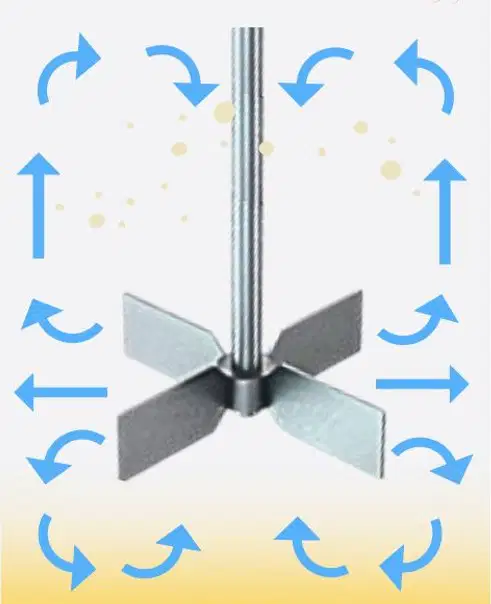
What type of flow pattern is created by the impeller shown in the image?
Axial flow
Radial flow
Tangential flow
What is the expected trend in the concentration of NaOH during the saponification reaction?
It decreases over time
It increases over time
It remains constant
What method is used to determine the reaction rate constant k?
By calculating the Reynolds number
By plotting NaOH concentration versus time
By observing the vortex formation

