

Wayground logo

Free Printable Worksheets

Font size

S
M
L
XL
Worksheets

Unit 3 Space TEKS 7.9ABC

Total questions: 52

Worksheet time: 31mins
Name
Class
Date
1.

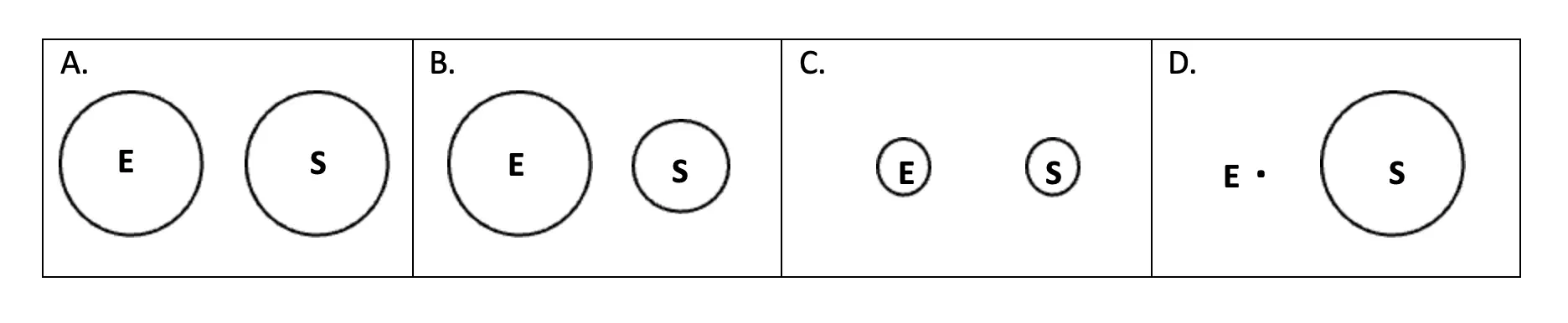
Which picture shows the Earth and the Sun to scale?

a)

Option A

b)

Option B

c)

Option C

d)

Option D

2.

When scientists look for other planets with life on them, they look for planets in the __________________.

a)

Big Bang

b)

Oxygen range

c)

Solar Zone

d)

Habitable Zone

3.

How does the temperature of inner planets compare to the outer planets?

a)

The inner planets are cooler because they are close to the Sun

b)

The outer planets are cooler because they are far from the Sun

c)

The inner planets are warmer because they are far from the Sun

d)

The outer planets are warmer because they are close to the Sun

4.

Which model of the Solar System do scientists currently accept?

a)

Geocentric-Earth Centered

b)

Heliocentric-Sun Centered

c)

Juliacentric-Jupiter Centered

d)

Redshift

5.

A cloud of gas and dust is called a....

a)

Solar System

b)

Nebula

c)

Galaxy

d)

Red Giant

6.

What is the largest planet?

a)

Jupiter

b)

Saturn

c)

Uranus

d)

Neptune

7.

This marks the boundary of our solar system.

a)

Asteroid Belt

b)

Kuiper Belt

c)

Comet Belt

d)

Oort Cloud

8.

What belt separates the Rocky Planets and the Gas Giants ?

a)

Kuiper Belt

b)

Asteroid Belt

c)

Comet Belt

d)

Joivian Belt

9.

Pluto and Ceres are both dwarf planets found in our solar system. Pluto is found in the Kuiper belt and Ceres is found in the asteroid belt.

a)

True

b)

False

10.
A force of attraction between any two objects is called _____________.
a)
static electricity 
b)
rotation
c)
gravity
d)
orbit
11.
Besides Pluto, which planet is the furthest planet from the sun?
a)
Mercury
b)
Earth
c)
Neptune
d)
Uranus
12.
What is similar about all of the Outer Planets?
a)
small
b)

large, no true surface

c)
few moons
d)
takes a short amount of time to go around the sun
13.

Which planet's average temperature make it the hottest planet in the solar system?

a)

Mercury

b)

Venus

c)

Earth

d)

Mars

14.
What celestial body is made of ice and cosmic dust?
a)
Meteor
b)
Meteoroid
c)
Asteroid
d)
Comet
15.
Put the planets in order from the sun.
a)

Mercury, Venus, Mars Earth, Jupiter, Saturn, Uranus, Neptune

b)

Mercury, Venus, Earth, Mars, Jupiter, Saturn, Neptune, Uranus

c)

Mercury, Venus, Earth, Mars, Jupiter, Saturn,  Uranus, Neptune

d)

Mercury, Venus, Earth, Mars, Saturn, Jupiter, Neptune, Uranus

16.
What is true of all planets in our Solar System?
a)
They are large bodies in space that orbit the Sun
b)
Planets do not move, only stars move
c)
Planets make their own light
d)
Planets are larger than stars
17.
Planets form by a process called...
a)
accretion
b)
dark matter interactions
c)
electromagnetic radiation
d)
sun-dropping
18.
An irregular, rocky body that orbits the sun but is too small to be classified as a planet is known as a:
a)
asteroid
b)
meteor
c)
comet
d)
dwarf planet
19.

The planets in the solar system are so far apart that scientists measure the distances between them in

a)

miles (mi)

b)

kilometers (km)

c)

astronomical units (AU)

d)

inches (in)

20.
A __________ is a chunk of ice & dust that has a bright head & a long narrow tail.
a)
asteroid
b)
planet
c)
meteoroid
d)
comet
21.

The more distance between two objects, the __________ gravity they will have.

a)

more

b)

less

22.

•a force of attraction between objects that is due to their masses and the distances between them.

a)

power

b)

gravity

c)

force

d)

motion

23.
What are moons?
a)
Planets that have their own unique features
b)
Natural satellites that orbit planets and dwarf planets
c)
Comets made up of ice, dust, and rock
d)
Small, rocky objects that orbit the Sun
24.
What are dwarf planets?
a)
Planets that are smaller than Earth
b)
Planets that are not visible from Earth
c)
Planets that do not have moons
d)
Smaller than planets and do not have the same gravitational pull as planets
25.
Which group of planets consists mostly of rock and metal?
a)
The inner planets
b)
The outer planets
c)
Both groups have the same composition
d)
None of the above
26.
What is the main celestial body in the Solar System?
a)
The Sun
b)
The Moon
c)
Jupiter
d)
Mars
27.
What influences the motion of the Solar System?
a)
The magnetic field of the Sun
b)
The gravitational pull of the Sun only
c)
The gravitational pull of the Sun and other celestial bodies in the Solar System
d)
The rotation of the planets
28.
Which planets are considered the outer planets of the Solar System?
a)
Mercury, Venus, Earth, Mars
b)
Pluto, Eris, Haumea, Makemake
c)
Jupiter, Saturn, Uranus, Neptune
d)
Ceres, Vesta, Pallas, Hygiea
29.
What makes the Solar System complex?
a)
The distance between planets
b)
The variety of celestial bodies
c)
The size of the Sun
d)
The number of planets
30.
Which planets are considered the inner planets of the Solar System?
a)
Mercury, Venus, Earth, Mars
b)
Jupiter, Saturn, Uranus, Neptune
c)
Pluto, Eris, Haumea, Makemake
d)
Ceres, Vesta, Pallas, Hygiea
31.
What is the largest object in the Solar System?
a)
The Moon
b)
Jupiter
c)
The Sun
d)
Mars
32.
Where are asteroids mostly found?
a)
Between Saturn and Uranus
b)
Between Earth and Mars
c)
Between Mars and Jupiter
d)
Between Jupiter and Saturn
33.
What is the source of energy for all the planets and other celestial bodies in the Solar System?
a)
Mars
b)
The Earth
c)
The Sun
d)
The Moon
34.
What is the role of the Sun's gravity in the Solar System?
a)
It causes the planets to collide
b)
It creates new celestial bodies
c)
It keeps the planets in orbit
d)
It has no effect on the Solar System
35.
Which group of planets consists mostly of gas and ice?
a)
The outer planets
b)
The inner planets
c)
Both groups have the same composition
d)
None of the above
36.

What dwarf planet was downgraded from planetary status in 2006?

a)

Mercury

b)

Uranus

c)

Neptune

d)

Pluto

37.

The surface of this planet appears red due to oxidation of iron in the rocks.

a)
Mercury
b)
Mars
c)
Pluto
d)
Venus
38.
Saturn's rings are made of chunks of 
a)
volcanoes
b)
ice and rock
c)
nitrogen and helium 
d)
ice and 
39.

What is the age of the Sun?

a)

Nearly 5 billion years old.

b)

Nearly 500 million years old.

c)

Nearly 1 billion years old.

d)

Nearly 10 billion years old.

40.

How many known planets are in our solar system?

a)

4

b)

7

c)

8

d)

9

41.

Which of the small solar system objects does not orbit the sun?

a)

comet

b)

dwarf planet

c)

asteroid

d)

meteor

42.

Which one of the following describes a meteoroid?

a)

A space rock that hits the Earth's surface.

b)

A small solar system object that is made up of small pieces of asteroids or comets.

c)

A space rock that enters the Earth's atmosphere

d)

A loose collection of rock and ice

43.

Where can most of the asteroids be found?

a)

In the Oort cloud

b)

In the area between Mars and Jupiter

c)

In the Kuiper Belt

d)

Out past Pluto

44.

A small solar system object that enters the Earth's atmosphere and creates streaks of light is called a _________

a)

comet

b)

meteor

c)

meteorite

d)

Meteoroid

45.

Where can most of the dwarf planets be found?

a)

Kuiper Belt

b)

Oort Cloud

c)

Asteroid Belt

d)

Outside of our solar system

46.
Meteorites...
a)
 hit the ground
b)
burn up completely in the atmosphere
c)
debris from asteroids/comets that float around in space
47.
What is the habitable zone?
a)
The zone where life is most abundant
b)
The zone where the atmosphere is thickest
c)
The zone where the Sun is brightest
d)
The zone where liquid water exists
48.
What is the purpose of Earth's atmosphere?
a)
To control the climate
b)
To protect against solar radiation
c)
To generate heat
d)
To sustain life
49.
What is the significance of the 'Goldilocks' Zone'?
a)
It is the zone where life is most abundant
b)
It is the zone where the atmosphere is thickest
c)
It is the zone where the Sun is brightest
d)
It is the zone where conditions are just right for life
50.

What does most every living thing need to survive?

a)

Steam

b)

Ice

c)

Plasma

d)

Liquid water

51.

The most abundant gas in the atmosphere is __________. Then __________ and argon. Trace gases, including carbon __________ are last.

(a)  

52.

Almost 99% of Earth's atmosphere is made up of two gases. What are the two gases and the percents of each?

a)

21% oxygen and 78% nitrogen

b)

21% water vapor and 78% oxygen

c)

21% nitrogen and 78% oxygen

d)

21% carbon dioxide and 78% oxygen
