
 Worksheets
Concept Check 3.4-3.5
Total questions: 38
Worksheet time: 34mins
Linda does four times as much work as James does and in one-third the time. Linda’s power output is ________.
four times James’ power output
one-third as much as James’ power output
twelve times James’ power output
the same as James’ power output
A new conveyor system at the local packaging plan will utilize a motor-powered mechanical arm to exert an average force of 890 N to push large crates a distance of 12 meters in 22 seconds. Determine the power output required of such a motor.
490 Watts
40. Watts
11 x 103 Watts
0.55 Watts
A weightlifter lifts a mass of weight m to a height h in time t. Which of the following represents the power exerted by the weightlifter during the lift?
mght
mg/(ht)
mgh/t
ht/(mg)
Power is the (a) at which work is done. It is measured in (b) . One watt is equal to (c) .

A 1500 kg car accelerates from 0 to 60 mph (27 m/s) in 7 seconds. What is the power of the car?
28, 350 watts
3.857 watts
78,107 J
78,107 watts


A satellite X of mass m is in a concentric circular orbit of radius R about a planet of mass M.
What is the kinetic energy of X?


Satellites X and Y orbit the Earth at distances R and 4R respectively, as shown in the diagram.
Which statement is incorrect?
The speed of Y is greater than the speed of X
The time period of Y is greater than the time period of X
The potential energy of Y is greater than the potential energy of X.
The gravitational force acting on Y is less than the gravitational force acting on X.

A satellite X is in a circular orbit of radius r about the centre of a spherical planet of mass M. Which line, A to D, in the table gives correct expressions for the centripetal acceleration a and the speed v of the satellite?
A
B
C
D
A satellite orbiting the Earth moves to an orbit which is closer to the Earth.
Which line shows correctly what happens to the speed of the satellite and to the time it takes for one orbit of the Earth?
Speed of satellite: decreases
Time For One Orbit Of Earth: decreases
Speed of satellite: decreases
Time For One Orbit Of Earth: increases
Speed of satellite: increases
Time For One Orbit Of Earth: decreases
Speed of satellite: increases
Time For One Orbit Of Earth: increases
Two satellites P and Q, of equal mass, orbit the Earth at radii R and 2R respectively. Which one of the following statements is correct?
P has less kinetic energy and more potential energy than Q.
P has less kinetic energy and less potential energy than Q.
P has more kinetic energy and less potential energy than Q.
P has more kinetic energy and more potential energy than Q.
Two satellites, P and Q, of the same mass, are in circular orbits around the Earth. The radius of the orbit of Q is three times that of P. Which one of the following statements is correct?
The kinetic energy of P is greater than that of Q.
The weight of P is three times that of Q.
The time period of P is greater than that of Q.
The speed of P is three times that of Q.
Which of the following are units for power? Select all that apply.
Watts (W)
Joules (J)
Joules/second (J/s)
Newton-meters/second: (N*m)/s
Which of the following are acceptable equations for power? Select all that apply. (HINT: unit analysis helps)
P=ΔtW
P = ΔtΔE
P = F⋅v
P=ΔE
P=F⋅Δxcosθ
A force of 200 N is required to keep an object sliding at a constant speed of 2 m/s across a rough floor. How much power is being expended to maintain this motion?
50 W
100 W
200 W
400 W

How much power is generated by Ashley (50 kg) running up a 6 m flight of stairs in 5 seconds?
60 W
62 W
600 W
1500 W

How far does a 18,210.9 newton car go if it it exerts 91,054.5 watts of power in 20 seconds.
100 meters

How much power is used if a force of 35 Newtons is used to push a box a distance of 10 meters in five seconds? (Hint: Solve for work first. This is a 2-step problem.)
70 W
3.5 W
7 W
350 J


If it took 9 seconds for the object to move 6 meters, what's the power?
81 W
27 W
3 W
6 W
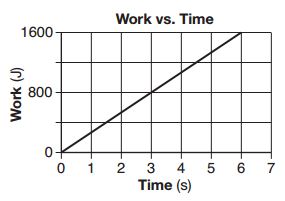
How much power was generated from 0-4 seconds?
1100 W
4 W
267 W
1600 W

On a work vs time graph, you can calculate the power by
the area.
the y-axis.
the y-intercept.
the slope.
Which of the following is assumed for calculating escape velocity?
The object is within a dense atmosphere
No other forces are acting on the object
Other gravity-producing objects exist
The object is propelled by engines
Why is escape velocity more accurately described as a speed rather than a velocity?
It is independent of direction
It varies with the object's mass
It depends on the direction of the object
It only applies at specific altitudes
Which of the following factors affects the escape velocity of an object from the surface of the earth?
Mass of earth
Gravity of satellite
Acceleration due to gravity
Mass of object
The escape velocity of a sphere of mass m from earth having mass M and radius R is given by
RGM
R2GM
2RGM
4GM/R
The escape velocity from the earth is about 11 km/second. The escape velocity from a planet having twice the radius and the same mean density as the earth, is
11km/s
5.6km/s
22km/s
55.6km/s

If g be the acceleration due to gravity at the earth surface, then what will be the increase in potential energy if object of mass m is raised by its radius R?
1/2mgR
2mgR
mgR
1/4mgR
The escape velocity on a planet is v. If the radius of the planet contracts to 1/4th of present value without any change in its mass, The escape velocity will be
halved
doubled
quadrupled
one- fourth
The velocity with which a projectile , must be fired so that it escapes earth's gravitation, does not depend on
mass of the earth
mass of projectile
radius of the projectile orbit
gravitational constant
ve and vp denotes the escape velocity from the earth and another planet having twice the radius and the same mean density as the earth. Then
vp= ve
vp = 2ve
vp= 4 ve
2vp= ve

