wayground logo

Free Printable Worksheets

Font size

S
M
L
XL
Worksheets

G6 Physics - Work and Energy

Total questions: 60

Worksheet time: 3hrs 20mins

Name
Class
Date
1.

What is the correct unit for energy?

a)

meters (m)

b)

kilogram meters per second (kg m/s)

c)

Newtons (N)

d)

Joules (J)

2.
The faster an object moves, the ________ kinetic energy it has. 
a)
more
b)
less
c)
none of the above
d)
all of the above 
3.
Gravitational potential energy depends on the ________ and ________ of the object. 
a)
Height and mass
b)
Friction and movement
c)
Mass and Movement
d)
Height and Friction 
4.

What is the equation for calculating gravitational potential energy

a)

mv

b)

1/2 mv^2

c)

mgh

d)

Ft

5.

What is the equation for calculating kinetic energy?

a)

mv

b)

1/2 mv^2

c)

mgh

d)

Ft

6.

Which passenger has the most potential energy?

a)

A

b)

B

c)

C

d)

D

7.

The formula for calculating the gravitational potential energy in an object is shown above. GPE will get bigger if

There is more than 1 correct answer

a)

the object has a greater mass

b)

the object is higher above the ground

c)

the object is on the ground

d)

the object is smaller

8.

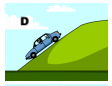
The formula for calculating the gravitational potential energy in an object is shown above. Which object will have the largest value for its GPE
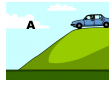
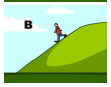
a)
b)
c)
d)
9.

The formula for calculating the kinetic energy in an object is shown above. The amount of KE a body has depends on

a)

its speed

b)

its mass AND its speed

c)

its mass

d)

its height above the Earth AND its mass

10.

The formula for calculating the kinetic energy in an object is shown above. Which object will have the largest value for its KE

a)
b)
c)
d)
11.

The formula for calculating the kinetic energy in an object is shown above. KE will get bigger if

There is more than 1 correct answer

a)

the object has a greater mass

b)

the object is moving quickly

c)

the object is moving slowly

d)

the object has a smaller mass

12.

Which is the best example that something has kinetic energy?

a)

a car parked on a steep hill

b)

a tennis ball rolling across the court

c)

a picture hanging on the wall

d)

a piece of coal before it's burned

13.

Conservation of energy means that

a)

energy can be created but not destroyed

b)

energy can be destroyed but not created

c)

energy can both be created and destroyed

d)

energy can neither be created nor destroyed

14.

If these are all moving at the same speed, the vehicle with the greatest KE would be

(Think about their sizes)

a)
b)
c)
d)
15.

This is energy that is stored for later use.

a)

kinetic energy

b)

potential energy

c)

motion/mechanical energy

d)

radiant energy

16.
The energy of motion.
a)
Potential Energy 
b)
Kineitc Energy 
c)
Mechanical energy 
d)
Transfer
17.
Stored energy
a)
Potential Energy 
b)
Kinetic Energy 
c)
Mechanical energy 
d)
Transfer
18.
Energy an object has due to its position or height.
a)
Potential Energy 
b)
Kinetic  Energy 
c)
Mechanical energy 
d)
Transfer
19.
The sum of the potential and kinetic energy. 
a)
Potential Energy 
b)
Kinetic  Energy 
c)
Mechanical energy 
d)
Transfer
20.
A scientific law stating that energy can’t be created or destroyed. It can only be transformed.
a)
Law of Conservation of matter.
b)
Law of Conservation of mass. 
c)
Law of Conservation of energy.
d)
Law of Conservation of momentum 
21.
The movement of energy from one object to another.
a)
Transform energy  
b)
Kinetic Energy 
c)
Mechanical energy  
d)
Transfer
22.
The change of energy from one form into another form.
a)
Kinetic energy  
b)
Transfer 
c)
Mechanical energy  
d)
Transform.
23.
If the potential energy is 45 J (joules)and the kinetic energy is 50 J, what is the mechanical energy? 
a)
5 J
b)
45 J
c)
50 J
d)
95 J
24.
Where  is the potential energy the greatest?
(enlarge the picture if needed)
a)
1
b)
2
c)
3
d)
4
25.
Where  is the kinetic energy the greatest?
(enlarge the picture if needed)
a)
1
b)
2
c)
4
26.

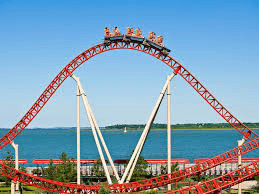
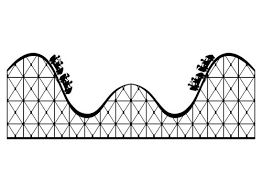
When a roller coaster is at the top of a hill it has

a)

high potential energy

b)

high kinetic energy

c)

low potential energy

d)

equal amounts of kinetic and potential energy
27.

When a roller coaster is at the bottom of a hill it has

a)

high potential energy

b)

high kinetic energy

c)

low kinetic energy

d)

equal amounts of kinetic and potential energy

28.

The sum of potential energy and kinetic energy equals

a)

work

b)

transformation

c)

total energy

d)

mechanical energy

29.

What is potential energy?

a)

The stored energy of an object due to its position or condition.

b)

The energy that an object has due to its motion.

c)

The energy an object has due to its speed.

d)

The energy an object has due to its volume.

30.

What is kinetic energy?

a)

The stored energy of an object due to its position or condition.

b)

The energy that an object has due to its motion.

c)

The energy an object has due to its speed.

d)

The energy an object has due to its volume.

31.

When does an object have no kinetic energy?

a)

When it is at rest

b)

When it is moving very slowly

c)

When the only force acting on it is gravity

d)

When it has no electrical charge

32.

When does a yo-yo have the most potential energy?

a)

when it is at its highest point

b)

when it is at its lowest point

c)

when it is moving between its highest and lowest point

d)

when it is moving at its top speed

33.

Calculate the potential energy of a car with a mass of 2,500 kg that is on a hill 100 meters above sea level. (g = 10 Nkg-1)

a)

250,000 J

b)

2,500,000 J

c)

25,000,000 J

d)

250 J

34.

Lilly's cat ran through your yard. The cat has a mass of 5 kg. He is running at a speed of 3 m/s. What is the kinetic energy of the cat as he runs? (KE = 1/2mv2)

a)

8.5 J

b)

45 J

c)

7.5 J

d)

22.5 J

35.

Alice kicks a soccer ball with a mass of 2.1 kg. The ball leaves the ground moving 30 meters per second. What is the kinetic energy of the soccer ball? (KE = 1/2mv2)

a)

567 J

b)

900 J

c)

945 J

d)

30 J

36.

If the 0.3 kg marble was moving at 6 m/s at the bottom of the ramp, how much kinetic energy did the marble have? (KE = 1/2mv2)

a)

5.4 J

b)

1.8 J

c)

3 J

d)

6 J

37.

If the 1.2 kg basketball rolls at 3 m/s, what is it's kinetic energy? (KE = 1/2mv2)

a)

2.7

b)

5.4

c)

3.6

d)

9

38.

____________ is the ability to do work. 

a)
Energy 
b)
Force 
c)
Friction
d)
Motion
39.
As a pendulum swings from its highest to lowest position, what happens to its kinetic and potential energy? 
a)
Both the potential energy and kinetic energy decrease
b)
The potential energy decreases while the kinetic energy increases 
c)
The kinetic energy decreases while the potential energy increases 
d)
Bothe the potential energy and kinetic energy increase 
40.

The ability to do work

a)

Power

b)

Energy

c)

Force

d)

Joule

41.

Work equals force times

a)

matter

b)

weight

c)

power

d)

displacement

42.

What is the formula of work

a)

w= S*D

b)

W=P*B

c)

W=F*D

d)

W=F*G

43.

The work done by a given force depends on two factors namely.

a)

The objects position

b)

Amount of force applied

c)

If object is still

d)

Displacement of an object

44.
The SI unit of work is?
a)
Joules
b)
Watts
c)
Newtons
d)
meters
45.

In which scenario is work = 0 J ?

a)

Pushing a stationary wall

b)

Pulling a trolley car

c)

Pushing a book across the table

d)

Dropping a set of keys from a height, h.

46.
Calculate the work needed to raise a 3 kg cat up to a height of 4 meters.
a)
12 J
b)
0 J
c)
120 J
d)
1.22 J
47.
When my velocity triples, my kinetic energy increases by ______ times.
a)
9
b)
 3 
c)
1.5
d)
4.5
48.
What is the unit used to measure work?
a)
Joule
b)
Watt
c)
Newton
d)
Pascal
49.
If W=Fd
Then how much work is done if it takes 20N to move a box 10 meters

a)
0
b)
2
c)
20
d)
200
50.
The _______ is the SI unit of energy.
a)
watt
b)
joule
c)
ampere
d)
volt
51.
A 5 kg drone cruises forward at 15 m/s. Its total mechanical energy is 1125 J. Ignoring air resistance, how high above the ground is the drone?
a)
9.8 m
b)
11.5 m
c)
13 m
d)
15 m
52.
A 60 kg snowboarder glides at 10 m/s with a total mechanical energy of 15000 J. What is the rider’s height above the ground?
a)
18.0 m
b)
20.4 m
c)
22.0 m
d)
25.0 m
53.
A 0.4 kg soccer ball is sailing at 18 m/s and is 5 m above the field. What is its total mechanical energy?
a)
80.0 J
b)
84.4 J
c)
88.0 J
d)
90.0 J
54.
A 1 kg toy rocket goes straight up with 300 J of kinetic energy. What maximum height does it reach?
a)
28 m
b)
30 m
c)
30.6 m
d)
32 m
55.
A 4 kg package falls from a delivery drone hovering 30 m above the ground. Just before impact, what is its speed (ignore air resistance)?
a)
20.0 m/s
b)
22.0 m/s
c)
24.2 m/s
d)
26.0 m/s
56.
A 0.6 kg water bottle slips off a 45 m cliff. What is its speed just before hitting the ground?
a)
27.0 m/s
b)
28.5 m/s
c)
29.7 m/s
d)
31.0 m/s
57.
A 0.25 kg apple is tossed straight up at 6 m/s from a picnic table. What maximum height does it rise above the release point?
a)
1.5 m
b)
1.8 m
c)
2.0 m
d)
2.2 m
58.
A 5 kg bowling ball is lifted and launched straight upward at 4 m/s by a mechanical arm. What maximum height does it reach?
a)
0.6 m
b)
0.8 m
c)
0.9 m
d)
1.0 m
59.
A 0.5 kg bird dives from rest off a branch 20 m above the ground. Neglecting air resistance, what speed does it have just before reaching the ground?
a)
18.0 m/s
b)
19.0 m/s
c)
19.8 m/s
d)
21.0 m/s
60.
A 2.5 kg metal ball is dropped from a factory tower 50 m tall. What is its speed just before impact (ignore air resistance)?
a)
28.0 m/s
b)
30.0 m/s
c)
31.3 m/s
d)
34.0 m/s