
 Worksheets
Air Tech - PPL POF BIG REVISION
Total questions: 64
Worksheet time: 36mins
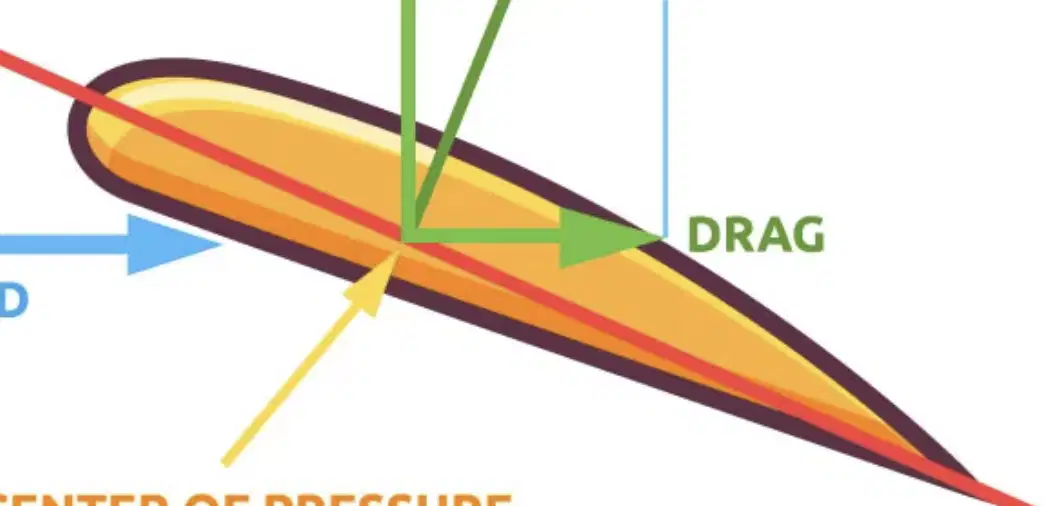
What does the red line represent in the image?
Lubber line
Camber line
Chord line
Straight line
Who's created this theorem?
"In the streamline flow of an ideal fluid the sum of all energies present must remain constant"
Bernoulli
Boyle
Charles
Newton
The laminar flow around an aerofoil extends how far?
2mm
20mm
20cm
2cm
What is Newtons Second Law?
F = na
The external force acting on a body is proportional to the product of it’s mass and the acceleration produced by the force
The external force acting on a body is inversely proportional to the product of it’s mass and the acceleration produced by the force
Every object continues in its state of rest or of uniform motion in a straight line, unless acted upon by an external force
As airflows in a Venturi what happens to the air?
Select all that apply
static pressure decreases
temperature reduces
dynamic pressure decreases
temperature increases
When there is an increase in AoA what happens to the centre of pressure?
Remains still
Moves rearward
Moves forward
Lift acts through which point?
Centre of Pressure
Centre of Gravity
Centre of Forces
Centre of the Universe
For a general purpose aerofoil the AoA for zero net lift is:
4º AoA
-4º AoA
16º AoA
0º AoA

Which of the these pressure envelopes represents an aerofoil at the critical angle (16°)
A
B
C
D
Select all answers that make up the lift formula
CL
½pV²
S²
S
CD

Which point on the graph would indicate CL max?
A
B
C
D
What is aspect ratio?
Ratio of aircraft length to wingspan
Ratio of wingspan to chord of a wing
Ratio of main wingspan to tail plane span
Ratio of depth to length of an aerofoil
Induced drag is:
Proportional to V²
Inversely proportional to V²
Proportional to V
Inversely proportional to V
Select all the correct components of zero lift drag
Skin friction drag
Induced drag
Interference drag
Form drag
What is the Drag formula?
CD ½pVs
CD ½pV²s²
CD ½pV²s
CD x CL
The basic purpose of lift augmentation devices is:
To provide an increase in lift at high airspeeds
To improve the lift to drag ratio
To provide an increase in lift at low airspeeds
To decrease the amount to lift produces
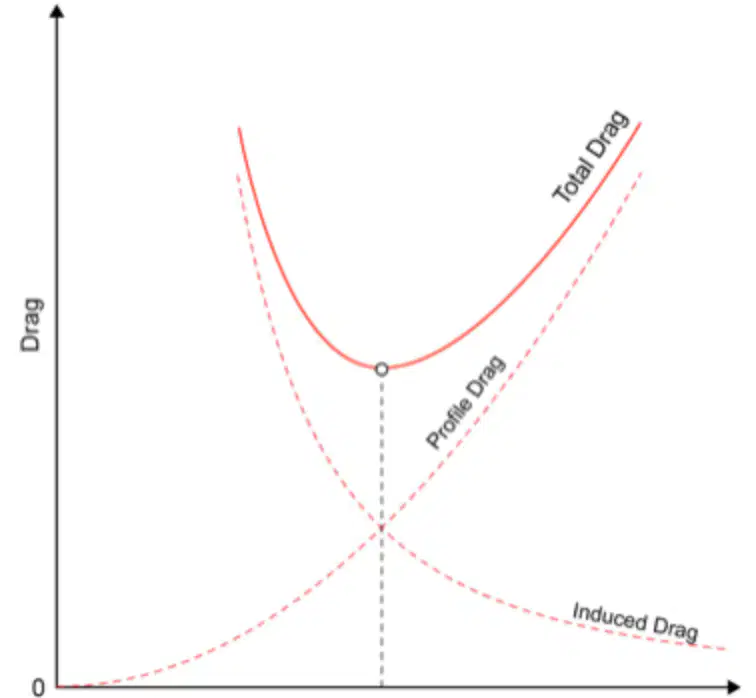
What is indicated by the black vertical line?
Minimum drag speed
Best L:D
Best glide speed
Maximum drag speed
Our best lift to drag ratio on a general purpose aerofoil will be found at which angle of attack?
-4º
0º
4º
16º
A symmetrical aerofoil will start producing lift at which angle of attack?
-4º
0º
4º
16º
TRUE or FALSE
When I deploy flaps my CL will be decreased and my drag will be increased.
TRUE
FALSE
In a steady left turn which aileron will be deflected upward?
LEFT
RIGHT
Why in a right turn does with right wing roll down and the left wing roll up?
We have moved the control column to do so, so it does what we do.
The right wing has a more camber therefore producing less lift.
The left wing has a more camber therefore producing more lift
Its just what happens when you use coordinate roll and rudder together
Select all the main control surfaces
Aileron
Elevator
Rudder
Flap
Gear
The elevator move about which axis?
Longitudinal
Lateral
Normal
Plane
The primary and secondary affect of aileron is:
Select all that apply
Roll
Slip
Yaw
Skid
What is this statement referring to:
"Brings the Centre of Gravity closer to the hinge line in order to reduce flutter"
Mass Balance
Aerodynamic Balance
Coordinated Controls
Adverse Reaction
What is the following statement referring to:
"..moves in the same direction as the control surface producing a force to oppose the control column movement making the controls not too light (to avoid full deflection from occurring so easily)"
Trim Tab
Aileron
Cross Coupling
Anti-balance Tab
What part of the lift formula does flap lower the flap increase?
Lift
Coefficient of lift
TAS
IAS
During straight and level flight the Lift and Weight couple make which type of pitching movement?
Nose up
Nose down
What is the purpose of the tail plane?
Balance residual rolling moments
Balance residual pitching moments
Balance the passengers incase one is much heavier
Hold the elevator on
What happens to the power required for straight and level flight with an increase in weight
Pr decreases because the aircraft has more potential energy for a given altitude therefore requires less lift
Pr increases because the aircraft has more potential energy for a given altitude therefore requires more lift
Pr decreases because of the decreased requirement for lift
Pr increases because of the increased requirement for lift
The forces acting on an aircraft in straight and level flight are:
Weight, Lift, Thrust, Drag
Weight, Lift, Drag, Torque
Weight, Lift, Thrust, Drag, Torque
Weight, Lift, Thrust, Drag, Slipstream
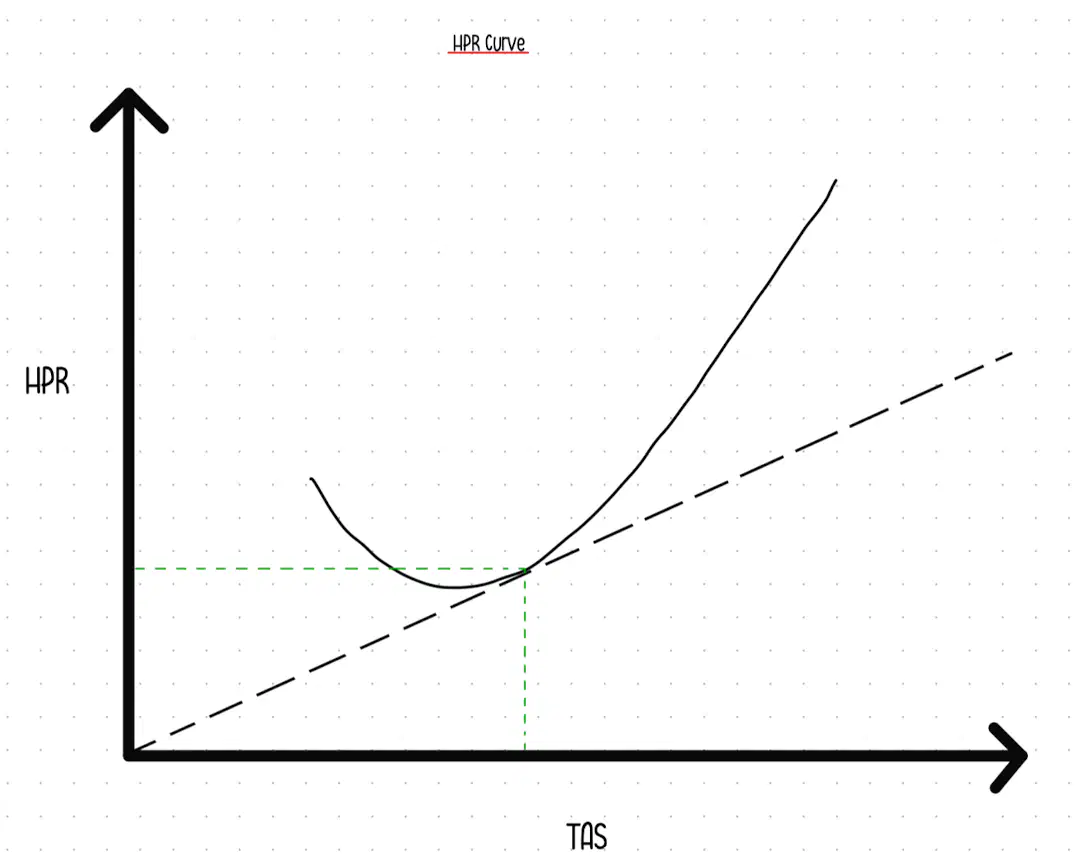
What speed will be found on the follow graph with the green dotted lines?
Range Speed
Endurance Speed
Minimum Drag Speed
Vy Speed
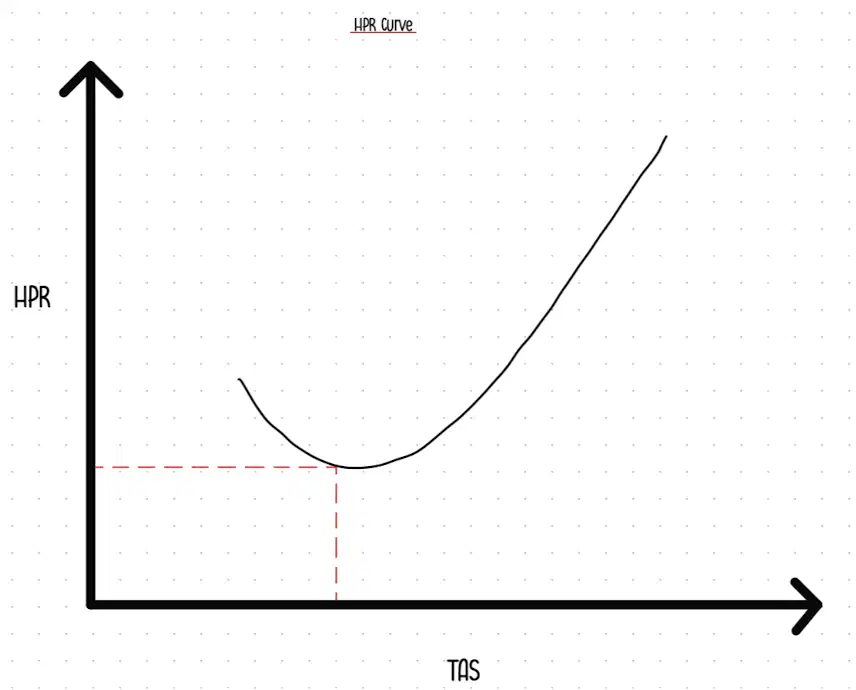
What speed will be found on the follow graph with the red dotted lines?
Range Speed
Endurance Speed
Minimum Drag Speed
Vy Speed
The power required versus TAS curve moves ________ as weight is increased.
down and to the left
up and to the left
down and to the right
up and to the right

Identify D and E for this aircraft in a steady climb
Forward component of weight
Drag
Weight
Lift
Rearward component of weight
Define Vy
Greatest gain in height over a given distance
Greatest gain in height for a given speed
Greatest gain in height for a given amount of fuel
Greatest gain in height over a given amount of time
Define Vx
Greatest gain in height over a given horizontal distance
Greatest gain in height for a given amount of fuel
Greatest gain in height over a given amount of time
Greatest gain in height for a given vertical distance
Select all the factors that will decrease climb performance:
Gear down
Increased temperature
Increased altitude
Increased weight
Flap in approach configuration
Climbing into a headwind will decrease rate of climb:
TRUE or FALSE
True
False
In a glide, flying into a headwind will:
(select all that apply)
Increase glide range
Increase glide angle
Decrease glide range
Reduce glide angle

Identify A, B and C for this aircraft in a glide
Lift
Weight
Thrust
Forward component of weight
Weight 1
Two aircraft of the same type are gliding. Aircraft 'A' is a student just departing on a dual cross country with full tanks and aircraft 'B' is a solo student just returning from a cross country with just over legal reserves. Select the correct statement:
Aircraft 'A' will glide a greater distance than aircraft 'B'
Both aircraft 'A' and 'B' will glide the same distance but aircraft 'B' will have a steeper glide angle
Aircraft 'B' will glide a greater distance than aircraft 'A'
Both aircraft 'A' and 'B' will glide the same distance but aircraft 'A' reach that same distance before aircraft 'B' will.
The turning force acting on the aircraft is called:
Centrifugal Force
Centrifugal Drag
Centripetal Force
Centripetal Drag
Load factor is:
An increase in weight
An increase in apparent speed
An increase in apparent weight
A decrease in apparent weight
Select all the factors that effect radius and rate of turn:
AoB
Airspeed
Weight
Power setting
You are flying into Dunedin control to get your turn coordinator fixed. Dunedin tower has asked you to make a rate one orbit in your current position. What will my AoB need to be in order to comply with their instructions?
Tecnam LSA
TAS 90kt
IAS 100kts
OAT 14ºC
ALT 1500ft
10º
17º
20º
27º
While orbiting over head Oamaru (NZOU) at 5500ft, you decide to descend down to 1600ft. As you descend what considerations must you make in regard to the inner and outer wing?
The inner wing will have a higher AoA and will cause an under banking tendency
The inner wing will have a higher AoA and will cause an over banking tendency
The outer wing will have a higher AoA and will cause an underbaking tendency
The outer wing will have a higher AoA and will cause an under banking tendency
Select all correct symptoms of an approaching stall
No airspeed
Buffeting of the controls
Higher and higher nose attitude
Reducing control effectiveness
Quieter
Select the options that make up the standard stall recovery
Stick forwards (to increase the AoA)
Power (to reduce height loss)
Stick forwards (to decrease the AoA)
Rudder (to prevent further yaw)
You have been doing some IFR flying and you have entered visible moisture, you start to note that there is a large build up on ice forming on the leading edge of your wing what does this do to your stall speed?
Increase
Decrease
Select all the options that could encourage or aggravate a wing drop
Difference in surface condition (eg. the left wing is dirtier)
Climbing or descending turn near the stall
Flap
Use of aileron near the stall
Power on near the stall
An aircraft in a spin is stalled
true
false
Select those that make up the standard recovery from a spin
Power - Full
Rudder - Opposite direction of spin
Power - Close
Ailerons - Central
Elevator - ease forward to break stall once rotation has stopped
The difference between a spin and spiral dive:
The aircraft is stalled in both but airspeed is increasing in a spiral dive
The aircraft is stalled in a spiral dive but not in a spin
The aircraft is only stalled in a spin and the airspeed will be increasing in a spiral dive
There is no difference they are different names for the same thing
Blade angle is:
Angle between the chord line and the plane of rotation
Angle between the chord line and RAF
Angle between the blade back and the plane of rotation
Angle between the RAF and the blade back
The angle between the RAF and the plane of rotation is known as:
AoA
Helix Angle
Blade Angle
Angle of Incidence
What is the purpose of helical twist?
A reduction in blade angle towards the propeller tip to maintain best thrust/torque ratio
A reduction in blade angle towards the propeller tip to maintain 16° AoA for the entire blade length
An increase in blade angle towards the propeller tip to maintain best thrust/torque ratio
An increase in blade angle towards the propeller tip to 16° AoA for the entire blade length
The centrifugal twisting moment will:
Always act to fine the blade
Always act to coarsen the blade
Act to fine the blade in normal flight but coarsen the blade in windmilling flight
Act to coarsen the blade in normal flight but fine the blade in windmilling flight
Aerodynamic twisting moment will always act to fine the blade:
True
False
An aircraft with a fixed pitch propeller best set for which phase of flight?
Climb
Descent
Straight and Level
If you put your CSU aircraft into a climb without adjusting the throttle, what will happen?
The CSU will alert the pilot
The CSU will coarsen the blade
The CSU will fine the blade
Nothing will happen unless you change it
In an aircraft with a CSU what is the correct technique to increase power?
Pitch/Rich/Power
Rich/Pitch/Power
Power/Pitch/Rich
Power/Rich/Pitch

What is represented by 'X' in this image?
Lift
Torque
Thrust
Helix Angle

