
 Worksheets
Geometric Proof Properties
Total questions: 24
Worksheet time: 24mins
Name
Class
Date
1.
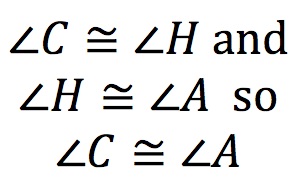
What is the justification?
a)
Symmetric Prop.
b)
Angle addition postulate
c)
Reflexive Prop
d)
Transitive Prop.
2.

What is the justification that the measure of angle DAE plus the measure of angle EAF = 90 degrees?
a)
definition of supplementary angles
b)
definition of complementary angles
c)
Vertical Angles Theorem
d)
definition of bisect
3.

What is the justification?
a)
Transitive Property
b)
Substitution Property
c)
Reflexive Property
d)
Symmetric Property
4.

What allows to say that angle IKH is congruent to angle GKJ?
a)
definition of vertical angles
b)
Linear Pairs Theorem
c)
definition of a straight angle
d)
Vertical angles theorem
5.

What is the justification?
a)
reflexive property
b)
definition of bisect
c)
definition of a midpoint
d)
substitution property
6.

What is the justification?
a)
Reflexive Prop.
b)
Symmetric Prop.
c)
Transitive Prop.
d)
Substitution
7.

What is the justification that segment GI is congruent to segment IH?
a)
segment addition postulate
b)
definition of perpendicular
c)
definition of midpoint
d)
definition of a segment
8.

What would allow you to write this equation?
a)
definition of complementary angles
b)
definition of supplementary angles
c)
Transitive Property
d)
Symmetric Property
9.

What is the justification that the measure of angle DAE plus the measure of angle EAF equals the measure of angle DAF?
a)
definition of a right angle
b)
definition of complementary angles
c)
definition of an angle bisector
d)
segment addition postulate
10.
An angle formed by opposite rays that measures 180 degrees
a)
right angle
b)
straight ange
c)
acute angle
d)
obtuse angle
11.
Two angles who sum is 90 degrees
a)
right angle
b)
supplementary angle
c)
complementary angles
d)
linear pair
12.
Two angles who sum is 180 degrees
a)
Complementary angles
b)
Right angle
c)
Supplementary Angles
d)
Acute angles
13.
The nonadjacent angles formed by two intersecting lines.
a)
Linear Pair
b)
Supplementary Angles
c)
Vertical Angles
d)
Adjacent Angles
14.
Reflexive property of Equality
a)
RQ=SP so SP=RQ
b)
RQ=RQ
c)
RQ=SP, SP=TV so RQ=TV
d)
the image is equal to the preimage
15.
step 1: 3x + 1 = 10
step 2: 3x = 9
Which property justifies going from step 1 to step 2?
step 2: 3x = 9
Which property justifies going from step 1 to step 2?
a)
additive inverse property
b)
transitive property
c)
substitution property
d)
multiplication property
16.
If A and B are vertical angles, what can we conclude about A and B?
a)
They are complementary angles
b)
They are supplementary angles
c)
They are congruent angles
d)
They are adjacent angles
17.
If we are given that angles C and D are complementary angles what can we conclude?
a)
C + D = 180 by definition of right angles
b)
C + D = 90 by definition of complementary angles
c)
C + D = 180 by definition of complentary angles
d)
C and D are congruent angles
18.
When starting a proof you always start with:
a)
Given information
b)
What it wants you to prove
c)
Equal Angles
d)
Linear Angles
19.

What is the reason for the above?
a)
Angle Addition Postulate
b)
Segment Addition Postulate
c)
Definition of Midpoint
d)
Transitive Property of Congruence
20.
What is the reasoning behind the following?
Given: ∠1 and ∠2 are supplementary. ∠2 and ∠3 are supplementary.
Prove: ∠1 ≅ ∠3
Given: ∠1 and ∠2 are supplementary. ∠2 and ∠3 are supplementary.
Prove: ∠1 ≅ ∠3
a)
Congruent Supplements Theorem
b)
Reflexive Property of Congruence
c)
Definition of Supplementary Angles
d)
Definition of Congruence
21.
What property is illustrated below?
a = b and b = c so a = c
a = b and b = c so a = c
a)
Reflexive Property of Equality
b)
Symmetric Property of Equality
c)
Transitive Property of Equality
d)
Substitution Property of Equality
22.
What is the reason for the statements below?
Given: m∠1 + m∠2 = 90
Prove: ∠1 and ∠2 are complementary.
Given: m∠1 + m∠2 = 90
Prove: ∠1 and ∠2 are complementary.
a)
Definition of Complementary Angles
b)
Congruent Complements Theorem
c)
Definition of Right Angles
d)
Angle Addition Postulate
23.
What is the reason for the statement below?
Given: m∠1 = 63
m∠1 + m∠2 = 90
Prove: 63 + m∠2 = 90
Given: m∠1 = 63
m∠1 + m∠2 = 90
Prove: 63 + m∠2 = 90
a)
Reflexive Property of Equality
b)
Symmetric Property of Equality
c)
Transitive Property of Equality
d)
Substitution Property of Equality
24.
What is the reasoning behind the following?
Given: ∠1 and ∠2 are supplementary. ∠2 and ∠3 are supplementary.
Prove: ∠1 ≅ ∠3
Given: ∠1 and ∠2 are supplementary. ∠2 and ∠3 are supplementary.
Prove: ∠1 ≅ ∠3
a)
Congruent Supplements Theorem
b)
Reflexive Property of Congruence
c)
Definition of Supplementary Angles
d)
Definition of Congruence
100 %

