
 Worksheets
Unit 3 Review
Total questions: 100
Worksheet time: 2hrs 2mins
What land did Great Britain own after the French and Indian War?
Land east of the Mississippi River
Land south of the Rio Grande River
All of Canada
the Hawaiian Islands
Before the Revolutionary War, colonists organized boycotts against Great Britain. What group used violence and threats to enforce these boycotts?
Imperial Policy
Sons of Liberty
Massachusetts Militia
Second Continental Congress

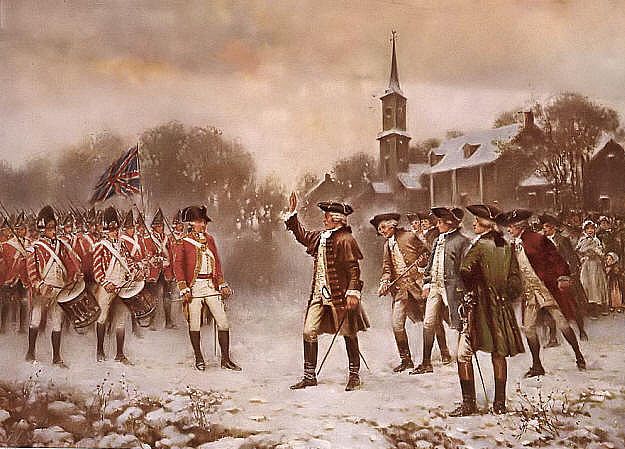
This image is most likely depicting
the Boston Tea Party
a ride to Valley Forge
George Washington crossing the Delaware.
Paul Revere's midnight ride.

This person was a great inventor, scientist, and writer. He also helped to convince France to support America during the revolution. Who was he?
George Washington
John Adams
Thomas Jefferson
Benjamin Franklin
Who was king of England during the American Revolution?
King Henry VIII
George Washington
King George III
King Edward III
Who wrote most of the Declaration of Independence?
Patrick Henry
Benjamin Franklin
Thomas Jefferson
John Adams
During the Boston Tea Party,
colonists raided British ships and threw crates overboard.
Native Americans threw tea at British troops.
Americans celebrated their victory at Trenton.
the cost of tea was very expensive.
Which battle convinced the French to become America's ally during the revolution?
Lexington and Concord
Yorktown
Saratoga
Bunker Hill
Most African Americans who lived in the British colonies were
indentured servants.
Puritans.
Quakers.
slaves.
The last major battle of the American Revolution was _
Saratoga.
Yorktown.
Trenton.
Princeton.

The painting shows Thomas Jefferson, Benjamin Franklin, and John Adams working on an important document in 1776. Based on your knowledge of social studies, what document were they working on?
the Articles of Confederation
the Bill of Rights
the Declaration of Independence
the Great Compromise

Why is the Battle of Saratoga considered a turning point in the American Revolution?
The British Army's victory forced George Washington and his troops to retreat to Valley Forge
The British Army's victory convinced Benedict Arnold to betray the United States and fight for Great Britian.
The continental Army's victory convinced the British to recognize the United States' independence
The Continental Army's victory convinced the French to support the United States against Great Britain.


Paul Revere rode through the town of Concord to warn the colonists that the ______ were coming.
Germans
Indians
British
French
The ___________ fought hard to gain America's freedom from the king of England.
Patriots
Loyalists
freedom
treaty

(Turning point is a big change in a situation)

The colonists were becoming more and more angry with Britain. Why?
Britain forced the colonists to pay high taxes
King George III refused to negotiate with the colonists.
The colonists thought it was unfair to be taxed without having any say in government.
All of the above
On July 4, 1776 the Continental Congress published an important document called?
The United States Constitution
Declaration of Independence
Treaty of Versailles
Stamp Tax Act
The French and Indian War broke out between _________________ ?
France and the Native Americans
Great Britain and the Native Americans
Great Britain and France
France and Spain
What was the 1765 Stamp Act?
A new tax was put on tea from Great Britain
A new tax was put on every piece of printed paper used by the colonists
A new law was passed that forced the colonists to join the Royal Navy
A new law was passed that forced the colonists to return to Britain
What happened during the Boston Tea Party?
When colonists threw 342 chests of tea overboard into the Boston Harbor to take a stand against Great Britain.
A huge party that took place in Boston to celebrate the colonist’s independence from Great Britain
When the first British Tea Party took place in Boston in 1773.
When the colonists sank several British ships in the Boston Harbor.
Who warned the colonists that the British were coming?
George Washington
Paul Revere
Ben Franklin
John Adams
How did the Revolutionary War end?
The war ended when the colonists surrendered to Great Britain
The war ended when France surrendered to Great Britain.
The war ended when Great Britain surrendered to the colonists.
The war ended when France surrendered to the colonists.
What important role did George Washington play during the war?
Washington was the President during the Revolutionary War
Washington was a spy for the American colonists during the war
Washington warned the colonists that the British were coming
Washington was in charge of the Continental Army during the war
True/False: The colonists thought it was unfair to be taxed without any say in government
True
False
True/False: America was always a free country.
True
False
True/False: When General George Washington surrendered in Yorktown, it officially ended the Revolutionary War.
True
False
Which of the following items were colonists only allowed to buy from England?
corn
chocolate
tea
cows
Which country made many decisions in the colonies?
England
France
America
Spain
Great Britain began to impose taxes on the colonists after the —
Spanish-American War
Mexican-American War
French and Indian War
Civil War
Great Britain passed the Proclamation of 1763 to prevent colonists' movement to the —
north
west
south
east

Colonists could not move wherever they wanted to along the east coast
Colonies had no representation in Parliament.
Colonists were not allowed to sell their goods abroad.
Colonists were not allowed to have free trade with Canada or Mexico.

Were the colonies represented in Parliament?
Yes
No
How did colonists react to the increase in British taxes?
They were fine with them.
They were unhappy
They had no opinion
What did Great Britain do to try and prevent France from taking back its colonies in North America?
Decided to keep a standing army in the Colonies - to defend them.
Decided to train militias that could defend the colonies when needed.
Decided to let France take over the colonies in North America
Decided to destroy France.
What two (2) problems did Great Britain face after the French and Indian war?
Needed to protect colonies in case France ever came back.
Needed to pay back debts from the French and Indian war.
Needed to regain control of India.
Needed to regain control of the North American colonies.
The Stamp Act taxed all [ ] goods
Molasses
Sugar
Paper
Tea
The French and Indian war was very [ ] for the British
Cheap
Expensive
Short
Who did the King feel should pay for the war?
Colonists
England
France
Native Americans
The colonists were happy about paying taxes
True
False
What famous phrase became a cry of the colonists
"Free the People!"
"We the people!"
"Ain't nobody got time for that!"
"No taxation without representation!"
Why were the colonists so angry about the taxes
They could not afford to pay taxes
They gave enough money to the king already
They had no representation in parliament
They were not angry!
The secret group formed in 1765 to protect colonist's rights and protest British taxation
Sons of Liberty
Sons of Freedom
Sons of God
Sons of Thunder
Why was the Declaration of Independence written?
to explain why the colonies were separating from Great Britain
the start the American Revolution
to offer a peace settlement to Great Britain.
to instruct how a county wins its freedom.
According to Thomas Jefferson, the power to rule comes from
the governed.
God
Parliament.
the king.
What are unalienable rights?
Rights that government cannot take away
Rights that government takes away
rights for aliens
Government is needed to promote equality
The Declaration of Independence is most like a what?
Love Letter
Treaty
Break-up letter
Constitution
Why were the colonists being taxed so heavily?
To pay for the French and Indian War
Because the King felt like it
Because they wanted a revolution
They owed a lot of money to China
What did the Continental Congress do with the Declaration once they had signed it?
Made copies to send to the colonies
Had it published in newspapers
Sent a copy to the King of England
All of the above
Who was the first to sign the document with a big signature nearly five inches long?
John Hancock
Thomas Jefferson
Ben Franklin
John Adams
Which of the following statements is a famous quote from the Declaration of Independence?
FIRST, We have granted to God, and by this our present Charter have confirmed
Four score and seven years ago our fathers brought forth on this continent a new nation
We hold these truths to be self-evident, that all men are created equal
If there be those who would not save the Union, unless they could at the same time save slavery
Which of the following was NOT a task of the Second Continental Congress?
organize the colonies for war
decide whether or not to declare independence
plan the Boston Tea Party
decide who should head the military
The pamphlet Common Sense persuaded colonists to
want independence.
forget about politics.
ask for help from the king.
remain loyal to Great Britain.
Which of these reasons explained why the colonists wanted to become a separate nation?
People needed to be loyal to England.
The King was always fair.
All men are created equal.
Government should leave people alone.
Signing the Declaration of Independence marks
the end of slavery.
giving rights to the Indians.
the birth of our country.
the age of enlightenment.
The Second Continental Congress was held in
Great Britain.
Plymouth.
Williamsburg.
Philadelphia.
A person that was in favor of independence was called a
Loyalist.
colonist.
Patriot.
Pilgrim.
A person that was against independence was called a
Loyalist.
colonist.
Patriot.
Pilgrim.
Who was the first to sign the Declaration of Independence?
George Washington
Thomas Jefferson
John Hancock
Benjamin Franklin
What were THREE unalienable rights that all people should have, according to the Declaration of Independence?
life
liberty
clothes
money
pursuit of happiness
The group of men who helped establish the new American colonies were called
Second Continental Congress
Presidents
Founding Fathers
Minutemen
What did Benjamin Franklin mean when he said, "We must all hang together, or assuredly we will all hang separately"?
The delegates must work together, or independence will never happen.
The delegates must sign the Declaration neatly, to get credit for helping create it.
The delegates must succeed at their task, or the people would be outraged.
The delegates must stay united because signing the Declaration of Independence was an act of treason.
What does it mean to boycott?
Pay money to the government
To buy things from another country
To protest by not buying or using goods or services
The Declaration of Independence is still considered one of the most famous written documents.
true
false
The British thought the colonists were committing treason towards their government.
true
false
Patriots celebrated once they found out about the Declaration of Independence on July 4th.
True
False
Some famous signers of the Declaration included, John Adams, Samuel Adams, and John Hancock.
True
False
Why was signing the Declaration of Independence considered dangerous.
By signing their name on the document the British would be able to identify them.
The French would find out about them signing their names.
The Native Americans would be upset.
Thomas Jefferson stated people have the right to life, _______, and the pursuit of happiness.
love
liberty
learning
How many parts are there to the Declaration of Independence?
5
2
7
1. The British ______ made laws for all British people.
king
Parliament
colonists
courts
1. American colonists were asked to cover the
cost of the French and Indian War by paying _____.
the monarch
refunds
taxes
1. The Sugar Act angered many colonists because
it required them to pay a _____ on goods brought into
the colonies.
tax
quarter
Knight Note
1. Many colonists were against the Stamp Act because
it was an example of taxation without _____.
a vote
a paw
representation
1. Many colonists protested the Sugar Act with a _____ of
British goods.
buyout
boycott
bungalo
band
1. Parliament ____ the Stamp Act when it heard that nine
of the colonies sent representatives to the
Stamp Act Congress
doubled
tripled
quadrupled
repealed
1. The colonists formed the ______ to keep colonists informed about protests against British laws.
newspaper
Kids of Liberty
Committee of Correspondence
Minutemen
1. Colonists in Massachusetts felt that to ______, or provide housing for, British soldiers was intolerable.
hotel
host
quarter
boycott
Five colonists were _________ by British soldiers at the Boston Massacre.
captured
killed

