
 Worksheets
Exponential and Logarithmic Functions
Total questions: 20
Worksheet time: 20mins

Which equation is represented by the table?
y = 40(2)x
y = 40(1/2)x
y = 40 - 2x
y = 40 - 1/2x
What type of pattern do exponential functions have?
Adds or subtracts by the same number every time
Multiplies or divides by the same number every time
Square roots all the inputs
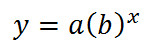
In an exponential function, what does the 'b' represent?
Input
Rate of change
Y-intercept
Output
Log with a base "e" (loge) is the same thing as...
"e"
Natural Logarithm (LN)
Common Logarithm (Log)
Natural Log, base "e"
LNe
Which of the following is an exponential decay model?
y = 3 * (1/2)x
y = 1/2 * (3)x
y = -2 * (2)x
y = -3 * (3/2)x
What is the asymptote for the logarithmic function
f(x)=log(x−2)
x = 2
x = -2
y = 2
y = -2

Write the function for the following table:
f(x) = 5x + .08
f(x)= 5x + 2
f(x) = .08(5)x
f(x)= 2(5)x

Write the function for the following table:
f(x)= 1(2)x
f(x)= 2(1)x
f(x) = 2x+1
f(x)= x+2

Which table represents the following equation?


Write an equations that models the data shown.
y=3x+6
y=3⋅2x
y=2x+3
Suppose the population of a species of insects doubles every year. The function gives the number of insects after x years. How many insects will there be after 3 years?
9600
12,800
200
8000
Use the function m(t)=.05(2)t where M is the amount of money you have after t days.
How much money will you have after 14 days?
$ 819.20
$ 1.4
$ 140

Solve for x
1
4
1/2
no solution
What type of function is f(x)=2(1/7)x ?
Exponential Growth
Linear
Exponential Decay
None of the Abovee
What type of function is
y = 7(5/4)x?
Exponential Growth
Exponential Decay
Linear
None of the above
Determine the asymptote for the function
f(x)=3(2)x-4+5
x=4
y=4
x=5
y=5
Determine the range for the function
f(x)=3(2)x-4+5
[5,∞)
(5,∞)
[4,∞)
(4,∞)
Determine the domain for the function
f(x)=3(2)x-4+5
[5,∞)
(5,∞)
(-∞,∞)
(∞,-∞)
A new savings account is opened with $400 and gains 3% every year. What is the exponential function?
f(x)=400(.97)x
f(x)=400(1-0.03)x
f(x)=400(1.03)x
f(x)=400(0.03)x
A new savings account is opened with $1500 and gains 1.5% annual interest. What is the exponential function?
f(x)=1500(1+1.5)x
f(x)=1500(1+0.015)x
f(x)=1500(1.00375)x
f(x)=1500(1.5)x

