
 Worksheets
Unit 3.1 Online Review
Total questions: 24
Worksheet time: 48mins
According to the endosymbiotic theory, which three organelles in the cell have DNA (genome)? (pg. 105)
Mitochondria
Chloroplast
Nucleus
Vacuole
Ribosome
What type of mutations exist? (pg. 108)
Good mutations
Bad mutations
Harmless mutations
Cool mutations like Ms. Rivas
retro mutations
Which two organisms are the least related to the human? (pg. 106)
Which of the following represents organisms having the same bone structures but different function? (pg. 106)

The picture shows a dolphin and human embryo. Evolution evidence tells us which of the following is true? (pg. 106)
They have the same common ancestor
They were born in the same location
They can survive in the same ecosystem
They are little cute aliens (dont pick this)
Label the picture. (pg. 106)
What is the difference between Punctuated equilibrium and Gradualism? (pg. 106)
Punctuated = rapid changes
Gradualism = slow changes
Punctuated = slow changes
Gradualism = rapid changes
Punctuated and Gradualism evolve in the same way
Punctuated = no changes
Gradualism = rapid changes
Natural selection is when the most favorable fittest traits can be seen in __________ over a long period of time. (pg. 108)
Populations
Organisms
You
your cool science teacher

This is a picture of thousands of fish eggs. Why would a fish overproduce the amount of eggs they lay? (pg. 105)
higher chance of survival
Higher chance they will get eaten
Lower chance of surviving
they are the power house of the cell
Large bird claws are slow in a fight and small claws cant fight predators. This is still true after evolution. Which graph represents this? (pg. 108)


Medium speed lions used to be the fittest. Now fast speed lions are the fittest. Which graph represents this? (pg.108)

The graph shows a population before and after evolution. Name which type of graph is represented. (pg. 108)
Disruptive Selection
Directional Selection
Stabilizing Selection
Quadratic Selection

The graph shows a population before and after evolution. Name which type of graph is represented. (pg. 108)
Disruptive Selection
Directional Selection
Stabilizing Selection
Quadratic Selection

Owls move very quickly and can catch mice easily to eat. After evolution, how will the population of mice change to help with their survival from the owls? (pg. 108)
Faster mice will be in the population
Slower mice will be in the population
Slower owls will be in the population
Faster mice will disappear from the population

The picture represents genetic drift. The small population is (a) likely to survive this disaster. As a result there is a (b) chance of population death. (pg. 108)
Where in the picture can you find the oldest and youngest fossils? (pg. 106)
The common ancestor had which characteristic? (hint where would the common ancestor be on the cladogram? ) (pg. 109)

This is a picture of different organisms. Scientists found several similarities between them which means ... (pg. 106)
share a common ancestor
Born in the same place
migrate across the sea the reproduce
have the exact same DNA
Label the place where change is in stasis meaning the population has not changed for hundreds of years. Label where punctuated equilibrium has happened. (pg. 106)
Ms. Rivas has bugs in her classroom. She sprays bug repellent all over. Most bugs die but some have survived. Why were some bugs fit to survive? (pg. 108)
They had favorable trait variations
They were the biggest bug
They were the most intelligent
They were just lucky
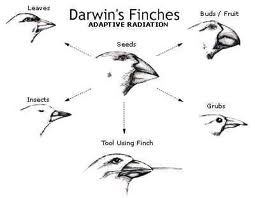
Formation of new species like when the finches appeared is called (a) (pg. 108)
What does it mean to be the fittest in nature. (Pick three) (pg. 108)
Flowers that out-compete others for sunlight
A bright red bug in a field of dirt.
slow moving prey near hungry cheetah
Polar bears thick insulated fur
Cactus storing water in the desert
Match the mechanism to the correct definition. (pop. = population) (pg. 108)
Natural Selection
fittest to survive and reproduce
Mutation
Change in genes, adds variation
Gene flow
pop. move to other pop. to add variation
Speciation
formation of new species
Place in correct category (pg. 109)
Gene Flow
Mutations
Genetic Drift
Non-random mating

