
NEW
Font size
 Worksheets
Probability with Random Variables
Total questions: 20
Worksheet time: 20mins
A random variable is defined by a rule that assigns a _______________ to every outcome in a sample space.
number
letter
Event
probability
A fair coin is flipped three times. What is the probability of seeing heads exactly once?
3/8
1/8
1/2
1/6
The Sum Rule states that the sum of the probabilities of all instances of a random variables equals...
1
0
P(E)
P(E')
Two fair dice are rolled and the numbers that appear are added. What is the probability that this sum is exactly 3?
1/12
1/18
1/4
1/6

Is this a probability distribution?
No, the sum of p(x) does not equal 1.
Yes, all p(x) are between 0 and 1.
No, all p(x) are not between 0 and 1.
Yes, the sum p(x) is 1.
It is a variable whose values are determined by chance.
Random Variable
Discrete Variable
Continuous Variable
Independent Variable
What is the numerical quantity assigned to the outcome of an experiment usually denoted by an uppercase letter such as X?
Frequency
Probability
Random variable
Sample
Which of the following refers to a rule that assigns a numerical value or characteristic to an outcome of an experiment?
Expected Value
Random Variable
Range Space
Probability Distribution
An instance of a random variable is...
an entry in a hypothetical list of possible outcomes.
any phenomenon in which all outcomes are equally likely.
a number that changes in a predictable way in the long run.
a number that is associated with a set of outcomes
In a small town of 100 households, 29 own no dogs, 38 own one dog, 22 own two dogs, and 11 own three dogs. Two different households are picked at random. Let "x" = the total number of dogs these two households own. Find P(x>2).
0.4244
0.4202
0.4278
0.4235
Let set A = {1, 2, 3, 4} and set B = {2, 3, 5, 7}. One number is chosen at random from each set and their sum is calculated.
What is the probability that this sum is exactly 6?
3/16
3/8
1/16
1/4
Let set A = {1, 2, 3, 4} and set B = {2, 3, 5, 7}. One number is chosen at random from each set and their sum is calculated.
What is the probability that this sum is less than 6?
5/16
3/8
5/8
1/3
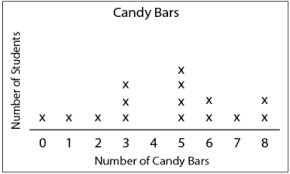
Consider the dot plot shown. A trial consists of selecting a single student at random from this sample. Let "x" = the number of candy bars this student sold. Find P(x>2) :
4/5
3/5
2/5
2/15
Integration: Consider the dot plot shown. A trial consists of selecting a single student at random from this sample. Let "x" = the number of candy bars this student sold.
Find P(x=2) :
1/15
2/15
1/8
1/4
A bag contains five blue marbles, four yellow marbles and three green marbles.
A trial consists of drawing two marbles from this bag at random and with replacement. Let "b" = number of blue marbles drawn. Find P(b=1).
0.2431
0.4861
0.2652
0.5303
A bag contains five blue marbles, four yellow marbles and three green marbles.
A trial consists of drawing two marbles from this bag at random and without replacement. Let "b" = number of blue marbles drawn. Find P(b=1).
0.2431
0.4861
0.2652
0.5303
A hockey team has an equal chance of winning, losing or tying any given game. A win earns the team three points, a loss no points, and a tie one point in the standings. What is the probability that after two games this team has at least four points in the standings?
1/3
1/4
2/9
1/8
Two fair dice are rolled. Let "x" = the sum of the numbers that appear on the dice.
Which value of "x" is most likely?
6
7
3
3.5
Two fair dice are rolled and the numbers that appear are added. What is the probability that this sum is at least 5?
5/12
5/36
5/6
1/6

.88
.12
.78
.22

