
 Worksheets
Ancient Greece
Total questions: 106
Worksheet time: 1hrs 26mins


The Delian League led to immense prosperity among Greek city states known as the "Golden Age"
True
False
Athens control of the Delian League led to the rising tension between Sparta and Athens, this started the ____________ War
Thermopylae
Peloponnesian
The Last Stand of The 300
The 25 year Wall War
What was significant about the Persian Wars?
Darius & Xerxes united to defeat Greece
Xerxes betrayed Persia by giving secrets to the Greeks
Athens & Sparta united to fight Persia
Athens & Sparta fought against each other
How did the Peloponnesian War end up?
Athens defeated Sparta
Sparta defeated Athens
Macedonia defeated Sicily
After the Persian Wars, Athens convinced its allies to join an alliance called ______________________.
the Delian League
the Macedonian League
the Peloponnesian League
the Major League
What was the ultimate cause of the Peloponnesian War?
Power struggles between the city-states
Disagreements about trade
The plague
The helots revolted.
What was the outcome of the Peloponnesian War?
Athens defeated Sparta
Sparta defeated Athens
Macedonia defeated Sicily
Which of the following did Sparta and Athens have in common?
Both Favored Democracy
Both were dominated by their military
Both were Greek city-states
They fought on the same side in the Peloponnesian Wars
Who came to Greece to end the turmoil between the city-states?
Phillip II
Hercules
Plato
Odyssey
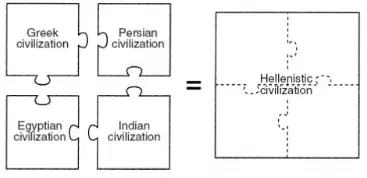
What caused the historical development depicted in this illustration above?
Spread of Buddhism
Fall of the Roman Empire
The expansion of Alexander the Great's empire
The collapse of the Greek civilization
"Let me say that our system of government does not copy the institutions of our neighbors. It is more the case of our being a model to others than of our imitating anyone else. Our constitution is called a democracy because power is in the hands, not of a minority, but of the whole people." Which early society is most likely described in this quotation?
Spartan
Athenian
Babylonian
Egyptian
In a comparison of the ancient cities of Athens and Sparta, Sparta placed more emphasis on ___.
human rights
education
family order
military service
An important factor that prevented the ancient Greek city-states from uniting to form a single nation was the __.
large, desert regions
a cold, hostile climate
mountainous terrain of the region
lack of a common language
Which event brought new ideas and peace to Athens?
Peloponnesian war
Olympics
Hellenistic age
Golden Age
Which city-state brought an end to the Golden Age in Athens
Sparta
Troy
Persia
Mycenae
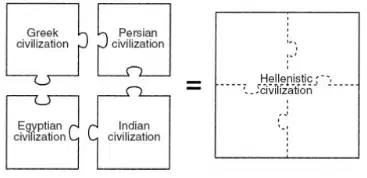
Which claim is supported by the illustration above?
Greek, Persian, Egyptian, and Indian civilizations used Hellenistic Irrigation to grow crops
Persian and Greek civilization were isolated from one another
Armed conflict between Indian and Egyptian civilizations led to the creation of Hellenistic civilization
Alexander the Great's empire led to cultural diffusion between the civilizations he conquered
Where did Phillip II live before coming to Greece
India
Macedonia
China
Crete
What effect did the geography of Greece have on its early development?
Greece had lots of natural resources, so they never had to trade with other nations
Being located on the Mediterranean Sea limited cultural diffusion
75 % of Greece was covered by mountains, which led to independent city-states (called polis)
Its location limited colonization outside of Greece
Which form of government involves all people who are residents of said location by giving each citizen the right to vote? (Used primarily in Athens)
Monarchy
Aristocracy
Direct Democracy
Oligarchy
How would someone from Athens describe Sparta after visiting it?
“The Spartans are so strict. Their military is what dominates their society.”
“It’s interesting how both the rich and poor can be rulers in Sparta."
"This society has so many personal freedoms, unlike in Athens.”
“Sparta is exactly like Athens."
Which of the following did Sparta and Athens have in common?
Both Favored Democracy
Both were dominated by their military
Both were Greek city-states
They fought on the same side in the Peloponnesian Wars
In a comparison between the Greek city-states of Sparta and Athens, Sparta placed more importance with ___
Equality and voting rights
Art and culture
education
the military
Which statement describes a direct democracy?
The government controls the actions of the people
Citizens participate in government decisions by voting
The military leaders create laws
Religious leaders control the governmen
Why is Ancient Greece considered important to Western Civilization?
Greek culture influenced today’s democracy, architecture, and entertainment
Athens defeated Sparta in the Peloponnesian Wars
The Greeks borrowed ideas from Rome and improved upon them
The Greeks invented the world’s first monotheistic religion
Which of the following is NOT a Greek achievement?
Mathematics, such as the formula for pi
Philosophy, such as the work of Socrates, Aristotle, and Plato
Medicine, such as the Hippocratic Oath
Government, such as using Confucius as the basis for the exam system
What were two regions conquered by Alexander the Great?
Egypt and Persia
China and Egypt
Persia and China
Macedonia and Germany
Who conquered all of Greece after the Peloponnesian Wars?
Alexander the Great
King Xerxes of Persia
King Darius of Persia
King Phillip of Macedonia
Why was the city of Alexandria in Egypt important?
It was the center of Hellenistic culture and the center of trade in the Mediterranean area
As a military power, Alexandria was second only to Sparta
The Greeks destroyed all of Egyptian culture
It was the military headquarters for the Macedonian Army

Based on this image, Hellenism was the result of ___
military strength
combining cultural ideas (cultural diffusion)
isolation of Egypt, India, Persia, and Greece
urbanization

Based on this image, what is “Hellenism”?
Separation of cultures to prevent the mixing of ideas
The study of Greek culture
The spread and blending of Greek culture with other cultures
A nation along the Mediterranean Sea
Which great leader is most closely associated with the spread of Hellenistic civilization?
Augustus Caesar
Chandra Gupta
King Phillip II of Macedonia
Alexander the Great
Greek cities had a(n) ________, a massive marketplace that was the center of trade and government.
Acropolis
Coliseum
Palace
Agora
the high, fortified area of Athens where the Parthenon is
acropolis
polis
agora
city-state
in ancient Greece, a market and open space used for public meetings
acropolis
polis
agora
city-state
ancient Macedonian ruler and king of Macedonia from 336-323 BC, he overthrew the Persians and established the largest empire the ancient world had ever seen
Aristotle
Alexander the Great
Plato
Socrates
an ancient Greek philosopher and student of Plato, he established a school in Athens in 335 BC and wrote many of his works there
Alexander the Great
Aristotle
Socrates
Plato
the goddess of arts, war, and wisdom and the protectress of Athens in Greek mythology
Zeus
Hercules
Athena
Medusa
a hero with great strength in Greek mythology
Zeus
Athena
Plato
Hercules
an independent state made up of a city and the land around it
acropolis
polis
city-state
country
a major philosopher from ancient Greece who wrote "The Republic" around 380 BC
Alexander the Great
Socrates
Zeus
Plato
an ancient Athenian philosopher who lived and taught approximately between 470-399 BC
Socrates
Zeus
Aristotle
Homer
king of the gods in Greek mythology
Pericles
Hercules
Socrates
Zeus
Belief in many gods.
Monotheism
Animism
Polytheism
Monoism

Greek goddess of Love
Minerva
Aphrodite
Hera
Artemis
Religion of the Ancient Greeks.
Islam
Christianity
Hinduism
Mythology

King of the Greek gods.
Zeus
Hermes
Apollo
Hades

Greek goddess of Wisdom and war.
Hera
Minverva
Athena
Aphrodite


First civilization in the Greek civilization (flourished from 2700 to 1450 BCE)
Athens
Sparta
Minoans
Troy
Greek name for City State
Polis
Socrates
Macedonia
Hoplites
Ancient Greek poet who recorded the history and myth of Greece famous for
Iliad and Odyssey.
Lisa
Bart
Marge
Homer
Center of the Greek City-State. Where government business was conducted.
Acropolis
Hoplite
Polis
Democrasy
Infantry soldiers for the Greeks, heavily armed foot soldiers.
Plato
Phalanx
Hoplites
Oligarchy
Traditional army formation of the Greeks. Formed a giant wall of shields.
Phalanx
Hoplite
Big Ol'Death Wall
Plato
Rulers of City-States who had complete power.
Dynasty
Democracy
Oligarchy
Tyrant
Government led by the rule of the people
Tyrant
Democracy
Oligarchy
Our Classroom
Rule of a few powerful aristocrats.
Dynasty
Tyrant
Democracy
Oligarchy
One of the largest city-states. Known for their military strength.
Sparta
Olympus
Athens
Xi'an
One of the largest city-states in Greece. Known for their political structure,
democracy and trade.
Sparta
Olympus
Athens
Xi'an
Famous philosopher in Athens. Known for his creation of ethics
Ethicles
Socrates
Plato
Aristotle
Famous student of Socrates. Considered the greatest philosopher of Western
Civilization.
Mr. Rappold
Socrates
Plato
Aristotle
Student of Plato and teacher of Alexander the Great.
Google Search
Socrates
Plato
Aristotle
King of Persia who would attack the Greeks in the Greco- Persian war.
Alexander the Great
Xerxes
Socrates
Homer
A series of wars between the Persian Empires and the Greek City
states. Eventually won by the Greeks solidifying their power in the region.
Greco-Persian War
War of the 3 kingdoms
Peloponnesian War
This is not the answer.
Northern City-State in the Greek region. Where Alexander the Great began
his rise to power.
Sparta
Athens
Mesopotamia
Macedonia
War between the two major Greek City States (Sparta and Athens).
Severely weakened all of Greece.
Greco-Persian War
Peloponnesian War
Aryan Invasion
The Great Flapjack War of Manchester Shortsville
Leader of Macedonia. Who would later go on to conquer all of
Greece, Egypt, Persia, Mesopotamia, and India.
Alexander the Great
Homer
Plato
Hoplites
Age of Greek Inspired cultural diffusion. Spread by Alexander the
Great’s conquests.
Hellenistic Age
Helenhasticks age
Helensastick age
Ellensontictok age
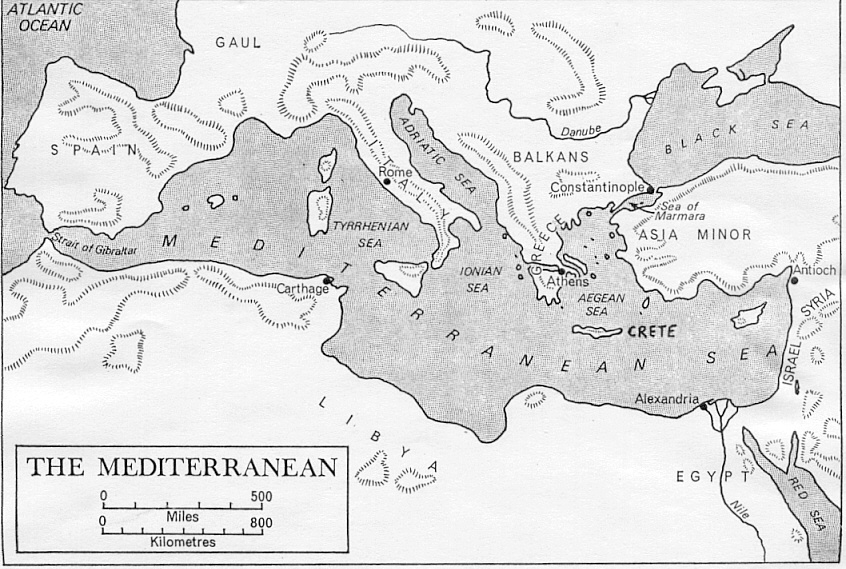
Which Greek city-state helped Athens?

The Spartan leader who led the Greek army at Thermopylae was
Lycurgus
Themistocles
Leonidas
Pheidippides
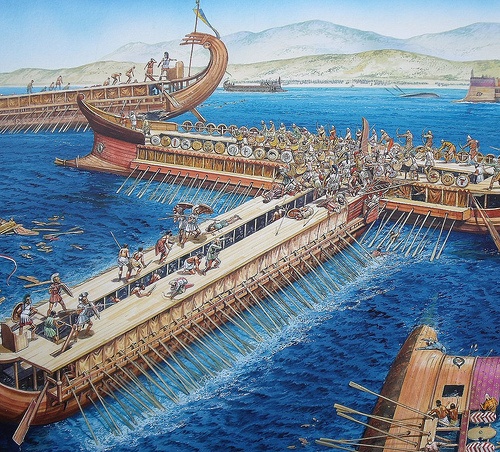
The Persian Wars were fought between who?
Greek city-states and Persia
Sparta and Athens
Greek city-states and Rome
Persia and Mesopotamia
Athens and Sparta took the lead in gathering the other city-states to defend Greece through the creation of what?
Peloponnesian League
Dynamite League
Hammurabi's Code
Delian League
Who had the strongest navy?
Athens
Sparta
Who had the strongest Army?
Athens
Sparta

