
 Worksheets
Unit 2: Massive Monster Review
Total questions: 65
Worksheet time: 40mins


What is the energy source needed for photosynthesis to occur.
sugar
water
sunlight
A Drake soundtrack
What is the plant organelle called that performs photosynthesis
Chloroplast
Mitochondria
Nucleus
DNA
What color is chlorophyll
purple
red
blue
green
What is made by plants during photosynthesis that can be used for energy by both plants and animals
Salt
Tacos
Sugar (glucose)
Carbon Dioxide
The main energy source of energy on earth comes from the
Sun
wall socket
Gasoline
Justin Beiber's new album
Reactants (ingredients) needed by the plant to do photosynthesis include sunlight and
Sugar and oxygen
oxygen and water
Autotrophs
Carbon Dioxide and water
Carbon Dioxide enters the plant through openings on the underside of their leaves called
Stomata
Chloroplasts
Autotrophs
Chlorophyl
Gas that you are breathing in right now that is made from plants
Carbon Dioxide
Water
Oxygen
Glucose
What organelle in your cells releases energy from sugars (glucose), made by the plant
Chloroplasts
Nucleus
Vacuole
Mitochondria
What gas do animals breath out that plants can use for photosynthesis
oxygen
Nitrogen
Hydrogen
Carbon Dioxide
Both animal and plant cells have cell membrane
True
False
It depends
Major part of a cell that is double layer for structure, protection and transport of materials needed by the cell.
Cytoplasm
Cell Wall
Cell Membrane
Nucleus
Type of diffusion where larger molecules enter through carrier proteins and channel proteins.
Osmosis
Diffusion
Homeostasis
Facilitated diffusion
These molecules can pass through the cell membrane freely
Oxygen and Water only
Oxygen and Carbon dioxide only
Oxygen, Water and Carbon dioxide
Oxygen, Water, Carbon dioxide and Sugar
13. This organelle is considered the digestive system and is the "cleanup crew" of the cell?
smooth ER
lysosome
Golgi Apparatus
rough ER
14. Which organelle folds, modifies, and transports proteins WITHIN the cell?
nucleus
endoplasmic reticulum
mitochondria
lysosome
15. Which organelle labels and ships proteins OUT of the cell?
ribosome
Golgi Apparatus
smooth ER
cell wall
7. Which organelle is found ONLY in plant cells and helps with photosynthesis?
smooth ER
chloroplasts
mitochondria
smooth ER
3. Which organelle is the "powerhouse" of the cell?
ribosome
nucleus
mitochondria
Golgi Apparatus
5. Which type of cell has no nucleus and its DNA is found loosely within the cell?
eukaryotic
otic
prokaryotic
roteric
What is cell differentiation?
groups of similar types of cells that work together to carry out specific tasks
groups of different tissues working together to perform a particular job
unspecialized cells that are able to develop into many different cell types
the process by which cells become different types of cells
What are stem cells?
long muscle cells
unspecialized cells that are able to develop into many different cell types
groups of different tissues working together to perform a particular job
the process by which cells become different types of cells
What are tissues?
groups of different organs that work together to complete a series of tasks
groups of similar types of cells that work together to carry out specific tasks
groups of different tissues working together to perform a particular job
groups of organ systems that work together to keep an organism alive
What are organs?
groups of different organs that work together to complete a series of tasks
groups of similar types of cells that work together to carry out specific tasks
groups of different tissues working together to perform a particular job
groups of organ systems that work together to keep an organism alive
What are organ systems?
groups of different organs that work together to complete a series of tasks
groups of similar types of cells that work together to carry out specific tasks
groups of different tissues working together to perform a particular job
groups of organ systems that work together to keep an organism alive
True or False. Unicellular organisms do not have all the characteristics of life.
True
False
True or False. Organ systems depend on each other and cannot work alone.
True
False
What is the role of white blood cells in a wound?
They cause bleeding.
They fight infection.
They slow down healing.
They form scabs.
How do platelets help in wound healing?
By causing infection.
By stopping bleeding.
By slowing down the process.
By removing white blood cells.
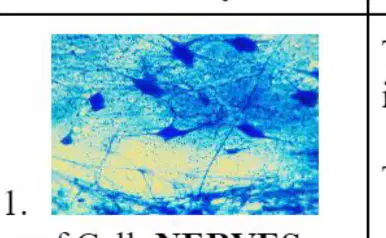
Which type of cell is shown in the image related to healing?
Skin cells
Muscle cells
Nerve cells
Blood cells
What is the role of nerve cells in the immune response?
To destroy bacteria
To start the healing response
To produce antibodies
To form a barrier
How do platelets help start scab formation?
By causing infection.
By slowing down the healing process.
By stopping bleeding and forming a clot.
By fighting infection.
Which type of cells are involved in fighting infection?
Red blood cells.
White blood cells
Nerve cells.
Muscle cells.
What can ruin the healing process by slowing it down?
White blood cells
Infection
Platelets
Scabs
What is the role of skin cells in the healing of a cut?
They stop the bleeding.
They create new structures and can force the wound to close.
They fight infection.
The send signals to start the immune response.
What organelle (cell structure) do nerves, skin and blood NOT have inside of them?
Mitochondria
Nucleus
Chloroplast
Cell membrane
The mitochondria is an important cell structure involved in healing because.
It commands all cell activity, including healing.
It creates the energy the cells need to do their jobs including healing.
It allows waste products out of the cell.
It creates healing properties like proteins.
The function of the cell membrane in the healing of a cut is....
to provide structure to the cell.
to direct the cell to make healing proteins.
to create energy from breaking down sugar.
to allow molecules like water, sugars, fats into the cell and to release healing proteins and waste products out.
The organelle that directs all other organelles in their role and function in healing is called the .....
Nucleus
Mitochondria
Endoplasmic Reticulum
Ribosome

What do seeds need in order to start growing?
wind
dirt
water & sunlight
The Stomata is ...
Part of the Chloroplast
A type of Vascular Tissue
An opening in the leaf to let in/out gas
An opening in the roots



