wayground logo

Free Printable Worksheets

NEW

Font size

S
M
L
XL
Worksheets

Genetics

Total questions: 66

Worksheet time: 57mins

Name
Class
Date
1.
Two brown eyed parents (Bb) have a baby. What is the chance the baby is blue eyed?
a)
0 %
b)
25%
c)
50%
d)
75%
2.
Dominant alleles are represented by a:
a)
Male gene
b)
lowercase letter
c)
recessive trait
d)
capital letter
3.
Which of the following is a phenotype?
a)
Aa
b)
red hair
c)
heterozygous genes
d)
mutated DNA
4.
Aa is
a)
homozygous (purebred)
b)
heterozygous (hybrid)
5.
In a heterozygous genotype, the ___________ allele takes over in the phenotype.
a)
recessive
b)
dominant
c)
lower case letter
d)
both 
6.
Why are your chromosomes arranged in pairs?
a)
Because DNA has a double-helix structure.
b)
Because pairs are able to divide more easily.
c)
Because you get one from your mother and one from your father.
d)
Scientists aren't sure.
7.
What kind of traits show themselves?
a)
shy traits
b)
brave traits
c)
recessive traits
d)
dominant traits
8.
What is the heterozygous genotype for having brown eyes?
(Remember: Brown (B) is dominant over blue (b).)
a)
BB
b)
Bb
c)
bb
9.
What is the homozygous genotype for having brown eyes?
(Remember: Brown (B) is dominant and blue (b) is recessive.)
a)
BB
b)
Bb
c)
bb
10.
What does heterozygous mean?
a)
An organism that has the same genes for a trait (TT or tt)
b)
An organism that has different genes for a trait (Tt)
c)
When neither gene is fully dominant; offspring is a mixture of both
d)
the different forms of a trait (hair color--> brown, blonde, red
11.
the passing of genetic traits from parent to offspring.
a)
heredity
b)
trait
c)
gene
d)
allele
12.
A single piece of coiled DNA found in the cells; contains genes that encode traits.
a)
gene
b)
chromosome
c)
trait
d)
DNA
14.
What is the definition of Heredity?
a)
the persons genes
b)
the genes 2 people have
c)
genetics passed from the  parent to the offspring.
d)
the division of sex cells and body cells
14.
What is the definition of Heredity?
a)
the persons genes
b)
the genes 2 people have
c)
genetics passed from the  parent to the offspring.
d)
the division of sex cells and body cells
15.
What is the definition of mitosis?
a)
The process that makes two daughter cells identical.
b)
cells split in three individual sex cells without duplicating DNA.
c)
the division of sex cells.
d)
Mrs. Carroll
16.
What is the definition of Genotype (choose the BEST answer)?
a)
a persons genes
b)
genes
c)
our jeans
d)
genes that are inside of us
17.
What is the definition of allele?
a)
trait that is there, but might not show
b)
the alternative forms of genes
c)
the observable chracerisitcs of an organism
d)
the non observable characteristics of an organism
18.
Humans have ___ chromosomes in their normal body cells. They received __ from their mother and __ from their father
a)
46, 23, 23
b)
92, 46, 46
c)
48, 24, 24
d)
1--, 50, 50
19.
Gregor Mendel studied heredity using ___ plants
a)
rose
b)
maize
c)
tundra
d)
pea
20.
If two different alleles for a trait are present and one allele doesn't entirely block the expression of the other, the genetic situation is called
a)
incomplete dominance
b)
codominance
c)
recessive
d)
purebred
21.
__ occurs when two different alleles act as dominant alleles. They are both expressed or appear in the phenotype.
a)
Incomplete Dominance
b)
Complete Dominance
c)
Codominance/Multiple Alleles
d)
Recessive Trait
22.
Squidward has light blue skin, and his genotype for this trait is Bb. Would Squidward be considered a purebred or hybrid for light blue skin?
a)
Purebred
b)
Hybrid
23.
Chromosomes are found in the ____________ of the cell
a)
Chloroplast
b)
Nucleus
c)
Cytoplasm
d)
Mitochondria
24.
The passing of DNA from parents to offspring
a)
Generation
b)
Heredity
c)
Inheritance
d)
Traits
25.
Which organelle is DNA usually found in?
a)
cell membrane
b)
vacuole
c)
chloroplast
d)
nucleus
26.
What are the possible combinations of a pea plant with the alleles PP and a male pea plant with the alleles pp.
P= purple
p= white
a)
all Pp
b)
all PP
c)
Pp,PP,Pp,PP
d)
all pp
27.
In asexual reproduction there is____ parent(s).
a)
two
b)
one
28.
A couple has 6 children, all girls. If the mother gives birth to a 7th child, what is the probability that the seventh child will be a girl?
a)
7 out of 7
b)
6 out of 7
c)
1 out of 2
d)
1 out of 7
29.
The primary function of the chromosome is to...
a)
relay messages between different cells in animals.
b)
transport waste materials rapidly out of the cell.
c)
release energy by breaking down food molecules.
d)
store the genetic instructions needed to specify traits.
30.
The inherited traits of an organism are governed by
a)
leukocytes
b)
cytoplasm
c)
genes
d)
enzymes
31.
In a heterozygous genotype, the ___________ allele takes over in the phenotype.
a)
recessive
b)
dominant
c)
lower case letter
d)
both 
32.
Homozygous is when...
a)
the alleles are the same
b)
the alleles are different
c)
the alleles are absent
d)
the alleles are present
33.
Purebred is another word for __________, while hybrid is another word for __________.
a)
dominant; recessive
b)
recessive; dominant
c)
homozygous; heterozygous
d)
heterozygous; homozygous
34.
A person with an XY chromosomes pattern will be
a)
a male
b)
tall
c)
smart
d)
athletic
35.
How many total chromosomes are shown in a normal human karyotype?
a)
2
b)
46
c)
44
36.
Why is DNA important?
a)
it is very small and very complicated
b)
it's in everything
c)
it serves as the blueprint for traits of all living things
d)
because we eat it every day for energy
37.

What is Vegetative Propagation?

a)

the organism produce its own spores. These spores are genetically identical to the parent

b)

only one parent provides DNA for the new organism, which would make the new organism or offspring genetically identical to its one parent.

c)

A new organism is created from the roots, stems or leaves.

d)

develops an outgrowth which is detached from the parent and becomes a new individual.

38.

What is Regeneration?

a)

develops an outgrowth which is detached from the parent and becomes a new individual.

b)

the organism produce its own spores. These spores are genetically identical to the parent

c)

Helps repair or grow lost body parts. Some of these animals can also grow new organisms from the individual pieces

d)

A new organism is created from the roots, stems or leaves.

39.

What is budding?

a)

the organism produce its own spores. These spores are genetically identical to the parent

b)

only one parent provides DNA for the new organism, which would make the new organism or offspring genetically identical to its one parent.

c)

A new organism is created from the roots, stems or leaves.

d)

develops an outgrowth which is detached from the parent and becomes a new individual.

40.

What is Binary Fission?

a)

develops an outgrowth which is detached from the parent and becomes a new individual.

b)

the organism produce its own spores. These spores are genetically identical to the parent

c)

during this type of reproduction the organism divides in half

d)

Organisms can be produced from unfertilized eggs

41.

What is a disadvantage of asexual reproduction?

a)

lack of diversity the offspring looks the same as the parent.

b)
  • can increase populations rapidly
  • does not require a mate for reproduction to take place
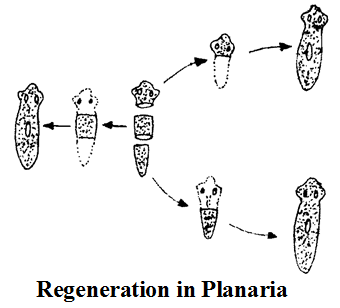
42.
a)
sexual
b)
asexual
43.
Which type of reproduction creates offspring from a single parent?
a)
asexual
b)
sexual
c)
internal
d)
external
44.
Which statement is always true about asexual reproduction?
a)
it always requires 2 parents
b)
all the offspring looks just like the parent
c)
it happens by joining two single-celled organisms
d)
an embryo is formed in the process
45.
Where does fertilization in a plant occur?
a)
flower
b)
leaf
c)
stem
d)
root
46.
A potato begins to develop new stems or sprouts from its eyes. Each of these sprouts can become a new potato plant. What is this?
a)
asexual reproduction
b)
sexual reproduction
c)
fertilization
47.
What does the image show?
a)
budding
b)
sporulation
c)
vegetative propagation
d)
binary fission
48.
If green is dominant over purple, then what is the genotype for this individual?
a)
Purple
b)
Green
c)
GG
d)
gg
49.
Which is the correct phenotype for this organism?
a)
BB
b)
blue
c)
green
d)
bb
50.
What is the genotype for this organism?
(E= 3 eyes, e= 1 eye)
a)
EE
b)
Ee
c)
ee
d)
EE or Ee
51.
All Offspring of Asexual reproduction are identical
a)
True
b)
False
52.
If the environment changes for an Asexual offspring it will?
a)
Explode
b)
Create another offspring
c)
Fall in love
d)
Die
53.
Which process is considered to be faster? 
a)
Asexual
b)
Sexual 
54.
How are genetic traits passed down from generation to generation?
a)
Chromosomes
b)
Reproduction
c)
DNA
d)
Genes
55.
a)
budding
b)
binary fission
c)
sporulation
d)
regeneration
56.
Which of the following best describes a DNA molecule?
a)
double helix
b)
contains ribose
c)
made of amino acids
d)
contains Uracil
57.
Why is DNA important?
a)
it is very small and very complicated
b)
it's in everything
c)
it serves as the blueprint for traits of all living things
d)
because we eat it every day for energy
58.
What part of our cells holds our DNA?
a)
cytoplasm
b)
cell membrane
c)
nucleus
d)
ribosomes
59.

Two parents contribute a sex cell to the new organism

a)

Sexual Reproduction

b)

Asexual Reproduction

c)

Sexual and Asexual Reproduction

60.

Creates a zygote (fertilized egg)

a)

Sexual Reproduction

b)

Asexual Reproduction

c)

Sexual and Asexual Reproduction

61.

Vegetative Reproduction

a)

Sexual Reproduction

b)

Asexual Reproduction

c)

Asexual and Sexual Reproduction

62.

Spores

a)

Asexual Reproduction

b)

Sexual Reproduction

c)

Sexual and Asexual Reproduction

63.

Binary Fission

a)

Asexual Reproduction

b)

Sexual Reproduction

c)

Sexual and Asexual Reproduction

64.

Budding

a)

Sexual Reproduction

b)

Asexual Reproduction

c)

Sexual and Asexual Reproduction

65.

Increases genetic variation

a)

Sexual Reproduction

b)

Asexual Reproduction

c)

Sexual and Asexual Reproduction

66.

Offspring have different traits that improve the chance that at least some offspring will survive

a)

Sexual Reproduction

b)

Asexual Reproduction

c)

Sexual and Asexual Reproduction