wayground logo

Free Printable Worksheets

NEW

Font size

S
M
L
XL
Worksheets

Thermal Energy

Total questions: 55

Worksheet time: 3620secs

Name
Class
Date
1.
Conduction is heat transfer by -
a)
Touch
b)
Circles
c)
Waves
2.
Warm air rises and the cool air sinks demonstrates this type of heat transfer. 
a)
conduction
b)
convection
c)
radiation
d)
Insolation 
3.
The heat from a hot burner to a pot is transferred by ______.
a)
convection
b)
insulation
c)
radiation
d)
conduction
4.
Radiation is a method of thermal energy transfer that moves -
a)
through empty space.
b)
when objects touch.
c)
only through solids.
d)
in the motion of fluids.
5.
Which of the following are kinds of heat transfer.
a)
Conduction
b)
Convection
c)
Radiation
d)
All of the above
6.

What type of heat transfer takes place in liquids and gasses?

a)

Conduction

b)

Convection

c)

Radiation

d)

Thermal Equilibrium

7.
What type of heat transfer takes place in solids?
a)
Conduction
b)
Convection
c)
Radiation
8.
Which example below is an example of radiation?
a)
Standing on a hot metal bridge
b)
The attic is warmer than the basement
c)
The Sun heating the Earth
d)
Touching hot sand with your feet
9.
What happens to particles as they heat up?
a)
They slow down
b)
Nothing
c)
They don't move
d)
They speed up
10.
What would be the effect on the particles if more heat is supplied to the system?
a)
They would slow down
b)
They would stop moving
c)
They would speed up
d)
There would be no effect
11.

What is defined as a measure of the average kinetic energy of the particles in a sample of matter?

a)

Temperature

b)

Heat

c)

Specific Heat

d)

Mechanical Energy

12.

_____________ is the form of energy that is transferred between systems or objects with different temperatures.

a)

Temerature

b)

Heat

c)

Specific Heat

d)

Mechanical Energy

13.

How does heat energy reach the Earth from the Sun

a)

Convection

b)

Radiation

c)

Conduction

d)

Insulation

14.
What is the definition of CONDUCTION?
a)
When heat is transferred from objects like rays of light or electromagnetically.
b)
a  hot liquid or air that  expands, becomes less dense, and rises or becomes more dense, and sinks.
c)
When heat transfers from objects that are touching.
d)
When heat transfers through the heater or AC in your house.
15.
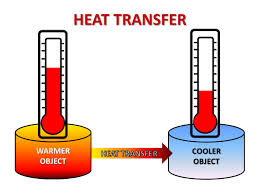
Heat transfers from an area of ____temperature to an area of ___ temperature.
a)
high to low
b)
low to high
c)
high to high
d)
It can travel high to low and low to high. 
16.

_________________ is the transfer of energy through or by electromagnetic waves.

a)

Conduction

b)

Convection

c)

Radiation

17.

Movements of water in a pot, molten mantle in the earth's crust and hot air rising in the atmosphere are examples of

a)

Sublimation

b)

Convection

c)

Conduction

d)

Radiation

18.
When the 2nd story of a house is warmer than the 1st floor of a house is heat transfer through 
a)
conduction
b)
convection
c)
radiation
d)
thermal equilibrium
19.
The sun warming your skin is an example of heat transfer through 
a)
conduction
b)
convection
c)
radiation
d)
thermal electricity
20.
What happens to particles as they cool down?
a)
They slow down
b)
Nothing
c)
They don't move
d)
They speed up
21.
Conduction, Convection and Radiation are three types of...
a)
Electrical energy
b)
Thermal Energy
c)
Chemical Energy
d)
Sound Energy
22.

Radiation is

a)

energy that comes from touching something

b)

energy you usually find in water

c)

energy that comes as wavelengths (like light) from something

d)

energy that moves the wax in a lava lamp

23.

______________ is the transfer of energy by touching

a)

Kinetic energy

b)

Radiation

c)

Conduction

d)

Convection

24.

Kinetic energy is energy based on ________________

a)

the sun

b)

radiation

c)

movement

d)

potential

25.
When you leave your cold drink outside, the glass may have water drops on it.  This is an example of...
a)
condensation
b)
evaporation
c)
precipitation
d)
estuary
26.

Which of the following is NOT a type of heat transfer?

a)

Conduction

b)

Convection

c)

Radiation

d)

Transformation

27.

Conduction is heat transfer by

a)

touch.

b)

currents.

c)

waves.

28.

Convection is heat transfer by-

a)

touch.

b)

currents.

c)

waves.

29.

Radiation is heat transfer by

a)

touch.

b)

current.

c)

waves.

30.

The sun's rays are an example of

a)

conduction.

b)

convection.

c)

radiation.

31.

Water molecules in boiling water is an example of

a)

conduction.

b)

convection.

c)

radiation.

32.

Heat transfer from a fire is an example of

a)

conduction.

b)

convection.

c)

radiation.

33.

Ironing a shirt is an example of

a)

conduction.

b)

convection.

c)

radiation.

34.

The transfer of heat energy through direct contact is

a)

conduction.

b)

convection.

c)

radiation.

35.
Conduction can only occur between two objects when –
a)
one object is less dense than the other.
b)
both objects are in physical contact with each other.
c)
one of the objects is made of a metal.
d)
both objects are exactly the same temperature.
36.
Radiation is a method of thermal energy transfer that moves -
a)
through empty space.
b)
when objects touch.
c)
only through solids.
d)
in the motion of fluids.
37.
On a cold rainy day a baby is touching a cold window.  It feels so cold. Which way is the heat moving moving? 
a)
Cold is moving from the window to the hand.
b)
Heat is moving from the hand to the window.
c)
Heat doesn't move.
d)
It moves in currents
38.
Heat transfer occurs
a)
in many directions
b)
both from warm objects to colder ones and from cold objects to warmer ones.
c)
only from warm objects to colder ones.
d)
only from cold objects to warmer ones.
39.

What happens to the kinetic energy of particles in a substance when the temperature is increased?

a)

The kinetic energy decreases.

b)

The kinetic energy remains the same.

c)

The kinetic energy increases.

d)

The kinetic energy is not affected by temperature.

40.

If you want to decrease the kinetic energy of particles in a glass of water, what should you do?

a)

Heat the water.

b)

Add more water.

c)

Place the water in a refrigerator.

d)

Stir the water vigorously.

41.

What is the effect on the gas inside a sealed container when the temperature drops?

a)

The particles spread out more.

b)

The particles move closer together.

c)

The particles gain kinetic energy.

d)

The pressure inside the container increases.

42.

Which of the following best describes the relationship between temperature and kinetic energy of particles?

a)

As temperature decreases, kinetic energy increases.

b)

As temperature increases, kinetic energy decreases.

c)

As temperature increases, kinetic energy increases.

d)

Temperature and kinetic energy are unrelated.

43.

How does adding ice to a glass of water affect the kinetic energy of the water particles?

a)

It increases the kinetic energy.

b)

It decreases the kinetic energy.

c)

It has no effect on the kinetic energy.

d)

It doubles the kinetic energy.

44.

Which of the following would result in an increase in the kinetic energy of particles in a liquid?

a)

Cooling the liquid.

b)

Heating the liquid.

c)

Adding more liquid.

d)

Removing some liquid.

45.
What is a measurement of the average kinetic energy of the particles in an object?
a)
Temperature
b)
Kinetic Energy
c)
Conductor
d)
Joules
46.
Which direction is heat flowing in the picture?
a)
from the hand to the ice
b)
from the ice to the hand
c)
heat is not being transferred
d)
there is no way to tell
47.
Thermal energy always moves:
a)
From a high temperature object to a lower temperature object.
b)
From a lower temperature object to a higher temperature object.
c)
From an object with lower kinetic energy to an object with higher kinetic energy.
d)
From an object of higher mass to an object of lower mass.
48.

Kinetic energy is...

a)

energy carried in ultraviolet waves

b)

energy stored in food

c)

energy in motion

d)

energy from splitting an atom

49.

At higher temperatures

a)

particles in an object have less kinetic energy

b)

particles in an object move faster

c)

a gas contracts

50.

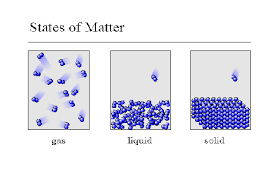
Which state of matter has particles that are somewhat close together and have enough kinetic energy to slide past each other?

a)

solid

b)

liquid

c)

gas

51.

Which of the following states of matter has the LOWEST level of kinetic energy?

a)

Solid

b)

Liquid

c)

Gas

d)

Plasma

52.
Which of the following is TRUE when particles GAIN Thermal Energy?
a)
Particles move more slowly
b)
Particles move further apart
c)
Particles stop moving
d)
Particles move closer together
53.

Which of the following states of matter can easily be compressed (made to fit into a small volume)?

a)

Solid

b)

Liquid

c)

Gas

54.
No Definite Shape and No Definite Volume
a)
Gas
b)
Liquid
c)
Solid
55.
All matter is made of _____ that are constantly moving.
a)
insulators
b)
particles
c)
convection
d)
pieces of plastic