
 Worksheets
Chapter 9 Behavior of Waves
Total questions: 90
Worksheet time: 1hrs 4mins
Name
Class
Date
1.

If this wave chain represents 1 second, What is the frequency of the waves?
a)
1 Hz
b)
9 Hz
c)
3 Hz
d)
6 Hz
2.

How many waves are in this wave chain?
a)
6
b)
3
c)
4
d)
5
3.
One end of the rope is vibrated to produce a wave with a wavelength of .25 m. The Frequency of the wave is 3.0 Hz. What is the speed of the wave?
a)
3.00 m/s
b)
2.50 m/s
c)
.75 m/s
d)
1.25 m/s
4.
Transverse and longitudinal waves both_____
a)
Have compression and rarefaction
b)
transfer energy through a medium
c)
move at right angles to the vibration of the medium
d)
are capable of moving the medium over a long distance
5.

What does the picture represent?
a)
diffraction
b)
reflection
c)
Interference
d)
refraction
6.
Sound is which type of wave?
a)
Longitudinal wave
b)
Transverse wave
c)
Standing wave
d)
Surface Wave
7.
Which wave causes the medium to vibrate only in the direction parallel to the wave's motion?
a)
S Waves
b)
Transverse waves
c)
Longitudinal waves
d)
Standing waves
8.

What type of wave is this?
a)
Surface Wave
b)
Standing Wave
c)
Electromagnetic Wave
d)
Transverse Wave
9.
A surface sends ripples across the lake water. These ripples are an example of _____
a)
Rarefaction
b)
Compression
c)
Longitudinal Wave
d)
Surface Wave
10.
For refraction to occur in a wave, the wave must_____
a)
Enter a new medium head on
b)
Enter a new medium at an angle
c)
Change the direction within a medium
d)
Strike an obstacle larger than the wavelength
11.
For refraction to occur in a wave, the wave must_____
a)
Enter a new medium head on
b)
Enter a new medium at an angle
c)
Change the direction within a medium
d)
Strike an obstacle larger than the wavelength
12.

The picture is an example of what?
a)
Diffraction
b)
Constructive Interference
c)
Destructive Interference
d)
Reflection
13.
When the surfer rides an ocean wave on her surfboard, she is actually riding on_____
a)
A crest that is toppling over
b)
The rest position of the wave
c)
A trough of the wave
d)
A region of rarefaction
14.

What does letter B stand for?
a)
Crest
b)
Rarefaction
c)
Trough
d)
Compression
15.
What is the formula for wave speed?
a)
speed = wavelength x period
b)
speed = wavelength x amplitude
c)
speed = frequency x amplitude
d)
speed = wavelength x frequency
16.
A period is the length of time it takes for ________
a)
a disturbance to start a wave
b)
two complete wavelengths
c)
a wave to travel the length of a rope
d)
one complete wavelength to pass a fixed point
17.
Amplitude of a wave is dependent on which other characteristic of a wave?
a)
Frequency
b)
Wavelength
c)
Energy
d)
Wave Speed
18.
To find the amplitude, measure_____
a)
From a trough to the rest position
b)
from the crest to the rest position
c)
neither a or b
d)
either a or b
19.
How does reflection differ from refraction and diffraction?
a)
reflection is the only process that involves a change in the wave
b)
reflection affects all types of mechanical waves but refraction and diffraction doesn't
c)
Reflection is the only process in which the wave does not continue moving forward
d)
Reflection is the only process that changes the direction of the wave
20.

The Picture is an example of ________
a)
Diffraction
b)
Longitudinal wave
c)
Constructive Interference
d)
Destructive Interference
21.
What is one property of a wave that determines how much it will diffract when it encounters an obstacle?
a)
speed
b)
amplitude
c)
polarization
d)
wavelength
22.
Pitch of a sound is directly related to what characteristic of a wave?
a)
Amplitude
b)
Wavelength
c)
Compression
d)
Frequency
23.
_____is the bending of a wave as it moves around an obstacle or passes through a narrow opening.
a)
Interference
b)
Diffraction
c)
Reflection
d)
Refraction
24.

Which type of wave is represented in this picture
a)
Electromagnetic wave
b)
transverse wave
c)
surface wave
d)
longitudinal wave
25.
__________is the bending of a wave as it enters a new medium at an angle.
a)
Refraction
b)
Reflection
c)
Diffraction
d)
Interference
26.
_____is the bending of a wave as it moves around an obstacle or passes through a narrow opening.
a)
Interference
b)
Diffraction
c)
Reflection
d)
Refraction
27.

the lowest point of a transverse wave
a)
mechanical wave
b)
medium
c)
crest
d)
trough
28.
A mechanical wave generally does NOT _____
a)
move the medium from one place to another
b)
move through a medium
c)
move through a solid
d)
disturb the medium
29.
A wave vibrating at right angles to the direction of the waves motion.
a)
surface wave
b)
medium
c)
transverse wave
d)
P waves
30.

What does this picture represent?
a)
Diffraction
b)
Constructive Interference
c)
Standing Waves
d)
Destructive Interference
31.

What does this picture represent?
a)
Diffraction
b)
Constructive Interference
c)
Standing Waves
d)
Destructive Interference
32.

What is represented at letter J?
a)
Amplitude
b)
Crest
c)
Trough
d)
Wavelength
33.

What is represented by letter G?
a)
Wavelength
b)
Crest
c)
Trough
d)
Amplitude
34.
What is vibration?
a)
how loud a sound is
b)
the back and forth movement of matter
c)
how high or low a sound is
d)
the loudness or softness of a sound
35.
This is what you get when sound waves are reflected, or bounce back, off of a hard surface.
a)
Amplitude
b)
Pitch
c)
Volume
d)
Echo
36.
The number of wavelengths that pass a point each per second is:
a)
frequency
b)
period
c)
longitudinal
d)
transverse wave
37.
The units for frequency are measured in _____________.
a)
hertz
b)
seconds
c)
m/s
d)
m
38.

Which statement can be made based on these data?
a)
Sound waves are slowest in liquids and fastest in gases.
b)
Sound waves are fastest in solids and slowest in gases.
c)
Speed of a sound wave increases from one medium to another.
d)
Speed of a sound wave decreases from one medium to another.
39.
If 3 complete wavelengths pass a fixed point in 2 seconds What is the frequency of the wave?
a)
3 Ha
b)
1.5 Hz
c)
3 Hz
d)
6 Hz
40.
Reflection does not change the speed or frequency of a wave, but the wave can be…
a)
thrown in a circle
b)
multiplied
c)
flipped upside down
d)
lengthened
41.
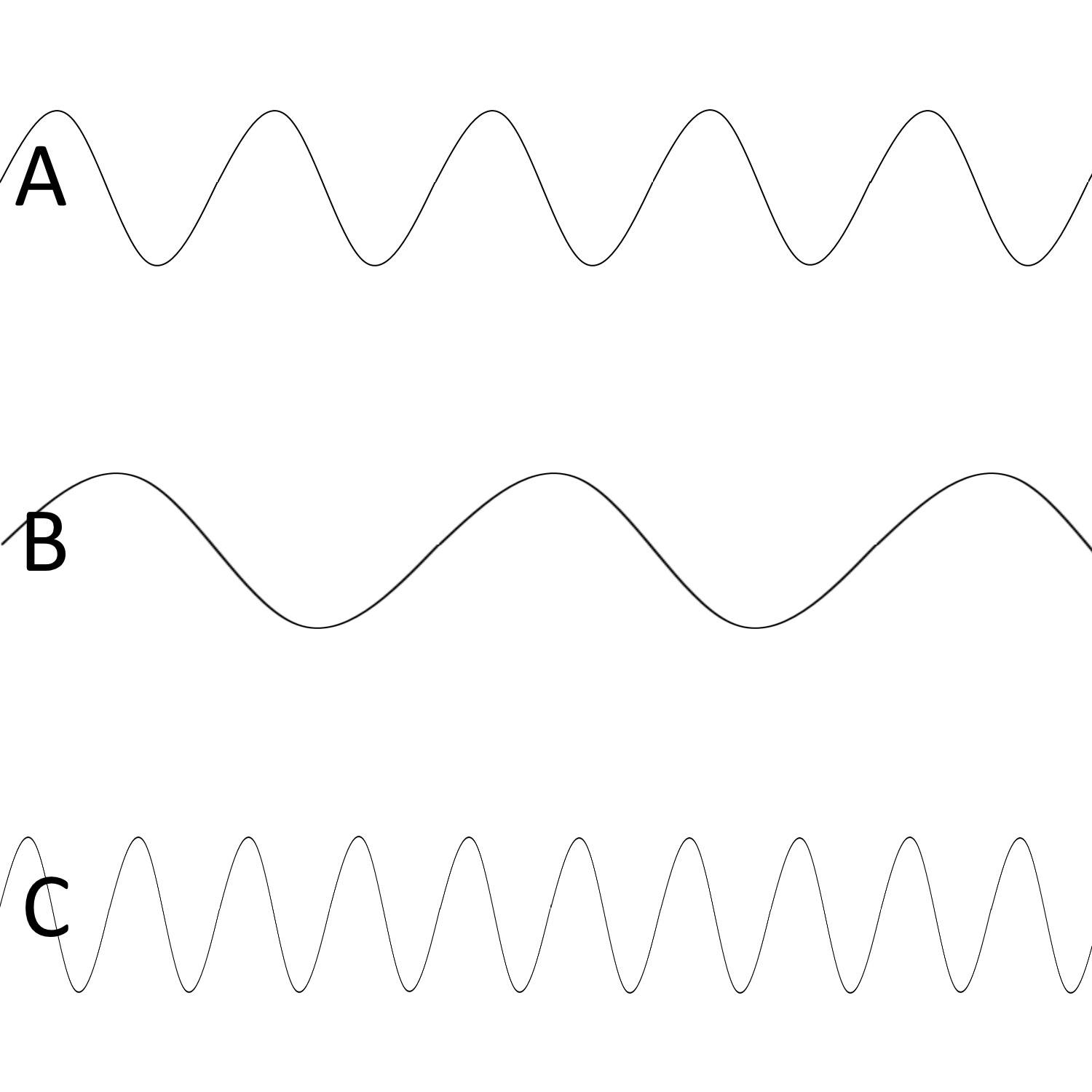
Which wave has the largest wavelength?
a)
A
b)
B
c)
C
d)
None (same wavelength)
42.

Which wave has the largest frequency?
a)
A
b)
B
c)
C
d)
None (same frequency)
43.

If all three are waves of light, which wave has the largest speed?
a)
A
b)
B
c)
C
d)
None (same speed)
44.
Which particle is a wave of light?
a)
proton
b)
neutron
c)
electron
d)
photon
45.

Which type of light has the lowest energy of this group?
a)
Radio
b)
Microwave
c)
Infrared
d)
Ultraviolet
46.
Which type of light has the largest wavelength of this group?
a)
X-rays
b)
Microwave
c)
Infrared
d)
Ultraviolet
47.

Which type of light has the highest energy of this group?
a)
red
b)
yellow
c)
green
d)
blue
48.
Which type of light has the smallest frequency of this group?
a)
red
b)
yellow
c)
green
d)
blue
49.
When an electron absorbs a photon of light, it also...
a)
gains positive charge
b)
gains negative charge
c)
increases energy level
d)
decreases energy level
50.

This color in the visible part of the spectrum has the highest energy.
a)
Blue
b)
Red
c)
Violet
d)
Yellow
51.

This color in the visible part of the spectrum has the lowest energy.
a)
Blue
b)
Green
c)
Red
d)
Violet
52.
Radio waves and _______ are used in communication
a)
Microwaves
b)
Gamma rays
c)
Visible light
d)
Ultraviolet
53.
When an electron emits a photon of light, it also...
a)
gains positive charge
b)
gains negative charge
c)
increases energy level
d)
decreases energy level
54.
This color in the visible part of the spectrum has the smallest wavelength.
a)
Blue
b)
Red
c)
Violet
d)
Yellow
55.
This color in the visible part of the spectrum has the largest frequency.
a)
Orange
b)
Yellow
c)
Blue
d)
Green
56.
The following path of an electron emits a light wave that our eyes can detect.
a)
Ground -> Excited
b)
Excited -> Ground
c)
One full orbit of the nucleus
d)
Protons emit light. The question is misleading.
57.
The highest point on a transverse wave is the
a)
compression
b)
crest
c)
rest position
d)
trough
58.
What does a wave carry from place to place?
a)
energy
b)
matter
c)
people
59.
Waves move ___ through vibrations
a)
Energy
b)
Matter
c)
Mass
d)
Weight
60.
Longitudinal waves are ______.
a)
Parallel
b)
Perpendicular
c)
Crazy
61.
Transverse waves are ___.
a)
Parallel
b)
Perpendicular
c)
Weird
62.
What is the wavelength?
a)
Length
b)
Height
c)
# of waves
63.
If the frequency gets higher, the wavelength gets
a)
longer
b)
shorter
64.

Which is the wavelength?
a)
1
b)
2
c)
3
d)
4
65.
If the wavelength gets longer, the frequency gets
a)
higher
b)
lower
66.
Which electromagnetic wave is responsible for cell phones?
a)
gamma
b)
xray
c)
microwaves
d)
radio
67.
Which EM wave is used to treat cancer?
a)
gamma
b)
radio
c)
xray
d)
infrared
68.

Which EM wave has the lowest frequency?
a)
radio
b)
xray
c)
gamma
d)
infrared
69.
The loudness of the sound depends on
a)
wavelength
b)
amplitude
c)
frequency
70.
The pitch of the sound depends on
a)
frequency
b)
amplitude
c)
wavelength
71.

Which EM wave has the longest wavelength?
a)
light
b)
radio
c)
ultraviolet
d)
red
72.

Which color has the highest frequency?
a)
blue
b)
yellow
c)
orange
d)
violet
73.

Which color has the lowest frequency?
a)
red
b)
green
c)
blue
d)
violet
74.
Rainbows are ______ light.
a)
Refracting
b)
Reflecting
c)
Diffracting
d)
Absorbing
75.
A blue tshirt looks blue because of ___.
a)
reflection
b)
refraction
c)
diffraction
76.
Light hits the ____ in your eyes telling your brain which color you see.
a)
Cones
b)
Retina
c)
Pupil
d)
Cornea
77.
Is refracting light bending or bouncing?
a)
bending
b)
bouncing
78.

What part of the wave is shown at letter A?
a)
crest
b)
trough
c)
wavelength
d)
frequency
79.
What happens to frequency when the energy increases?
a)
it increases
b)
it decreases
c)
it stays the same
80.

Which part of the wave is shown at letter B?
a)
crest
b)
trough
c)
wavelength resting point
81.

Which part of the wave is shown at letter C?
a)
crest
b)
wavelength
c)
resting point
d)
amplitude
82.

Which part of the wave is shown at letter E?
a)
trough
b)
crest
c)
resting point
d)
amplitude
83.

Which part of the wave is shown at letter D?
a)
trough
b)
resting point
c)
wavelength
d)
frequency
84.
What does a wave carry?
a)
boats
b)
matter
c)
energy
d)
water
85.

What is the frequency of this wave?
a)
3 Hertz
b)
4 Hertz
c)
5 Hertz
d)
6 Hertz
86.
If there is no wave, the particles would be at the _____________________.
a)
wavelength
b)
resting point
c)
trough
d)
beach
87.

Which wave has a longer wavelength?
a)
wave C
b)
wave D
88.
What is the speed of a wave that has a wavelength of 2 and a frequency of 2.5?
a)
2.5 m/s
b)
5 m/s
c)
4.5 m/s
d)
6 m/s
89.

Which wave has a greater frequency?
a)
wave B
b)
wave C
90.

Which wave has the most energy?
a)
top wave
b)
bottom wave
100 %

