
 Worksheets
Quarter Review
Total questions: 90
Worksheet time: 1hrs 15mins

What is the unit to MEASURE force?
Kilogram
Meter
Pounds
Newton

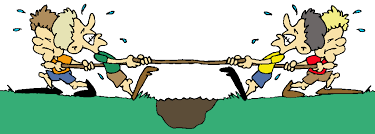

A car braking is an exmaple of what type of force?
Gravity
Air Resistance
Friction
Rubbing a balloon on your head causes charge to build up on the balloon The balloon can then "stick" to the wall - what force is acting here?
Gravity
Electrostatic
Friction
Applied

Why do planets orbit the Sun?
The Sun is the only celestial object that has a gravitational pull.
The Sun’s chemical composition makes it attract planets.
Only celestial bodies that emit light, like the Sun, can be at the center of an orbit.
The Sun is the most massive object in our solar system, so it exerts the greatest gravitational pull.
Atoms That have a positive charge will be attracted to atoms with a _______ charge.
Positive
Negative
Neutral
Which of these forces works only by combining electric and magnetic forces?
Magnetic
Electric
Electromagnetism
This force occurs when ions create attractive and repulsive forces.
Magnetic
Electric
Electromagnetism

A runner races in the 100 meter dash. It takes her 10 seconds to finish. What is her average speed?
10 m/s
1000 m/s
100 seconds
10 seconds

Which EM waves have the longest wavelength?
radio
x-rays
ultraviolet
gamma rays
Which EM waves have the shortest wavelength?
radio
x-rays
ultraviolet
gamma rays
Which EM waves are invisible? (more than one correct answer)
radio
visible
ultraviolet
gamma rays
Which EM waves are have the lowest frequency?
radio
none
infrared
x-rays
Which EM waves are have the highest energy & are the most dangerous?
radio
gamma rays
infrared
x-rays
Which type of electromagnetic wave travels fastest through a vacuum?
radio
gamma rays
visible light
They all travel at the same speed.

The diagram shows a person observing a thunderstorm located several kilometers away. The person hears the thunder several seconds after seeing the lightning. Which statement accurately explains the difference in observations of sound and light by the observer?
Human eyes see light faster than their ears can hear sound.
The medium the waves are traveling through is different for each type of wave.
Light waves travel faster than sound waves.
Sound waves travel faster than light waves.

The diagram below shows a pencil in a glass of water. When viewed from the side, the pencil appears to be broken. What process causes this to happen?
absorption
evaporation
reflection
refraction

The diagram below shows a light ray. In this diagram, the light ray is being
transmitted
absorbed
reflected
refracted
What do electromagnetic waves NOT need to transfer energy?
matter
speed
wavelength
frequency
In the electromagnetic spectrum, which of the following is true of waves with long wavelengths?
They have high frequencies
They have low frequencies
They have moderate frequencies
They have inconsistent frequencies
Sunscreen bottles often include the phrase: “Protects against UVA and UVB waves.” This refers to ultraviolet radiation coming from the sun. Which of the following is true of ultraviolet radiation?
Ultraviolet radiation has shorter wavelengths than x-rays, therefore it is more dangerous than xrays.
Ultraviolet radiation has longer wavelengths than infrared light, therefore it is more dangerous than infrared light.
Ultraviolet radiation has shorter wavelengths than visible light, therefore it is more dangerous than visible light.
Ultraviolet radiation has longer wavelengths than gamma radiation, therefore it is more dangerous than gamma radiation.

The distance between E and H is called
Crest
Wavelength
Amplitude
Frequency

The diagram below shows the electromagnetic spectrum. Which letters represent radio and gamma waves?
A F
F C
A G
C G


The color of visible light that has the longest wavelength is (a) .
Which of the following is true about visible light? (check all that apply)
can bend
can reflect
used for medical scans
includes ROYGBIV
Cause skin cancer
Uses of infrared? (check all that apply)
Night vision goggles
Heat Lamps.
Satellite communications
TV remotes
Cause skin cancer

A slingshot that has been pulled back, but has not been let go.
Kinetic
Potential
A bobsled is moving at its greatest speed around the final turn.
Kinetic
Potential

Freezing
F
C
A
D
Liquid to Gas
melting
vaporization
condensation
sublimation

Sublimation
A
B
C
F
Condensation
endothermic
exothermic
Solid to liquid
freezing
melting
sublimation
condensation
What happens to molecules when their kinetic energy increases?
The molecules move slower
The molecules move faster
The molecules get heavier
It depends on the type of molecule

Three containers with the same amount of the same material are shown below. Which container has the substance with the highest amount of energy?
The container on the left
The middle container
The container on the right
All have an equal amount of energy
Three containers with the same amount of the same material are shown below. Which container has the substance with the lowest amount of energy?
The container on the left
The middle container
The container on the right
All have an equal amount of energy
Amy was sitting outside on a hot, summer day, enjoying a glass of sweet iced tea. She notices some water droplets on the outside of her glass. What is causing those water droplets?
The outside air is heating up the ice, causing it to melt into a liquid.
The cold liquid in the glass is cooling the air around it, making it condense into a liquid.
The outside air is heating up the liquid in the glass, causing it to evaporate.
The liquid in the glass is cooling the air around it, causing it to evaporate.
The slower the particles in a substance move,
the colder it is.
the warmer it is.
the more energy it has.
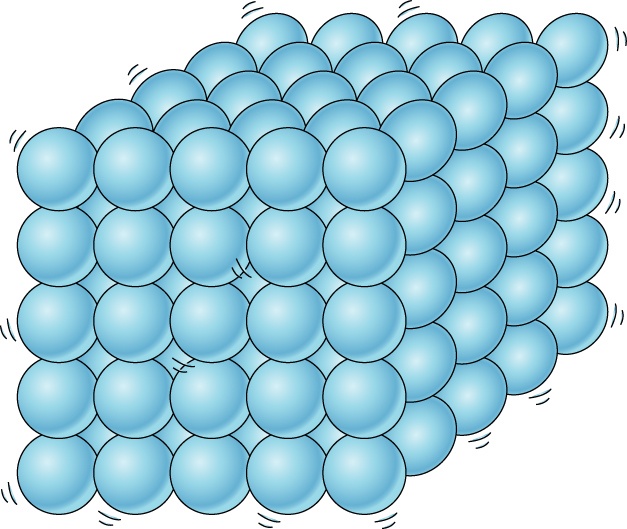
What state of matter?
Solid
Liquid
Gas
Plasma!!!
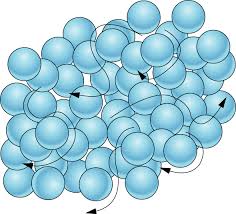
What state of matter?
Solid
Liquid
Gas
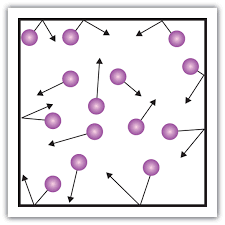
What state of matter?
Solid
Liquid
Gas

TRUE/FALSE: Matter can change from one phase to the other just as water can evaporate.
True
False

How many protons are in Sodium?
11
22
12
33

How many electrons are in Aluminium?
40
27
13
14

How many neutrons are in Magnesium?
36
12
24
6

How many neutrons are in Phosphorus?
16
15
31
46

How many electrons are in Sulfur?
32
16
48
8

How many protons are in Chlorine?
35
18
17
52

How many neutrons are in Argon?
18
40
58
22
Which charge is POSITIVE?
Proton
Neutron
Electron
Cell
Which charge is NEGATIVE?
Proton
Neutron
Electron
Cell
Which particle is NEUTRAL - NO CHARGE?
Proton
Neutron
Electron
Cell
All of the COLUMNS on the Periodic Table are called?
Periods
Rows
Groups
Lines
All of the ROWS on the Periodic Table are called what?
Periods
Groups
Columns
Lines
Column / Group 2 on the Periodic Table has what family name?
Alkali Metals
Alkali Earth Metals
Halogens
Noble Gases
The NOBLE GASES are considered:
Metals
Nonmetals
Metalloids
None
Which type of particle would you find floating around the nucleus, outside of the atom with its negative charges?
Proton
Neutron
Electron
Nucleus
Which TWO particles are found housed in the nucleus of the atom?
Protons and Electrons
Protons and Neutrons
Electrons and Neutrons
Protons, Neutrons, and Electrons

What is an element?
A substance that is made up of one type of atom and can't be reduced to simpler substances.
A substance made of two or more different atoms chemically bonded to one another. They can only be destroyed by chemical processes.
A material containing two or more elements or compounds that are in close contact and are mixed in any proportion. They can be separated by physical means.


Milk
Solution
Suspension
Colloid

Sand in Water
Solution
Suspension
Colloid

Vinegar
Solution
Suspension
Colloid

Oil in Water
Solution
Suspension
Colloid

Shaving Cream Foam
Solution
Suspension
Colloid
Which of the following values would represent the pH of a strong base?
1
8
7
13
A substance has a pH value of 8. It is most likely to be what?
Strong acid
Weak acid
Strong base
Weak base
Mass is ________________________________.
The amount of matter in an object.
Anything that has Mass and volume.
The amount of space an object occupies.
Which of the following is a heterogenous mixture?
neon
soil
steel
salt water
Which of the following is a homogeneous mixture?
sand in a bottle
lemonade
Mercury
salad

Diagram B is an example of a(n)
element
compound
mixture

Which of the diagrams below represent a mixture?
A
B
C
D
Fish breathe oxygen, which is dissolved in water. Is the oxygen the fish breathe considered to be the solute or solvent?
Solute
Solvent
Pure water has a pH of 7
is a base
is a neutral substance
is an acid
could be either an acid or a base

Based on the image which liquid is the most dense?
(a)

The ping pong ball is floating on top because it is the most :
lowest in volume
lowest in mass
lowest in density

Which box has a higher density?
A
B
They are the same

