

Wayground logo

Free Printable Worksheets

Font size

S
M
L
XL
Worksheets

IC2 Chemical Equations

Total questions: 29

Worksheet time: 3575secs
Name
Class
Date
1.

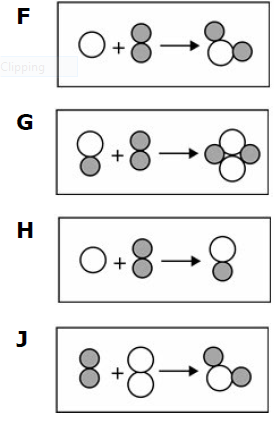
Which of the following models best demonstrates a balanced chemical equation?

a)

F

b)

G

c)

H

d)

J

2.

Which of these formulas contain equal numbers of nitrogen atoms?

a)

Formulas I and V

b)

Formulas I and IV

c)

Formulas II and III

d)

Formulas III, and IV

3.
The reactants are on the left side of the chemical equation.
a)
True
b)
False
4.
All of the following reactions are correctly balanced except-
a)
A
b)
B
c)
C
d)
D
5.

In a ___________change, a substance changes into a different substance.

a)

Physical

b)

Chemical

6.

The Law of Conservation of Mass states

a)

that matter exists in all states and reacts the same

b)

that matter can only be changed into new substances by introducing a catalyst

c)

that matter exists in the same state throughout any chemical change

d)

that matter cannot be created or destroyed and that the mass of the products must equal the mass of the reactants

7.

How many Al atoms are in this coefficient and compound ? 4Al2O3

a)

2

b)

8

c)

6

d)

4

8.

How many F atoms are in this coefficient and compound?

6MgF2

a)

2

b)

6

c)

8

d)

12

9.
What are the PRODUCTS of the chemical reaction pictured?
a)
CH4 and CO2
b)
CH4 and O2
c)
CO2 and H2O
d)
O2 and H2O
10.
Two Reactants and One Product
a)
Decomposition
b)
Combination
c)
Combustion
d)
Single Replacement
11.
CxHy +O2 --> H2O + CO2
a)
Decomposition
b)
Double replacement
c)
Combustion
d)
Single Replacement
12.
One reactant into several products.
a)
Decomposition
b)
Synthesis
c)
Combustion
d)
Single Replacement
13.
One element replaces another in a compound.
a)
Synthesis
b)
Combustion
c)
Single Replacement
d)
Double Replacement
14.
Si + S8 --> Si2S4
a)
Synthesis (combination)
b)
Decomposition
c)
Single replacement
d)
Double replacement
15.
The following reaction is an example of what reaction type? 
CoCO3 → CoO + CO2
a)
Synthesis
b)
Decomposition
c)
Single Replacement
d)
Double Replacement
16.
KOH + H3PO4 --> K3PO4 + H2O
a)
Synthesis (combination)
b)
Decomposition
c)
Single replacement
d)
Double replacement
17.
What are the products in the following chemical equation? 
2H2 + O2   -->   2H2O
a)
H2
b)
O2
c)
2H2 + O2
d)
2H2O
18.
3Ca + 2AlCl3 --> 3CaCl2 + 2Al
a)
Synthesis
b)
Decomposition
c)
Single diplacement
d)
Double displacement
19.
C3H6O + 4 O2 -->3 CO2 + 3 H2O 
a)
single
b)
double
c)
combustion
d)
synthesis
20.
Type of Reaction? 
____ O2 + ____ C5H12O2  => 
a)
Single Replacement
b)
Combustion
c)
Decomposition
d)
Double Replacement
21.
Type of Reaction? 
____ PbSO4 + ____ AgNO3 =>   
a)
Single Replacement
b)
Combustion
c)
Decomposition
d)
Double Replacement
22.
Which of the following is a product of the equation:

Cl2  +  KBr  => 
a)
BrCl
b)
K2
c)
KCl
23.

Which of the following is one of the products of the equation:


AgNO3 + MgCl2 =>

a)

AgMg

b)

NO3Cl2

c)

MgNO3

d)

Mg2NO3

24.

Which of the following is the product of the equation: HINT: Balance the charges in the ionic compounds!


K + N2 =>

a)

KN

b)

K2N

c)

K3N

d)

KN3

25.
Balance this reaction: ____ NaF + ____ Br2 ---> ____ NaBr + ____ F2
a)
3,1,2,1
b)
1,2,3,4
c)
2,1,2,1
d)
1,2,1,2
26.
Balance this reaction: ____ Na3PO4 + ____ KOH ---> ____ NaOH + ____ K3PO4
a)
1,3,3,1
b)
1,3,2,1
c)
2,3,3,1
d)
1,1,3,1
27.
Balance this reaction: ____ C5H14 + ____ O2 ----> ____ CO2 + ____ H2O
a)
1,8,5,7
b)
2,12,5,14
c)
3,27,15,24
d)
2,17,10,14
28.
_Al + _HCl →_H2 + _AlCl3
a)
2 Al + 2 HCl → 2 H2 + 6 AlCl3
b)
3 Al + 3 HCl → 6 H2 + 2 AlCl3
c)
1 Al + 1 HCl → 3 H2 + 1 AlCl3
d)
2 Al + 6 HCl → 3 H2 + 2 AlCl3
29.
Balance this equation,            Al2O3 ---> Al + O2 
a)
Cannot be balanced
b)
2Al2O3 ---> 2Al + 3O2 
c)
2Al2O3 ---> 4Al + 3O2 
d)
3Al2O3 ---> 2Al + O2
