wayground logo

Free Printable Worksheets

NEW

Font size

S
M
L
XL
Worksheets

Physical Chemical Earth Biology Questions

Total questions: 62

Worksheet time: 43mins
Name
Class
Date
1.
The natural chemical or physical processes that breaks down rock on Earth's surface.
a)
weathering
b)
erosion
c)
deposition
d)
jackhammering
2.
These rocks were made smooth by wind blowing smaller rock particles across their surface.  This is an example of:
a)
ice wedging
b)
chemical weathering
c)
acid rain
d)
abrasion
3.
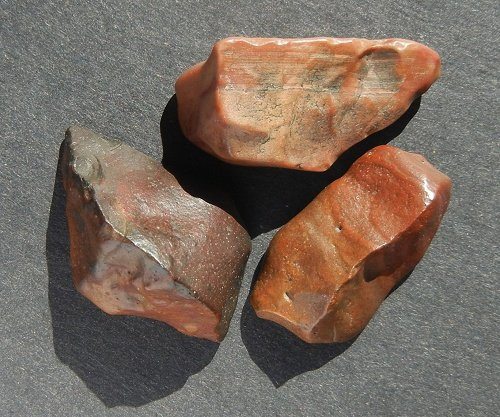
These rocks were broken apart from the continuous freeze/thaw of water in the cracks of the rocks. This is an example of:
a)
ice wedging
b)
acid rain
c)
permeability
d)
abrasion
4.

Potholes forming in the road after a cold winter is an example of:

a)

physical weathering

b)

chemical weathering

5.
How does freezing water cause the weathering of rocks?  The freezing water—
a)
keeps the rocks in place
b)
makes the rocks last longer
c)
expands cracks and breaks rocks
d)
causes rocks to fall in landslides
6.
All of the following are causes of physical weathering except...
a)
plant growth
b)
wind
c)
acid rain
d)
running water
7.
Rocks being made smooth by tumbling across a streambed
a)
Weathering
b)
Erosion
c)
Deposition
8.
Rust that forms on rocks or metal because of extended exposure to oxygen is what example of chemical weathering?
a)
carbon dioxide (carbonic acid)
b)
acid rain
c)
oxidation
d)
lichens
9.
Which type of climate will have faster chemical weathering?
a)
Hot and Wet
b)
Cold and Dry
c)
Hot and Cold
d)
Cold and Wet
10.
What is the relationship between surface area and the rate of weathering?
a)
As surface area increases, the rate of weathering decreases
b)
As surface area increases, the rate of weathering increases
c)
As surface area decreases, the rate of weathering increases
d)
There is no relationship
11.
What does it mean when a rock's surface area increases?
a)
There are more surfaces available to be weathered on the rock
b)
There are less surfaces available to be weathered on the rock
c)
The rock has weathered completely
d)
Surface area has nothing to do with rocks
12.
Which of the following is an example of chemical weathering?
a)
Acid rain dissolving limestone
b)
roots breaking into concrete
c)
paper being ripped
d)
Water running over rocks
13.
All of the following are causes of physical weathering except...
a)
plant growth
b)
wind
c)
acid rain
d)
running water
14.
How does freezing water cause the weathering of rocks?  The freezing water—
a)
keeps the rocks in place
b)
makes the rocks last longer
c)
expands cracks and breaks rocks
d)
causes rocks to fall in landslides
15.
How does freezing water cause the weathering of rocks?  The freezing water—
a)
keeps the rocks in place
b)
makes the rocks last longer
c)
expands cracks and breaks rocks
d)
causes rocks to fall in landslides
16.
Chemical weathering
a)
May change the composition of a piece of rock, but definitely changes the size.
b)
Is no different from mechanical weathering in changing rocks.
c)
Is much less important than mechanical weathering because it acts under very few conditions.
d)
May change the size of a piece of rock, but definitely changes the composition.
17.
What type of weathering is it when acid rain breaks down and changes the rock.
a)
chemical weathering 
b)
physical or mechanical weathering
c)
erosion
18.

This type of weathering occurs when rocks weaken then break down due to chemical changes in the composition of the rock.

a)

mechanical weathering

b)

chemical weathering

c)

erosion weathering

d)

deposition

19.

The picture is demonstrating what type of weathering?

a)

physcial

b)

chemical

20.

The Statue of Liberty is an example of what type of weathering?

a)

physical

b)

chemical

21.

Which layer of sediment is least resistant to weathering?

a)

A

b)

B

c)

C

d)

D

22.

Which layer of sediment is most resistant to weathering?

a)

A

b)

B

c)

C

d)

D

23.

A sidewalk being uprooted by a tree is an example of

a)

frost action

b)

biological action

c)

abrasion

d)

oxidation

24.

Which lettered diagram will be most resistant to weathering?

a)

A

b)

B

c)

C

25.

Which lettered diagram has the greatest surface area?

a)

A

b)

B

c)

C

26.

An area that has an average yearly temperature of 5 oC and an average yearly precipitation of 75 cm has what kind of climate?

a)

Slight frost action

b)

moderate chemical weathering with frost action

c)

moderate chemical weathering

d)

strong frost action

e)

moderate frost action

27.

Which conditions are possible for an area with very slight weathering?

a)

0 oC and 25 cm

b)

75 cm and 20 oC

c)

25 oC and 100 cm

d)

30 oC and 105 cm

28.

The breakdown of rock material due to physical and chemical changes

a)

deposition

b)

erosion

c)

weathering

d)

abrasion

29.

Physical weathering changes....

a)

the composition of the rock

b)

the shape and size

c)

the shape and density

d)

the size and density

30.

Frost action happens due to

a)

the contraction and shrinkage of water in the racks of rocks

b)

the contraction and expansion of water in the cracks of rocks

c)

the enlargement and expansion of water in the cracks of rocks

31.

When rocks are transported they bounce or collide into one another. These collisions cause the rocks to change size and shape. This is an example of

a)

physical weathering: abrasion

b)

physical weathering: biological action

c)

chemical weathering: abrasion

d)

chemical weathering: frost action

32.

Burrowing animals and plant roots grown in the cracks of rocks causing them to split or break part.

a)

frost action

b)

abrasion

c)

acid rain

d)

biological action

33.

Changing the composition of a rock form a new substance

a)

chemical weathering

b)

physcial weathering

c)

erosion

d)

deposition

34.

An example of chemical weathering

a)

the formation of caves

b)

the breaking up of rock by bouncing along the bottom of a stream

c)

a pot hole

d)

biological action

35.

An example of carbonic acid is also known as...

a)

rust

b)

oxidation

c)

acid rain

36.

All of the following affect the rate of weathering except...

a)

composition of the rock

b)

type of climate

c)

amount of surface area exposed

d)

how much force is on the rock

37.

Which type of climate increases the rate of weathering?

a)

warm and wet

b)

warm and dry

c)

cold and wet

d)

cold and dry

38.

Which will weather faster?

a)

a boulder

b)

a cobble

c)

a pebble

39.
a)

A

b)

B

c)

C

d)

D

40.
a)

A

b)

B

c)

C

d)

D

41.
a)

A

b)

B

c)

C

d)

D

42.
a)

A

b)

B

c)

C

43.
a)

A

b)

B

c)

C

d)

D

44.
a)

A

b)

B

c)

C

d)

D

45.
a)

A

b)

B

c)

C

d)

D

46.
a)

A

b)

B

c)

C

d)

D

47.
a)

A

b)

B

c)

C

d)

D

48.
a)

A

b)

B

c)

C

d)

D

49.
a)

A

b)

B

c)

C

d)

D

50.
a)

A

b)

B

c)

C

d)

D

51.
a)

A

b)

B

c)

C

d)

D

52.
a)

A

b)

B

c)

C

d)

D

53.
a)

A

b)

B

c)

C

d)

D

54.
a)

A

b)

B

c)

C

d)

D

55.
The process of breaking up Earth's surface into sediment is called...
a)
sediment
b)
erosion
c)
weathering
d)
deposition 
56.
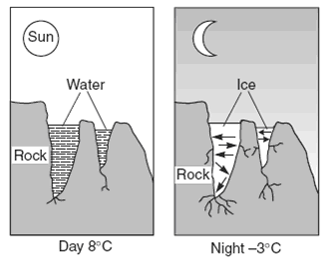
The diagrams  shows a natural process that weathers rock.
 Which statement best explains why this process results in weathering?
a)
frozen water acts as a solute
b)
water expands when it freezes
c)
the mass of water increases when it freezes
d)
frozen water dissolves most types of rock
57.
Which type of climate will have faster chemical weathering?
a)
Hot and Wet
b)
Cold and Dry
c)
Hot and Cold
d)
Cold and Wet
58.
How does freezing water cause the weathering of rocks?  The freezing water—
a)
keeps the rocks in place
b)
makes the rocks last longer
c)
expands cracks and breaks rocks
d)
causes rocks to fall in landslides
59.
How do plants weather rocks?
a)
during photosynthesis
b)
when roots grow into cracks of rocks and expand the rock
c)
when the plant moves water from the roots to the leaves
d)
Plants don't weather rocks
60.

Which image below shows an effect of ice wedging?

a)
b)
c)
d)
61.

What is this an image of?

a)

Delta

b)

Dune

c)

Glacier

d)

Lake

62.

Which lettered diagram will be least resistant to weathering?

a)

A

b)

B

c)

C