
Font size
 Worksheets
The Solar System Study Guide1
Total questions: 41
Worksheet time: 15mins
Venus experiences a severe greenhouse effect.
True
False
A meteor is a meteoroid that burns in the Earth's atmosphere.
True
False
Long-term comets originate in an area called the Oort cloud.
True
False
Outer planets are small, rocky planets with metal cores.
True
False
The outer planets are called
dwarf planets
satellites
comets
Venus and Mars both have atmospheres composed primarily of carbon dioxide. _______________
false
A miniplanet is an object that orbits a star, has enough mass and gravity to be spherical in shape, and has similar objects orbiting around. _______________
dwarf planet
_____ has colored clouds in bands of white, red, tan, and brown.
Saturn
Uranus
Jupiter
Neptune
Two of the inner planets are ____.
Venus and Saturn
Mars and Venus
Earth and Neptune
Mercury and Jupiter
_____ are pieces of rock that hit the surface of the moon or planet.
Meteoroids
Comets
Meteor shower
The Meteorites
Evidence suggests that the _____ came from the Oort cloud beyond Pluto's orbit.
Comets
Asteroids
Meteoroids
The Meteorites
_____ is the largest planet in the solar system, is the fifth planet in the sun, and has colorful clouds.
Saturn
Neptune
Uranus
Mercury is the _____ planet of the Sun.
first
Why did the artists of these two illustrations feel it was necessary to depict the inner planets with the fragment removed?
They thought it was prettier.
The distance between planets in the outer part of the solar system is so great that drawing everything at the same scale makes it difficult to represent the inner planets.
The distance between planets in the inner part of the solar system is so great that drawing everything at the same scale makes it difficult to represent the outer planets.
It's the most striking representation.
What is the basic unit of astronomy based on?
The distance between Mercury, the nearest planet, and the sun.
Earth, the planet where scientists live, is far from the sun.
The distance that Neptune, the farthest planet, is far from the Sun.
1,000,000,000 km
The outer planets are composed primarily of which of the following?
Hydrogen and oxygen
Hydrogen and Helium
Helium and oxygen
Nitrogen and Helium
Which of the following do all the outer planets have?
Two months and ring systems
Just a month
only ring systems
None of the above; Saturn has rings while others have moons.
The astronomical unit is the average distance between ________________________.
Mars and Jupiter
Earth and the Sun
Uranus and Neptune
Earth and Mars
The time it takes for a planet or other object to travel immediately around the Sun is its (a) period.
The time it takes for a planet or anything else to spin or orbit at once is its (a) period.
What are comets made of?
frozen gases
rock
dust
All of the answers are correct
A comet's head is made up of a nucleus and its ________________.
coma
light
tail
orbit
Long period comets come from the _____________.
mountains of Alaska
sun
moon of Jupiter
Oort Cloud
Which of the following is the correct order for the terrestrial planets, closest to farthest from the sun?
Mars, Venus, Earth, Mercury
Mars, Earth, Venus Mercury
Mercury, Venus, Earth, Mars
Venus, Earth, Mars, Mercury
Which of these statements is true of Venus?
Venus has two moons
On Venus, a day is longer than a year.
Venus is the fourth planet from the sun
Venus is capable of supporting life
What is a gas giant?
a large, red star
a cloud in space made of gas and dust
a planet that has a deep, massive atmosphere
a rock from space that reaches Earth's surface without burning up
Even though it's Earth's twin, _______ has an atmosphere full of carbon dioxide and acid rain.
Mercury
Venus
Earth
Mars
_______ looks a lot like our moon; rocky, full of craters, and no atmosphere
Mercury
Venus
Earth
Mars
With water & oxygen, _______ is the only planet that supports life.
Mercury
Venus
Earth
Mars
____________ has the strongest gravity of all the planets because it has the most mass.
Jupiter
Saturn
Uranus
Neptune
Because _________ is tilted on its side as it rotates around the sun, its seasons last 21 years .
Jupiter
Saturn
Uranus
Neptune
The rings of _____________ are 500,000 km in diameter and are made of small, icy bodies
Jupiter
Saturn
Uranus
Neptune
True or False. The Milky Way Galaxy is 100,000 light years in diameter.
True
False
A galaxy is made up of...
planets and moons that revolve around one star.
billions of stars, gas, and dust held together by gravity.
two stars that circle each other.
all of the stars in the universe.
What is the speed at which light travels in space?
186,000 meters/sec
5.5 miles/hour
285,000 miles/hour
186,000 miles/sec
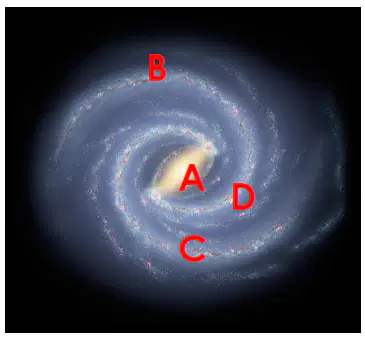
Which letter best represents the location of the Sun in the Milky Way Galaxy?
A
B
C
D
A galaxy with "arms" and a dense center; our Milk Way is this type of galaxy
Irregular Galaxy
Elliptical Galaxy
Spiral Galaxy
Andromeda Galaxy
The AU represents ...
The largest separation of Earth from the Sun
The average separation of Mars from the Sun
the shortest separation of the Earth from the Sun
The average separation of the Earth from the Sun
The AU stands for ...
Astrological Unit
Astronomical University
Astronomical Unit
The unit of distance best suited for describing distances to stars in the night sky
Kilometer
AU
Parsecs
Light years
The unit best used for describing distances in the Solar System
Mega Kilometer
AU
Miles
Light years

