
 Worksheets
Cfe Q3
Total questions: 88
Worksheet time: 21hrs 21mins
Use the information in your databook to calculate the enthalpy change for the following reaction:
H2(g) + Cl2(g) --> 2HCl(g)
172
200
-185
450
1. Chloromethane can be produced by the reaction of methane with chlorine.
CH4(g) + Cl2(g) --> CH3Cl(g) + HCl(g)
Using bond enthalpies from the data booklet, calculate the enthalpy change, in kJmol−1, for this reaction
26
-234
15
-115
1. 0.22g of propane (C3H8) was used to heat 200cm3 of water. The temperature of water was raised by 35oC. Calculate the enthalpy of combustion of propane.
-5852
-3218
2297
3456
The enthalpy of combustion can be described as
When 1 mole of solute dissolves in water
When 1 mole of substance is fully combusted in oxygen
1 one mole of water is produced in a neutralisation reaction
6.9 g of ethanol (C2H5OH) was burned and the heat produced was used to raise the temperature of one litre of water by 49oC. Assuming all the heat released by the burning ethanol was absorbed by the water; calculate the enthalpy of combustion of ethanol.
204
1365
-1365
-768
1. The enthalpy of combustion of methanol (CH3OH) is -715kJ mol-1. What mass of methanol would be burned to produce 71.5kJ of energy?
6.4
32
3.2
7.15

Use Hess's Law to calculate the enthalpy of combustion of methane
- 891 KJ mol-1
- 605 KJ mol-1
- 1041 KJ mol-1
- 1435 KJ mol-1

Calculate the enthalpy of combustion of ethane using Hess's Law
- 1561 KJ mol-1
- 1731 KJ mol-1
- 1167 KJ mol-1
- 989 KJ mol-1
Using bond enthalpies in the data booklet, calculate the energy to convert 2 moles of O2 molecules into 4 moles of oxygen atoms in the below reaction.
2 O2 ------------> 4 O
996 KJ
1192 KJ
- 996 KJ
996 KJmol-1


SO2 + O2 <=> SO3
If the concentration of SO2 is increased, the equilibrium position of the reaction will shift ___________.
N2 + O2 <=> 2NO
If O2 is removed, the concentration of N2 will _______.
N2 (g) + 3 H2 (g) <=> 2 NH3 (g)
If the pressure in the system is increased, which substance(s) will increase in concentration?
N2 + O2 <=> 2NO: Δ H = +182 kJ mol-1.
If the temperature is increased the equilibrium position will shift _______.
2SO2(g) + O2(g) <=> 2SO3(g): ΔΗ = - 197 kJ mol -1
Which of the following will NOT shift the equilibrium position to the right?
If a (dynamic) equilibrium is disturbed by changing the conditions, the position of equilibrium................

Increasing the temperature of the reaction in the Haber Process shifts results in equilibrium
moving to the right
moving to the left
unchanged

As pressure in the Haber Process is increased equilibrium shifts
to the right
to the left
unchanged
When reacting Na with Cl2, we calculated that the theoretical yield should be 13 grams. Our actual yield was 12.5 grams. What is the percent yield?
90.4%
104%
96.15%
1.04%
24 grams of CH4 was added to the above reaction. Calculate the theoretical yield of CO2.
2Fe2O3 + C → Fe + 3CO2
You add 28 grams of carbon. You find the actual yield to be 181.2 grams of CO2. What is the percent yield of CO2? (Hint: calculate theoretical yield of CO2 first)
58.83%
308%
6435%
15.5
The reaction of 75.0g P4 with excess chlorine gas produces 110g PCl3 in lab. Find the theoretical yield and calculate percent yield for the reaction.
The reaction of 25.0 g benzene, C6H6, with excess HNO3 resulted in 21.4 g C6H5NO2. What is the percentage yield?
C6H6 + HNO3 → C6H5NO2 + H2O
100%
27.39%
54.29%
85.62%
Percent yield can never be greater than ________.
theoretical yield
100%
both a and b
50%
6MgF2

Why are chemical equations always balanced? Select ALL that apply.
Matter cannot be created.
Matter cannot be destroyed.
Matter can only be rearranged/conserved.
Matter doesn't matter.

In a chemical reaction, if the reactants are heated, the reaction usually happens
slower
faster
at the same rate
in a smaller volume
In a chemical reaction, no new atoms are created, and no atoms are destroyed.
__K + __Br2 --> __KBr
It refers to the substance(s) that are considered to be "ingredients" of a chemical reaction.
reactants
products
catalysts
enhancers
Use the equation 2 Al + 3 Cl2 ---> 2 AlCl3. If 2 moles of aluminum and 2 moles of chlorine are reacted, identify the limiting reactant.
AlCl3
Cl2
Al
4NH3+6NO --> 5N2 + 6H2O
The excess reactant
is the reactant that is left over
is used up first
Why is it important to identify the limiting reagent?
The limiting reagent speeds up the reaction.
The limiting reagent controls the amount of product formed.
If there is no limiting reagent, the reaction will not occur.
No stoichiometry calculations can be done without a limiting reagent.

The quantity, 22.4 L, is called the ........................ of a gas.
molar volume
molar mass
Atomic volume
Oxidation is the _________ of electrons.
loss
gain
sharing
transfer
Reduction is the ___________ of electrons.
loss
gain
sharing
transfer
In the reaction Zn + 2HCl --> ZnCl2 + H2
which element, if any, is oxidized?
Zinc
Hydrogen
Chlorine
None
2Ca(s) + O2(g) --> 2CaO(s), calcium is __________
Mg → Mg2+ + 2e–
The forward reactions in the Electrochemical Series are examples of...
Oxidation
Reduction
Gaining hydrogen is an example of...
oxidation
reduction
Gaining oxygen is an example of...
oxidation
reduction
A redox equation has...
electrons on the left side
electrons on the right side
electrons on both sides
no electrons on either side
In a redox reaction, spectator ions...
become oxidised
become reduced
remain unchanged

MnO4- + 5Fe2+ + 8H+ --> Mn2+ + 4H2O + 5Fe3+
What volume of 0.01M MnO4- reacts with 0.002 moles of Fe2+
0.1 dm3
0.04 dm3
0.4 dm3
1.0 dm3
2MnO4- + 6H+ + 5H2O2 --> 2Mn2+ + 8H2O + 5O2
How many moles of H2O2 react with 0.4 moles of MnO4- reacts
0.4
0.2
1.0
5.0
2MnO4- + 6H+ + 5H2O2 --> 2Mn2+ + 8H2O + 5O2
What volume of 0.5M H2O2 react with 0.01 moles of MnO4- reacts
0.01 dm3
0.05 dm3
0.04 dm3
0.1 dm3

Ink can be separated by a method of -----------------------------------------------
distillation
filtration
chromatography
sedimentation
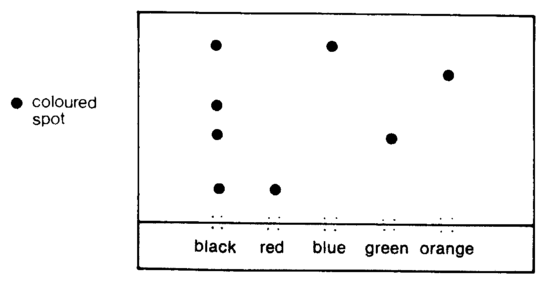
On the chromatogram given, ___________ is a mixture.
red
orange
green
black
A pure substance shows ____ spot on a chromatogram
0
1
2
3
C6H8O7 + 3NaOH → C6H5O7Na3 + 3H2O
Calculate the percentage atom economy for the production of sodium citrate, C6H5O7Na3.
82.7%
90%
93.5%
Iron can be produced from iron(III) oxide.
2Fe2O3(s) + 3C(s) → 4Fe(s) + 3CO2(g)
The atom economy for the production of iron is
69.9%
62.8%
58.2%
32.5%
100 cm3 of propane is mixed with 600 cm3 of oxygen and the mixture is ignited.
C3H8(g) + 5O2(g) → 3CO2(g) + 4H2O(ℓ)
At the end of the reaction, the total volume of gas would be
300cm3
400cm3
700cm3
800cm3
In a redox titration with potassium permanganate, no indicator was added, why?
a pH meter is used
It is a self-indicating reaction
In a redox titration, what is the purpose of adding concentrated sulphuric acid to the reaction mixture?
to increase the pH
to provide H+ ions
to slow down the reaction
to heat it up

This chromatogram from a gas chromatography shows that there is a higher concentration of sucrose than glucose
true
false

Stachyose has a higher retention time than sucrose, this means that it spends less time on the gas chromatography column
true
false

These are results from a titration experiment. The average volume used for calculations must be taken from results that are concordant (within 0.2cm3 of eachother). Which results can be used to obtain the average.
3, 4 and 5
2, 3, 4 and 5
4 and 5
all of them

The first titration result is never used to calculate the average, this is because it is used as a 'rough' guide to the endpoint.
true
false

