wayground logo

Free Printable Worksheets

NEW

Font size

S
M
L
XL
Worksheets

Oxidation Reduction AP Chemistry

Total questions: 44

Worksheet time: 1hrs 18mins

Name
Class
Date
1.

Which process involves the transfer of electrons?

a)

double replacement

b)

neutralization

c)

oxidation-reduction

d)

sublimation

2.

During an oxidation-reduction reaction, the number of electrons gained is

a)

equal to the number of electrons lost

b)

equal to the number of protons gained

c)

less than the number of electrons lost

d)

less than the number of protons gained

3.

In a redox reaction, there is a conservation of

a)

mass, only

b)

charge, only

c)

both mass and charge

d)

neither mass nor charge

4.

During which process does an atom gain one or more electrons?

a)

transmutation

b)

reduction

c)

oxidation

d)

neutralization

5.

When a lithium atom forms an Li+ ion, the lithium atom

a)

gains a proton

b)

gains an electron

c)

loses a proton

d)

loses an electron

6.

The oxidation number of nitrogen in N2 is

a)

+1

b)

0

c)

+3

d)

-3

7.
What is oxidation number of P in K3PO4?
a)
+1
b)
+5
c)
-2
d)
0
8.
Which substance is reduced in the following reaction? 
NaOH + Li --> LiOH + Na
a)
Li
b)
Na
c)
O
d)
H
9.
What is the oxidation number of Br in BrO3-1?
a)
+3
b)
-2
c)
+5
d)
+2
10.
In the reaction
2Ca(s) + O2(g) --> 2CaO(s), calcium is __________
a)
Reduced
b)
Synthesized
c)
Oxidized
d)
None of the above
11.

Determine the oxidation number of phosphorous in PO2-.

a)

0

b)

-3

c)

+3

d)

+5

12.
What is the oxidation number of O in CO2?
a)
+2
b)
-1
c)
+4
d)
-2
13.
Oxidation happens at the
a)
anode
b)
cathode
c)
salt bridge
d)
voltmeter
14.
Reduction happens at the 
a)
anode
b)
cathode
c)
salt bridge
d)
voltmeter
15.
This electrode loses mass 
a)
anode
b)
cathode
16.
This electrode in a voltaic cell gains mass
a)
anode
b)
cathode
17.
Which energy conversion shown below takes place in an electrochemical cell?
a)
Electrical to chemical
b)
Mechanical to chemical
c)
Mechanical to electrical
d)
Chemical to electrical
18.
Which cell is not spontaneous?
a)
voltaic
b)
electrolytic
19.

When a voltaic cell is operating, what flows through the Salt Bridge?

a)

electrons

b)

water

c)

ions

d)

love

20.

During an oxidation-reduction reaction, the number of electrons gained is

a)

equal to the number of electrons lost

b)

equal to the number of protons gained

c)

less than the number of electrons lost

d)

less than the number of protons gained

21.

Which of these equations represents a redox reaction?

a)

Ca(HCO3)2 --> CaCO3 + H2O + CO2

b)

CH3COOH + NaOH --> CH3COONa + H2O

c)

Zn + 2FeCl3 --> ZnCl2 + 2FeCl2

d)

NaCl + AgNO3 --> AgCl + NaNO3

22.

Which of the following statements refers to an oxidation process?

a)

Hydrogen is added to ethene

b)

Oxygen is removed from carbon dioxide

c)

Chlorine accepts electrons

d)

Increase in the oxidation number of magnesium metal

23.
What is the oxidation number of potassium in potassium permanganate? 
a)
-1
b)
+3
c)
+1
d)
0
24.
What is oxidation number of H in H2O?
a)
0
b)
-2
c)
-1
d)
+1
25.
If an atom loses electrons during a chemical reaction, the atom was:
a)
Oxidized
b)
Reduced
c)
Neutralized
d)
Precipitated
26.
What is the oxidation number of Fe in FeO?
a)
+1
b)
-1
c)
+2
d)
-2
27.

Which would be an accurate half-equation at the cathode for aluminum?

a)

Al3+ + 3e- --> Al

b)

Al --> Al3+ + 3e-

c)

Al3+ --> Al + 3e-

d)

Al + 3e- --> Al3+

28.
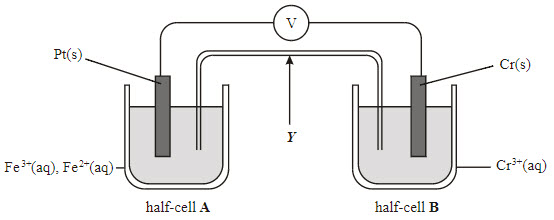
What is the function of Y in cell below?
a)
To complete the circuit
b)
To allow flow of electrons between both cells
c)
To allow flow of ions 
d)
To connect both half cells
29.

The anode is where oxidation occurs in...

a)

A Galvanic Cell

b)

A Electrolytic Cell

c)

Both Galvanic and Electrolytic cells

30.
Which of the following metals is the most reactive according to the reactivity series of metals.
a)
Copper
b)
Zinc
c)
Magnesium 
d)
Lithium
31.

ANOTHER NAME FOR A SPONTANEOUS ELECTROCHEMICAL CELL

a)

SALT BRIDGE

b)

VOLTMETER

c)

ELECTROLYSIS CELL

d)

VOLTAIC CELL

32.
In a voltaic cell, the salt bridge is necessary for
a)
the movement of electrons to create a current
b)
the movement of ions to create a current
c)
the movement of electrons to maintain the neutrality of solution
d)
the movement of ions to maintain the neutrality of solution
33.

Oxidation is the _________ of electrons.

a)

loss

b)

gain

c)

sharing

d)

transfer

34.

Reduction is the ___________ of electrons.

a)

loss

b)

gain

c)

sharing

d)

transfer

35.
Which of the following half reactions correctly represents a reduction half reaction?
a)
Fe →Fe2+ + 2e-
b)
Pb4+ + 2e- →Pb2+
c)
2O-2 →O2 + 4e-
d)
Fe + 3e- →Fe3+
36.

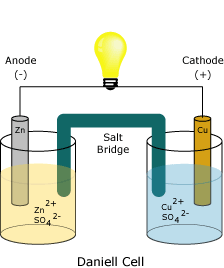
In the above Galvanic Cell, which half cell is undergoing reduction?

a)

Cu | Cu2+

b)

Zn | Zn2+

37.

The process in which an atom or ion experiences an increase in oxidation state

a)

Oxidation

b)

Reduction

38.

The process in which an atom or ion experiences a decrease in oxidation state

a)

Oxidation

b)

Reduction

39.
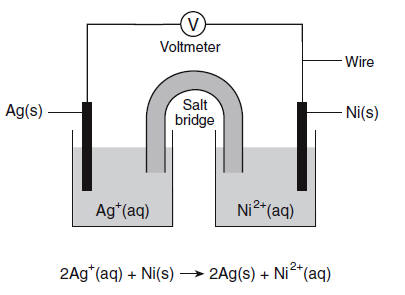
What reaction occurs at the anode?
a)
Ag+ + e- →Ag
b)
Ag → Ag+ + e-
c)
Ni2+ + 2e- → Ni
d)
Ni → Ni2+ + 2e-
40.
What is an electrolytic cell? 
a)
a cell that converts chemical energy into electrical energy 
b)
a cell that converts electrical energy into electrical energy 
c)
a cell that converts electrical energy into chemical energy 
d)
A cell that converts kinetic energy into potential energy. 
41.
Complete the half equation Al3+ --> 
a)
Al3+ - 3e- --> Al
b)
Al2+ + 3e- --> Al
c)
Al3+ + 3e- --> Al
d)
Al3+ --> Al + 3e-
42.
     In the reaction Zn + H2O --> ZnO2 + H2
 which element, if any, is oxidized? 
a)
Zinc
b)
Hydrogen
c)
Oxygen
d)
None
43.
What substance is oxidized in the following reaction?
4Fe + 3O2 --> 2Fe2O3
a)
Iron
b)
Fluorine
c)
Oxygen
44.

If oxidation happened, then...

a)

something gained electrons

b)

reduction also happened

c)

flames are always involved

d)

oxygen is always involved