
 Worksheets
Atoms Molecules Isotopes Periodic Table
Total questions: 105
Worksheet time: 3570secs

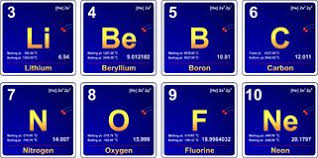


What goes in place of the question marks?
Element name
Atomic Mass
Atomic Number
Electrons
An atom has 3 protons, 4 neutrons, and 3 electrons. What is the charge of the atom’s nucleus?
+4
+3
−4
−3

How many protons, electrons and neutrons are present in an atom of carbon, C, with the mass of 12?
12 protons, 12 electrons, 12 neutrons
6 protons, 12 electrons, 6 neutrons
12 protons, 6 electrons, 12 neutrons
6 protons, 6 electrons, 6 neutrons

How would you write the isotope name from this nuclide symbol?
Sodium-23
Sodium-11
Sodium-12
Sodium-22
How many neutrons are in the isotope of sulfur,36S?
16
20
24
26
Which of the following does NOT differ in isotopes of the same element?
mass number
number of neutrons
number of protons
chemical properties

How many neutrons are in the following atom?
47
61
108
155

How many protons are in the following atom?
82
125
207
189


What isotope is shown here? (Red = protons, gray = neutrons, blue = electrons)
Beryllium-5
Beryllium-9
Boron-4
Boron-9
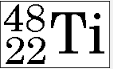
47

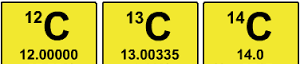
These three isotopes of carbon have different -
Atomic numbers
Mass numbers
Numbers of protons
Symbols

Which of these determines the identity of an atom?
proton
neutron
valence electron
protons and neutrons

_______ are atoms with the same number of protons but varying numbers of neutrons.
ions
elements
allotropes
isotopes
What is a mass number?

Which of these pairs of atoms are isotopes?
pair A
pair B
pair C
What is the correct hyphen notation name for the isotope with 19 electrons and 21 neutrons?
Potassium-40
Scandium-19
Potassium-21
Scandium-40

Determine the number of neutrons in the following isotope:
(a)
How many electrons are in a neutral atom of the isotope fluorine-20?
20
9
19
18
What is the name of the isotope with 54 protons and 79 neutrons?
Xenon-79
Gold-79
Gold-133
Xenon-133
The order of elements in the periodic table is based on
the number of protons in the nucleus.
the electric charge of the nucleus.
the number of neutrons in the nucleus.
atomic mass.
Which of the following elements is an alkali metal?
calcium
magnesium
mercury
sodium
In Mendeleev's periodic table, elements in each column had similar
atomic masses.
properties.
atomic numbers.
symbols.
How was Mendeleev's periodic table arranged?
by increasing atomic mass
by decreasing atomic mass
by increasing atomic number
by decreasing atomic number
Mendeleev left gaps in his periodic table because
the table was too small.
protons belonged there.
the table was too full.
no known elements fit there.
Each column of the periodic table is
an element.
a group.
an isotope.
a period.
Most elements are
metals.
nonmetals.
metalloids.
semiconductors.
Which statement about the alkali metals is correct?
They are located in the left-most column of the periodic table.
They are extremely nonreactive.
They are usually gases.
They form negative ions with a 1- charge.
Metals tend to be
gases.
dull.
brittle.
good conductors.
Which group is very stable due to the fact that they have a full outermost energy level?
alkali metals
halogens
alkaline-earth metals
noble gases
atomic number
gas at room temperature, low boiling point
a subatomic particle that has a negative charge
number or protons and neutrons
the number of protons in the nucleus of an atom
Which group of the periodic table are alkali metals found in?
Group 1
Group 2
Group 7
Group 8
Which of the followings is not an alkali metal?
Li
Cl
K
Cs
How many electrons do the alkali metals have in their outer most shell?
1
2
8
7
Which of the followings is the most reactive alkali metal in water?
Lithium
Sodium
Potassium
Hydrogen
What is formed when sodium reacts with water?
Sodium oxide and hydrogen
Sodium hydroxide and hydrogen
Sodium hydroxide and oxygen
Sodium hydroxide and carbon dioxide
What is the symbol equation for the reaction between potassium and water?
2K + 2H2O → 2KOH + H2
2Na + 2H2O → 2NaOH + H
2K + H2O → 2KOH + CO2
2Na + 2H2O → 2NaOH + CO2
What happens to the atomic radius of the alkali metals as going down the group?
increases
decreases
no change
first increases than decreases
What happens to the melting point of the alkali metals as going down the group?
decreases
increases
no change
first increases than decreases
Which alkali metals is the least reactive?
Lithium
Sodium
Potassium
Rubidium
What is the general formula of a group 1 metal oxide?
M2O
MO
MO2
Mo
Alkali are so reactive to air. Because of that they are generally stored in ......
water
paraffin oil
vaults
cotton
Which alkali metal burns in oxygen to produce lilac flame?
Lithium
Sodium
Potassium
Rubidium
.................. is released when alkali metals react with water.
Hydrogen
Oxygen
Metahne
Carbon dioxide
What kind of solution is produced when group 1 metals react with water?
Neutral
Acidic
Alkaline
Ionized
Which alkali metal is very important for battery industry?
Fr
Na
Li
Cs
Which halogen is the most reactive?
Fluorine
Chlorine
Bromine
Iodine
Describe the reactivity of Group 7 (halogens) elements as you go down the group?
How many electrons to halogens have in their outer shell?
Complete the following equation: Chlorine + Potassium Bromide -->
Potassium Chloride + Bromine
Chlorine + Potassium Bromide
No reaction
Which halogen is the least reactive?
Fluorine
Chlorine
Bromine
Iodine
Complete the following equation: Iodine + Potassium Bromide -->
Potassium Iodine + Bromine
Iodine + Potassium Bromide
No reaction
Complete the following equation: Bromine + Potassium Iodide -->
Potassium Iodine + Bromine
Iodine + Potassium Bromide
No reaction
Complete the following equation: Chlorine + Potassium Iodide -->
Potassium Iodine + Chlorine
Iodine + Potassium Chloride
No reaction
Complete the following equation: Iodine + Potassium Iodide -->
Potassium Iodine + Bromine
Iodine + Potassium Chloride
No reaction
What happens when fluorine reacts with sodium?
They form sodium fluoride.
They form sodium chlorate.
No reaction occurs.
They form sodium and fluorine gas.
Which of the "Halogens" is found in liquid state at room temperature?
Flourine
Astatine
Iodine
Bromine
As you move down the group, halogens' reactivity...
increases
decreases
doesn't change
shows no trend.
Which halogens can displace bromide ions to make bromine?
Fluorine and iodine.
Fluorine and bromine.
Fluorine and chlorine
Chlorine and iodine.

A displacement reaction involves...
a solution turning brown or yellow.
a less reactive element taking the place of a more reactive element.
a dislocated hip.
a more reactive element taking the place of a less reactive element.
Would a displacement reaction occur for Bromine + Potassium Iodide?
Yes
No
Maybe
How many electrons do the halogens all have in their outer shells?
1
2
7
8
The Halogens are found in which group number?
5
6
7
0
Would a displacement reaction occur for Iodine + Potassium Bromide?
Yes
No
Maybe
As you go down the group, how does the boiling point of the halogen elements change?
Increases
Decreases
They're all about the same
Which of the "Halogens" has yellowish green color?
Chlorine
Bromine
Flourine
Iodine
Which halogen would be able to replace chlorine in sodium chloride?
Flourine
Bromine
Iodine
Astatine
Which statement is true about halogens?
Form covalent compounds with other non-metallic elements
A less reactive halogen will displace a more reactive element form its ionic salt
Form ionic compound with hydrogen
form negative ion of charge -2
The process by which solid iodine particles change directly to gas without first becoming a liquid is called ____.
evaporation
ionization
condensation
sublimation
Which of the following is / are not a gas at room temperature
fluorine
bromine
iodine
chlorine
Which of the following is the most unreactive
fluorine
bromine
iodine
chlorine
Which of the following is black
fluorine
bromine
iodine
chlorine
Which of the following is explosive
fluorine and hydrogen
chlorine and hydrogen
iodine and hydrogen
bromine and hydrogen

