
NEW
Font size
 Worksheets
DNA Structure, Replication, Protein Synthesis, Meiosis
Total questions: 25
Worksheet time: 13mins
When does DNA replication occur?
before a cell divides.
before a makes a protein.
to replace damaged DNA.
to make new mRNA.
DNA is semi-conservative because after replication there are -
one molecule with two original strands and one molecule with two new strands
two molecules, each with one original and one new strand
two molecules, each with two new strands
two molecules, each with two old strands

The sequence of DNA below is part of a gene. How many amino acids are coded for by this segment? (Remember - each set of 3 letters codes for ONE amino acid)
4
8
12
20
Which of the following carries amino acids to the site of protein synthesis?
mRNA
rRNA
tRNA
nRNA
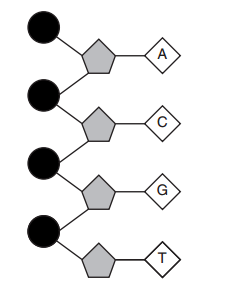
The diagram below represents a portion of a DNA molecule. The letters or codes are the different types of
sugar molecules
nitrogen bases
phosphates
proteins
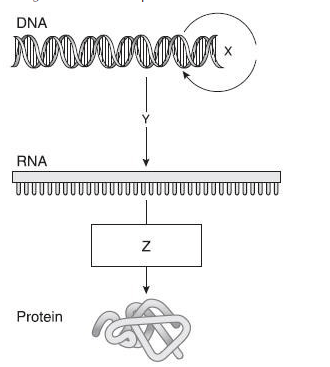
A diagram of a cellular process (protein synthesis) is shown below. Where does the process happening a 'Y' occur?
Nucleus
Ribosome
Cytoplasm
Lysosome
Where do we find DNA?
all living things.
plants only.
animals and plants but not bacteria.
only non-living things.
What DNA sequence would match C-G-A-T-C
G-C-T-A-G
C-G-A-T-C
C-T-A-G-C
A-T-C-G-A

Photo 51 shows an X-ray diffraction of DNA. This image was taken by-
Watson
Crick
Rosalind Franklin
Chargaff
The photo shows an X-ray diffraction of DNA. What did this image show about DNA? (the first evidence that DNA is this shape)
it's a double helix
it contains base pairs
it is used to make proteins
it has Ts instead of Us
The monomers, or subunits, of DNA are called - (think about the N part of DNA)
nucleotides
amino acids
proteins
monosaccharides
DNA strands are held together by weak hydrogen bonds. This allows -
DNA strands to be separated and used as templates during replication.
the DNA code to be rearranged.
tRNA to bring amino acids to DNA.
In which organelle are proteins made?
ribosome
lysosome
Golgi body
mitochondria
Which molecule carries the code from the nucleus to the ribosome?
DNA
mRNA
amino acid
tRNA
Which of these bases is NOT found in RNA?
A
T
C
G
U

The image shows a mutation in which one letter is changed to another. This is called a -
(THQ BIG OLD HOG SAW ONE MAD DOG)
frameshift
substitution
insertion
deletion

The image shows a frameshift mutation where a nucleotide is added or deleted from a DNA sequence. The effect of this is
(THB IGO LDH OGS AWO NEM ADD OG)
one amino acid will change.
many amino acids will change.
there will be no change in protein.
the protein will not be made at all.
The human genome project sequenced all the genes in a human. What is the main benefit of this research?
To study genetic diseases
To classify humans among species
To make new species of humans
To identify superior humans
When a set of genes is removed from a chromosome, this is called a(n) -
insertion
deletion
translocation
inversion
Which enzyme unzips the DNA?
DNA Polymerase
DNA Helicase
DNA Peptidase
DNA Goldfarbase
Which enzyme adds the new strand of DNA?
DNA Polymerase
DNA Helicase
DNA Peptidase
DNA Goldfarbase
What direction must DNA polymerase travel in order to make the new DNA?
3-5
5-3
up and down
left to right
The strand of DNA that gets copied in one smooth direction is called the-
effortless strand
Lagging Strand
Leading Strand
mutated strand
The strand of DNA that gets copied in segments called Okazaki fragments is-
effortless strand
Lagging Strand
Leading Strand
mutated strand

