

wayground logo

Free Printable Worksheets

Font size

S
M
L
XL
Worksheets

Electrostatics Worksheet

Total questions: 75

Worksheet time: 1hrs 11mins

Name
Class
Date
1.
Two like charges
a)
 neutralize each other.
b)
repel each other. 
c)
must be neutrons. 
d)
attract each other.
2.
The charge of an electron is 
a)
positive. 
b)
negative. 
c)
Electrons have no charge
3.
An atom loses an electron.  What type of charge does it have now?
a)
positive
b)
negative
4.
An atom gains an electron.  What type of charge does it have now?
a)
positive
b)
negative
c)
No charge
5.
Charged objects are not attracted to neutral objects
a)
True
b)
False
6.
When a balloon is rubbed on clothes it acquires a charge by ___________
a)
Induction
b)
reduction
c)
friction 
d)
concuction
7.
Where do electrons go when you rub a balloon on your hair?
a)
Onto the balloon
b)
Into your hair
c)
Nowhere
8.
After you rub a balloon on your hair, what charge does the balloon have?
a)
Positive
b)
Negative
c)
Neutral
9.
After you rub a balloon on your hair, what charge does your hair have?
a)
Positive
b)
Negative
c)
Neutral
10.
What do you call the process of charging a conductor by bringing it near another charged object?
a)
induction
b)
polarization
c)
neutralization
d)
conduction
11.
Which of the following is not a good conductor of electricity?
a)
copper
b)
silver
c)
Glass
d)
aluminum
12.
Which of the following is not a good insulator?
a)
Copper
b)
Glass
c)
rubber
d)
wool
13.
The law of conservation of charge states that...
a)
all atoms have more protons than electrons
b)
only protons can be rubbed off of an atom
c)
charge cannot be created or destroyed
d)
charge cannot be transferred 
14.

An atom of oxygen has 8 protons and 10 electrons, this means the atom is ____________

a)

positively charged because it has excess electrons

b)

negatively charged because it has excess electrons

c)

positively charged because it has a deficiency of electrons

d)

negatively charged because it has a deficiency of electrons

15.

After a balloon is rubbed against wool, the two objects will ________ each other because they have ___________ charges

a)

attract; like

b)

attract, opposite

c)

repel; like

d)

repel; opposite

16.

Which statement is true of a positively charged object?

a)

Positively charged objects do not contain any electrons.

b)

Positively charged objects do not contain neutrons or electrons.

c)

There is a lack of electrons on a positively charged object.

d)

The protons and the electrons are both positively charged on such objects.

17.

What is the end result of charging by contact?

a)

Both object have the same charge, so they will attract one another

b)

Both object have the same charge, so they will repel one another
c)

Both object have the opposite charge, so they will attract one another

d)

Both object have the opposite charge, so they will repel one another

18.

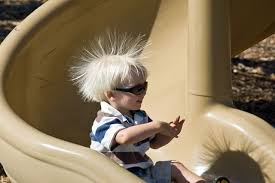
What method of static charging is shown in this picture

a)

Contact

b)

Friction

c)

Grounding

d)

Electron Shifting

19.

Why does the child's hair stick up?

a)

The boy is grounded since he's at the bottom of the slide

b)

He gained a charge from the slide, and since he's not grounded, his hairs have the same charge so they repel one another

c)

He gained a charge from the slide, and since he's not grounded, his hairs have opposite charges so they repel one another

d)

When hair is neutral, some have a positive side and some have negative side, so they will attract to each other, making it stand up

20.

What is the end result of charging by friction?

a)

Both object have the same charge, so they will attract one another

b)

Both object have the same charge, so they will repel one another

c)

Both object have the opposite charge, so they will attract one another

d)

Both object have the opposite charge, so they will repel one another

21.

A balloon is rubbed against a student's hair and then touched to a wall. The balloon sticks to the wall due to

a)

The balloon is charged neutral, so is the wall, so it attracts to the wall

b)

The balloon is charged opposite the wall, so it attracts to the wall

c)

The balloon has a charge, so it attracts the neutral wall

d)

The wall grounds the balloon, so it sticks

22.
According to Coulomb's law, you can do all of the following to increase the electric force of repulsion EXCEPT
a)
Increase charge 1
b)
Increase charge 2
c)
Decrease the distance
d)
Increase the distance
23.
What is the SI unit used to measure force? 
a)
pounds 
b)
grams 
c)
newtons 
d)
friction
24.
The SI unit of charge is
a)
the ampere
b)
the newton
c)
the coulomb
d)
the joule
25.
Electric charges that are alike _______ each other.
a)
Attract
b)
Repel
26.
If two balloons have the same charge, what will happen if you place them close to each other?
a)
Nothing
b)
They will be attracted
c)
They will pop
d)
They will push each other away.
27.
A repelling force occurs between two charges objects with the charges are of 
a)
unlike signs
b)
like signs
c)
equal magnitude
d)
unequal magnitude
28.
electric charge is
a)
found only in a conductor
b)
conserved
c)
found only in insulators
d)
not conserved
29.
Charge is mostly easily transferred in 
a)
nonconductors
b)
conductors
c)
semiconductors
d)
insulators
30.
What occurs when two charges are moved closer together?
a)
electric field doubles
b)
Coulomb's law takes effect
c)
the total charge increases
d)
the force between the charges increase
31.

If you have an electric force of 6 N and double the charge of both charges, what will be resulting force?

a)

6 N

b)

12 N

c)

24 N

d)

1.5 N

e)

3 N

32.

Which is NOT a similarity between gravitational force and electrical force?

a)

They both depend on the distance

b)

The both involve two objects (either charged or with mass)

c)

They are both repulsive and attractive

d)

They both significantly decrease with distance

33.

If the distance between two charged particles is quadrupled (4 times larger), what will happen to the force between them?

a)

It becomes four times larger

b)

It becomes sixteen times larger

c)

It becomes four times smaller

d)

It becomes sixteen times smaller

34.

When the distance between two charges is halved, the electrical force between the charges

a)

quadruples

b)

reduces to one fourth

c)

halves

d)

doubles

35.
Electric charge is neither created nor destroyed, but can be rearranged.
a)
true
b)
false
36.

2 charged objects both feel a force of 200 N. If q1 becomes 3 times bigger, what is the new force

a)

203

b)

600

c)

66.7

d)

1800

37.

2 charges feel a force of 40 N. if we cut the distance between them in half, what is the new force they feel

a)

20

b)

80

c)

160

d)

10

38.

Coulomb's law is used to calculate

a)

Magnetic dipole moment

b)

Force between two charges

c)

Energy of a conductor

d)

Force due to gravity

39.

The smallest possible amount of charge is

a)

Charge on an electron

b)

Charge on your blanket

c)

Charge of a battery

d)

Charge on a proton

40.
There are only .......... types of electric charge in nature.
a)
Three (positive, negative, neutral)
b)
TWO (positive, negative)
c)
TWO (positive, neutral)
d)
THREE (negative, positive, medium)
41.
What is the symbol of electric charge?
a)
k
b)
q
c)
c
d)
h
42.

........... contains protons and neutrons in its nucleus and electrons which revolving around.

a)

Object

b)

Atom

c)

Charge

d)

Electricity

43.
Which picture(s) is/are example(s) for Electrostatics?
a)
B, C, D
b)
B, C
c)
A, D
d)
A, B, C
44.
Like charges ........... each other,
unlike charges ............. each other.
a)
ATTRACT, REPEL
b)
REPEL, ATTRACT
c)
REVEAL, ATTACK
d)
LIKE, DISLIKE
45.
After you rub a balloon on your hair, what charge does the balloon have?
a)
Positive
b)
Negative
c)
Neutral
46.
After you rub a balloon on your hair, what charge does your hair have?
a)
Positive
b)
Negative
c)
Neutral
47.
Which part of the atom is negatively charged?
a)
Proton
b)
Neutron
c)
Electron
48.
An atom that has more protons than electrons would have what charge?
a)
Positive
b)
Negative
c)
Neutral (Zero)
49.
What does it mean for an atom to be neutral?
a)
It has no charge.
b)
It has neutrons.
c)
It isn't attracted to other atoms.
d)
It has no net charge.
50.
When does an attractive force occur between two charged objects?
a)
Like charges.
b)
Unlike charges.
51.
What is the overall charge of an object that has been charged by polarization?
a)
Positive
b)
Negative
c)
Neutral
52.
How is the electric force between two charges affected when the distance between the charges is halved?
a)
Four times as much.
b)
Two times as much.
c)
Half as much.
d)
One-quarter as much.
53.
Two point charges initially 4 cm apart are moved to a distance of 12 cm apart.  By what factor does the resulting electric force between them change?
a)
8
b)
1/3
c)
1/9
d)
9
54.
If the charge is tripled for each of two identical charges maintained at a constant separation, the electric force between them will be changed by what factor?
a)
3
b)
9
c)
1/3
d)
1/9
55.
Electrostatic force F is directly proportional to:
a)
r2 (distance squared)
b)
q1
c)
q2
d)
both q1 and q2
56.
When distance increases, electrostatic force ____________. We call this relationship ____________ proportional.
a)
decreases; directly
b)
decreases; inversely
c)
increases; inversely
d)
increases; directly
57.
The accumulation of excess electric charge on an object is called:
a)
Static electricity 
b)
Electric discharge
c)
Resistance
d)
Circuit 
58.
According to the Law of Conservation of Energy, You cannot create or _________ energy.
a)
eat
b)
hug
c)
destroy
d)
transform
59.

The accumulation of excess electric charge on an object is called

a)

Static electricity

b)

Electric discharge

c)

Resistance

d)

Circuit

60.

A metal spoon is an example of _____.

a)

a conductor

b)

an insulator

61.
What causes static electricity?
a)
only an object losing electrons
b)
only an object gaining electrons
c)
when positive and negative charges balance
d)
when positive and negative charges are not balanced
62.
Which type of charges do these balloons have?
a)
like charges
b)
opposite charges
63.
What type of charge do these balloons have?
a)
like charges
b)
opposite charges
64.
Metals such as copper, iron, gold, and silver are ...
a)
conductors
b)
brittle
c)
insulators
d)
resistors
65.
Materials that are not metals, such as glass, plastic, wood, and Styrofoam are ...
a)
conductors
b)
brittle
c)
insulators
d)
resistors
66.

Which of the following equations represents Coulomb's Law?

a)

F= kQ/d2

b)

F = kQ1Q2/d2

c)

F = Q1Q2/d2

d)

F = kQ1Q2/d

67.

If you increase the magnitude of two charges, what happens to the force between them?

a)

The force is less than before

b)

The force is more than before

c)

The force remains unchanged

68.

What is the difference between the Coulomb's force and gravitational force?

a)

Gravitational force is greater than Coulomb's force

b)

Coulomb's force is attractive, gravitational force is repulsive

c)

Coulomb's force is bigger than gravitational force

d)

Coulomb's force depends on the distance; gravitational force does not.

69.

If you double both charges and double the distance between them, what happens to the force?

a)

The force is less than before

b)

The force is more than before

c)

The force remains unchanged

70.

How can an object become charged?

a)

Conduction

b)

Induction

c)

Friction

d)

All of the choices

71.

If you halve the distance between two charges, what would the new force be?

a)

2 times bigger than before

b)

Half of the original force

c)

The force would remain unchanged

72.
When you brush your hair you scrape off electrons, and your hair
a)
becomes positively charged
b)
becomes negatively charged
c)
becomes positively and negatively charged
d)
remains uncharged, or neutral
73.
Gravitational force depends on mass.  What comparable quantity governs the electrical force?
a)
Volume
b)
Density
c)
Charge
d)
Charge density
74.
What method of charging is depicted here?
a)
Induction
b)
Conduction
c)
Reduction
d)
Friction
75.
A charge placed in the presence of an electric field at 1m would feel ____ at 2m.
a)
the same force
b)
double the force
c)
one half the force
d)
one quarter the force
