
 Worksheets
Ecology Maap
Total questions: 33
Worksheet time: 22mins
Name
Class
Date
1.

Which of the following would be most likely to occur if a disease killed off all of the grasshoppers in an area?
a)
An increase in mice.
b)
A decrease in the number of snakes.
c)
An increase in fox.
d)
A decrease in grass.
2.
Some octopi are able to change color and blend in with their environment. What is this an example of?
a)
cryptic coloration
b)
mullerian mimicry
c)
batesian mimicry
d)
aposematic coloration
3.
Poison dart frogs are poisonous and display bright coloration to warn predators. What is this an example of?
a)
cryptic coloration
b)
mullerian mimicry
c)
batesian mimicry
d)
aposematic coloration
4.
Multiple species of bees, wasps, and hornets have similar color and banding patterns. What is this an example of?
a)
cryptic coloration
b)
mullerian mimicry
c)
batesian mimicry
d)
aposematic coloration
5.
Many species of insects that are not harmful look similar to bees, wasps, and hornets. What is this an example of?
a)
cryptic coloration
b)
mullerian mimicry
c)
batesian mimicry
d)
aposematic coloration
6.

Which of the following correctly describes the interactions between T. castaneum and the parasite.
a)
The parasite decreases the population density of beetles in each culture dish.
b)
The parasite increases the population density of beetles in each culture dish.
c)
The parasite has no effect on the population density of the beetles.
7.

What is the rate of change for the population grown without a parasite from day 200 to day 400?
a)
200 days
b)
a loss of approximately 15 beetles/200 days
c)
a loss of approximately 30 beetles/200 days
d)
30 beetles
8.
Which type of succession occurs when soil is not present and what are the pioneer species for this type of succession?
a)
secondary, annual grasses
b)
secondary, lichen
c)
primary, annual grasses
d)
primary, lichen
9.
Bacteria in the soil convert nitrates and ammonia into nitrogen gas and hydrogen gas. What is this process called?
a)
nitrogen fixation
b)
denitrification
c)
cellular respiration
d)
photosynthesis
10.
Bacteria found in the soil and in the root nodules of plants are able to convert atmospheric nitrogen into nitrates and ammonia that are usable for plants. What is this process called?
a)
nitrogen fixation
b)
denitrification
c)
cellular respiration
d)
photosynthesis
11.
Autotrophs are able to remove carbon dioxide from the air and transfer the carbon from carbon dioxide into glucose (sugar). What is this part of the carbon cycle called?
a)
nitrogen fixation
b)
denitrification
c)
cellular respiration
d)
photosynthesis
12.
Both autotrophs and heterotrophs are able to add carbon dioxide to the air when they break down glucose (sugar) and use it to produce energy for their cells. What is this part of the carbon cycle called?
a)
nitrogen fixation
b)
denitrification
c)
cellular respiration
d)
photosynthesis
13.
Which of the following statements would NOT be true of a population that is remaining at its carrying capacity?
a)
Birth rate is equal to the death rate.
b)
Immigration and emigration are equal.
c)
Temperature and rainfall patterns are consistent.
d)
The number of predators in the area is decreasing due to a viral disease.
14.

Which of the following organisms would contain the highest levels of a pesticide due to biological magnification?
a)
A
b)
B
c)
D
d)
H
15.

If 22,000 J of energy entered this ecosystem at the first trophic level, how much would be available at the trophic level of organism D?
a)
220000
b)
2200
c)
220
d)
22
16.

Which of the following organisms feeds at only T3?
a)
C
b)
F
c)
G
d)
E
17.

Which of the following organisms is a tertiary consumer?
a)
H
b)
F
c)
G
d)
E
18.

Which of the following statements is true regarding carrying capacity?
a)
The carrying capacity for P. aurelia was reached on Day 14 and is 275 cells. This is the highest number.
b)
The carrying capacity for P. aurelia was reached at Day 10 when grown alone and Day 15 when grown with P. caudatum.
c)
The carrying capacity for P. aurelia when grown alone was reached on Day 5 and is 175 cells.
d)
The carrying capacity for P. aurelia and P. caudatum is similar when grown alone and together.
19.
Suppose that wildlife workers capture 328 penguins on an island, mark them, and allow themto mix with the rest of the population. Later, they capture 200 penguins, 64 of which are marked.What is the estimate for the number of penguins on the island?
a)
1025
b)
513
c)
105
d)
39
20.

How many times more wolves are there compared to moose in 1990?
a)
80
b)
24
c)
10
d)
60
21.

What is the appoximate carrying capacity for this population?
a)
1.5
b)
1.75
c)
1.5 million
d)
1.25 million
22.

When two species of cattails are grown together, they grow at different water depths and coexist. When grown alone, they grow at similar water depths. Which of the following is best demonstrated by the data?
a)
natural selection
b)
character displacement
c)
resource partitioning
d)
ecological succession
23.

Which of the following best describes this graph?
a)
Character displacement and resource partitioning are both occurring
b)
character displacement only is occurring
c)
resource partitioning alone is occurring
d)
competitive exclusion is occurring
24.

What percent of the population of Mexico is under the age of 10?
a)
32%
b)
16%
c)
35%
d)
10%
25.

Which population is growing at a faster rate?
a)
Mexico
b)
U.S.
26.
As succession occurs, the number of available habitats and niches increases. Does this increase or decrease biodiversity?
a)
increase
b)
decrease
c)
has no effect on
27.
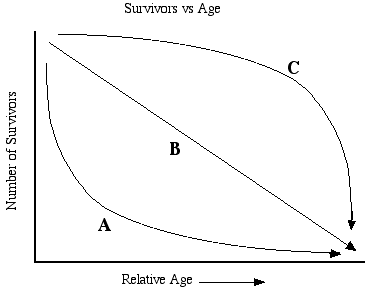
Refer to the diagram of the survivorship curve.
Which curve best describes an organism that invests a lot of energy in parenting?
Which curve best describes an organism that invests a lot of energy in parenting?
a)
A
b)
B
c)
C
d)
this is not a survivorship curve
28.

What type of survivorship is shown in Great Britain in 1999 (teal and blue lines)?
a)
Type I
b)
Type II
c)
Type III
29.
Cattle egrets foraging in fields among cattle. The egret gets easy access to food and the cattle don't care if they are there or not.
a)
mutualism
b)
commensalism
c)
competition
d)
parasitism
30.
Barnacles create home sites by attaching themselves to whales. This neither harms nor benefits the whales.
a)
Mutualsim
b)
Parasitism
c)
Commensalism
31.
What type of symbiosis is this?
*Hermit crabs find shells left by snails that have died and move in.
* Snails die and leave behind their shells.
*Hermit crabs find shells left by snails that have died and move in.
* Snails die and leave behind their shells.
a)
commensalism
b)
mutualism
c)
parasitism
d)
predation
32.
Yucca flowers are pollinated by yucca moths. The moths lay their eggs in the flowers where the larvae hatch and eat some of the developing seeds. Both species benefit.
a)
Mutualism
b)
Parasitism
c)
Commensalism
33.
What type of symbiosis?
*Snapping Shrimp have poor eyesight and depend on their goby fish roommate to give the danger signal when predators come and guide them
back home if they wander too far.
* Goby fish who don't have a place to hide are quickly eaten. They find a Snapping Shrimp roommate who digs a hole for both to live in.
*Snapping Shrimp have poor eyesight and depend on their goby fish roommate to give the danger signal when predators come and guide them
back home if they wander too far.
* Goby fish who don't have a place to hide are quickly eaten. They find a Snapping Shrimp roommate who digs a hole for both to live in.
a)
commensalism
b)
mutualism
c)
parasitism
d)
predation
100 %

