wayground logo

Free Printable Worksheets

NEW

Font size

S
M
L
XL
Worksheets

Chemistry Regents NYS

Total questions: 62

Worksheet time: 1hrs 10mins

Name
Class
Date
1.

Which electron shell contains the valence electrons of a radium atom in the ground state?

a)

the sixth shell

b)

the second shell

c)

the seventh shell

d)

the eighteenth shell

2.

Each diagram represents the nucleus of an atom. How many different elements are represented by the diagram?

a)

1

b)

2

c)

3

d)

4

3.

Chlorine and element X have similar chemical properties. An atom of element X could have an electron configuration of

a)

2-2

b)

2-8-1

c)

2-8-8

d)

2-8-18-7

4.

Which group of elements contains a metalloid?

a)

Group 8

b)

Group 2

c)

Group 16

d)

Group 18

5.

Which Lewis electron-dot diagram represents a fluoride ion

a)
b)
c)
d)
6.

In the formula for the compound XCl4, the X could represent

a)

C

b)

H

c)

Mg

d)

Zn

7.

Given the balanced equation representing a reaction:

4Al(s) + 3O2(g) --> 2Al2O3(s)

How many moles of Al(s) react completely with 4.50 moles of O2(g) to produce 3.00 moles of Al2O3(s)?

a)

1.50 mol

b)

2.00 mol

c)

6.00 mol

d)

4.00 mol

8.

What is the percent composition by mass of oxygen in Ca(NO3)2 (gram-formula mass = 164 g/mol)?

a)

9.8%

b)

29%

c)

48%

d)

59%

9.

Compared to a 1.0-mole sample of NaCl(s), a 1.0-mole sample of NaCl(l) has a different

a)

number of ions

b)

empirical formula

c)

gram-formula mass

d)

electrical conductivity

10.

Which ion combines with Ba2+ to form a compound that is most soluble in water?

a)

S2-

b)

OH-

c)

CO32-

d)

SO42-

11.

In the laboratory, a student investigates the effect of concentration on the reaction between HCl(aq) and Mg(s), changing only the concentration of HCl(aq). Data for two trials in the investigation are shown in the table below.

Compared to trial 1, what is the expected reaction time for trial 2 and the explanation for that result.

a)

less than 48 s, because there are fewer effective particle collisions per second
b)

less than 48 s, because there are more effective particle collisions per second
c)

more than 48 s, because there are fewer effective particle collisions per second

d)

more than 48 s, because there are more effective particle collisions per second

12.
What is the density of an object having a mass of 8.0 g and a volume of 25 cm3?
a)
0.32 g/cm3
b)
2.0 g/cm3
c)
3.1 g/cm3
d)
200 g/cm3
13.
Which compounds are classified as electrolytes? 
a)
KNO3 and H2SO4
b)
KNO3 and CH3OH
c)
 CH3OCH3 and H2SO4
d)
CH3OCH3 and CH3OH 
14.
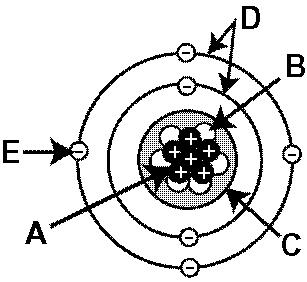
In the atom diagram shown, E is pointing to
a)
An electron
b)
a proton
c)
a neutron
d)
the nucleus
15.
A molecule is________
a)
two ions held together by opposite charges
b)
smaller than an atom
c)
can be physically separated into smaller atoms
d)
more than one atom bonded together by covalent bonds
16.
What charge does an electron have?
a)
Negative
b)
Positive
c)
Neutral
d)
Contrated
17.

In this chemical equation, the elements in red are the_______.

a)

Products

b)

Reactants

c)

Subscripts

d)

Coefficients

18.

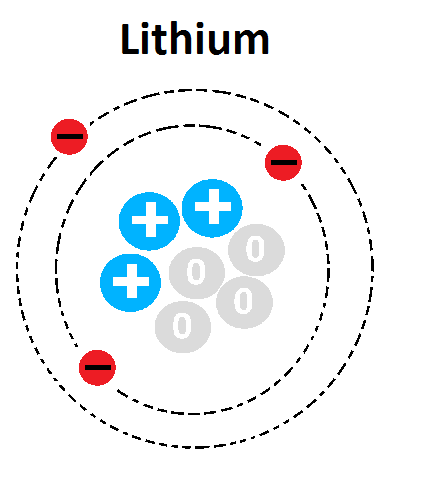
What is the atomic mass of this atom?

a)

1

b)

3

c)

4

d)

7

19.
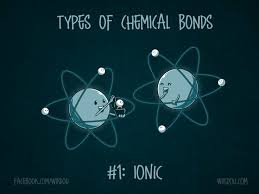
An ionic bond forms when 
a)
Valence electrons are shared
b)
a sea of mobile electrons surround the cations
c)
valence electrons are transferred between atoms
d)
none of the above
20.
Which of these molecules is nonpolar?
a)
O2
b)
H2O
c)
HBr
d)
NI3
21.
Why does H2O have a higher boiling point than H2Se?
a)
It has stronger bonding
b)
it has dipole-dipole forces
c)
it has london dispersion forces
d)
it has hydrogen bonding
22.
Arrange in order of increasing ability to penetrate matter.
a)
Beta, gamma, alpha
b)
Alpha, gamma, beta
c)
Gamma, beta, alpha
d)
Alpha, beta, gamma
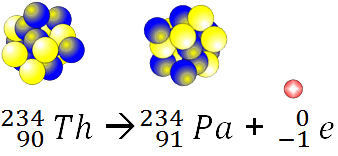
23.
Classify this process.
a)
Nuclear fission
b)
Nuclear fusion
c)
Alpha decay
d)
Beta decay
24.
Which process involves the splitting of large nuclei?
a)
Beta decay
b)
Alpha decay
c)
Nuclear fission
d)
Nuclear fusion
25.
What type of reaction is this?
a)
Endothermic
b)
Exothermic
26.
How many moles of Na2SO4 is needed to make 2.5 L of 2.0 M solution?
a)
5 moles
b)
1 moles
c)
1.25 moles
d)
0.80 moles
27.
How many neutrons would Potassium-41 (K) have?
a)
22
b)
19
c)
41
d)
1
28.
N2 +  3H2 → 2NH3 
How many moles of hydrogen are needed to react with 5 moles of nitrogen?
a)
6 mol H2
b)
2 mol H2
c)
3 mol H2
d)
15 mol H2
29.
N2 +  3H2 → 2NH3 
How many moles of hydrogen are needed to react with 5 moles of nitrogen?
a)
6 mol H2
b)
2 mol H2
c)
3 mol H2
d)
15 mol H2
30.
What bonds to make an ionic bonds?
a)
metals and metals
b)
metals and nonmetals
c)
nonmetals and metalloids
d)
nonmetals and nonmetals
31.
Elements in the same group have the same ____.
a)
number of protons
b)
number number of neutrons
c)
# valence electrons
d)
color
32.
The general formula for a synthesis reaction
a)
A + B--> AB
b)
AB--> A + B
c)
A + BX--> AX + B
d)
AX + BY --> AY+ BX
33.
In the formation of a covalent bond, electrons are _____.
a)
transferred
b)
shared
c)
exchanged
d)
lost
34.
Isotopes of the same element have different ____.
a)
hair
b)
protons
c)
neutrons
d)
electrons
35.
When the solution is holding more solute than its maximum (by raising the temperature saturating the solution and then lowering the temperature) it is said to be
a)
Supersaturated
b)
Saturated
c)
Unsaturated
d)
Undefined
36.
What is the empirical formula of the following molecular formula:  C3H6
a)
C3H6
b)
CH2
c)
C2H4
d)
CH3
37.
What is the empirical formula of the following molecular formula:  C3H6
a)
C3H6
b)
CH2
c)
C2H4
d)
CH3
38.
Balance this equation:  H2 + N2 → NH3
a)
 H2 + 4N2 → NH3
b)
 H2 + 3N2 → 2NH3
c)
 3H2 + N2 → 2NH3
d)
 2H2 + 2N2 → 2NH3
39.
What is the equation for the positron emission by oxygen-16?
a)
168O + 0+1e --> 169F
b)
168O --> 42He + 126C
c)
168O --> 0-1e + 169F
d)
168O --> 0+1e + 167N
40.
Which type of nuclear radiation is being emitted here?
a)
Alpha
b)
beta
c)
gamma 
d)
none
41.
2NH3+22kJ↔N2+3H2
Which direction does the reaction shift if N2 was removed?
a)
Shift right 
b)
Shift left
c)
No shift
d)
Shift both directions
42.
At what time the reaction reached equilibrium?
a)
t1
b)
t2
c)
t3
d)
t4
43.
At approximately what temperature does the solubility of sodium chloride, NaCl, match the solubility of potassium dichromate, K2Cr2O7?
a)
60 ºC
b)
30 ºC
c)
50 ºC
d)
83 ºC
44.
Which substance is MOST soluble at 0 ºC?
a)
KI
b)
NaNO3
c)
NaCl
d)
Ce2(SO4)3
45.
A solution of potassium chlorate, KClO3, has 20 grams of the salt dissolved in 100 grams of water at 70 ºC. Approximately how many more grams of the salt can be added to the solution before reaching the saturation point?
a)
10 grams
b)
30 grams
c)
80 grams
d)
60 grams 
46.
Attractions between water molecules are called
a)
Covalent bonds
b)
Ionic bonds
c)
Polar bonds
d)
Hydrogen bonds
47.
What is happening in section C-D?
a)
A. There is an increase in the kinetic energy of the molecules
b)
B. There is an increase in the electrical potential energy of the molecules
c)
There is a decrease in the electrical potential energy of the molecules
d)
A and B
48.
What is happening in section A-B?
a)
A. There is an increase in the kinetic energy of the molecules
b)
B. There is an increase in the electrical potential energy of the molecules
c)
There is a decrease in the electrical potential energy of the molecules
d)
A and B
49.
What type of reaction is this?
a)
Exothermic
b)
Endothermic
50.
What type of reaction is this?
a)
Exothermic
b)
Endothermic
51.
Which of the following elements make up the unknown sample?
a)
A and B
b)
B and C
c)
C and D
d)
B and C
52.
What scientist is best known for his "Plum Pudding" model of the atom?
a)
J.J. Tomson
b)
Ernest Rutherford
c)
John Dalton
d)
Democritus
53.
Rutherford's gold foil experiment provided evidence that...
a)
Negative and positive charges are spread evenly throughout the atom.
b)
Alpha particles have a positive charge.
c)
Gold is not a dense as previously thought.
d)
There is a dense positively charged nucleus at the center of an atom.
54.
This picture represents which of the following?
a)
Element
b)
Compound
c)
Mixture
55.
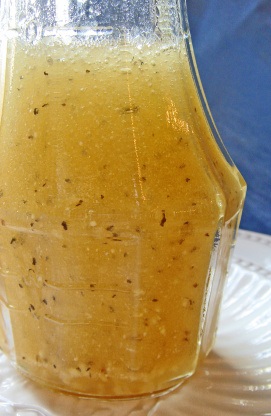
Italian Salad Dressing
a)
heterogeneous mixture
b)
homogeneous mixture
56.
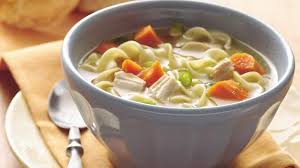
Chicken noodle soup
a)
heterogeneous mixture
b)
homogeneous mixture
57.
a)
Gas particles are elastic and do not attract each other.
b)
The kinetic energy of gas is dependent on temperature 
c)
Energy is not lost when gas particles collide with each other or with the walls of the container.
d)
All of the above
58.
Which type of force is this?
a)
Intramolecular
b)
Intermolecular
59.
What is oxidation number of Cr in Cr2O7-2?
a)
-2
b)
+2
c)
+6
d)
+12
60.
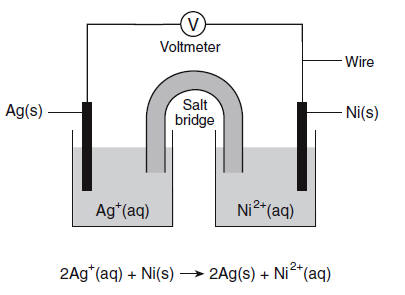
What reaction occurs at the anode?
a)
Ag+ + e- →Ag
b)
Ag → Ag+ + e-
c)
Ni2+ + 2e- → Ni
d)
Ni → Ni2+ + 2e-
61.
Which of the following is the balanced half -reaction for the oxidation of Cu to Cu+2?
a)
Cu   --> Cu+2
b)
Cu + 2 e-   --> Cu+2
c)
Cu  --> Cu+2  + 2 e-
d)
Cu - 2e-  --> Cu+2
62.
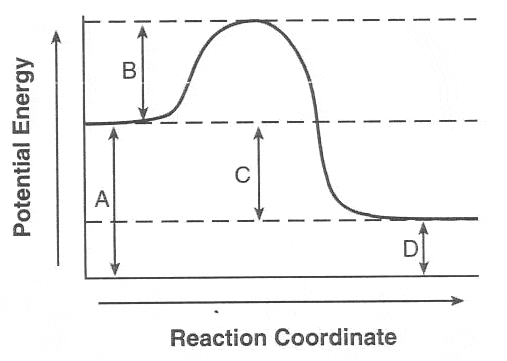
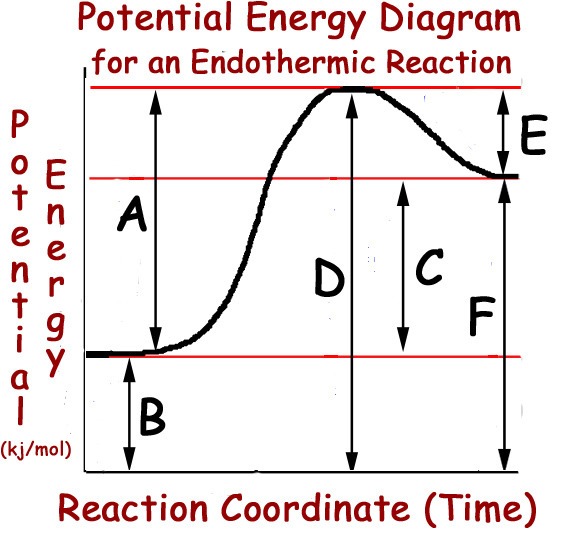
What letter represents the activation energy of the forward reaction?
a)
A
b)
B
c)
C
d)
D