
 Worksheets
Origin of Life Crash Course
Total questions: 22
Worksheet time: 25mins
Which statement best describes conditions on early Earth?
hot with volcanic activity and electrical storms
dry, arid land covered with cacti
cold oceans
dark and dusty with abundant water
Which of the following is required for all life on earth?
Coffee
Water
Eating plants
Jiggling and Sliding


This experiment was conducted by the scientists:
Stanley Miller and Harold Urey
David Attenborough and Albert Einstein
Louis Pasteur and Francesco Redi
James Watson and Francis Crick

Which question were the scientists trying to answer with this experiment?
Where do cells come from?
How did prokaryotes form cell membranes?
How were the earliest organic molecules formed?
What gave rise to the first eukaryotic cell?
Miller/Urey and other scientists have shown that:
Life on early Earth required material from space
Cells survived in the primitive atmosphere
Amino acids could be produced from inorganic molecules
Simple cells can be produced in a laboratory
The idea that Earth's early oceans had organic molecules that became the first life is called the...
Primordial soup hypothesis
Bubble hypothesis
Clam chowder hypothesis
Radioactive dating theory
The Miller-Urey experiment of 1953 was designed to test the hypothesis that lightning supplied the energy needed to turn atmospheric gases into organic molecules such as amino acids. Which of the following describes why the Miller-Urey theory is widely accepted today?
Amino acids spontaneously form from molecules in the atmosphere today
Organic molecules are present today in extremely high concentrations
The process of synthesizing organic molecules from a mixture of gases has been successfully modeled in the laboratory
Miller and Urey were legit scientists
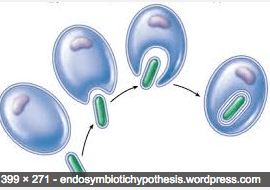
What process is shown within this diagram?
Agario
Endosymbiosis
Chemical evolution
Abiogenesis
The theory of Endosymbiosis explains...
The origin of eukaryotes
How prokaryotes first appeared on Earth
How bacteria evolved
Why cells rely on one another
Which concept refers to life arising from non-living molecules?
Organic evolution
Abiotic synthesis
Chemosynthesis
Photosynthesis
Endosymbiosis gave rise to
golgi bodies and ribosomes
chloroplasts and mitochondria
lysosomes and nuclei
the rough and smooth endoplasmic reticulum

These two scientists hypothesized (but never tested) that the early Earth atmosphere contained the necessary molecules and energy sources to produce organic molecules.
Oparin-Haldane
Darwin-Wallace
Miller-Urey
Lyell-Hutton
All of the following are evidence of endosymbiosis EXCEPT
mitochondria and chloroplast contain ribosomes but lack most other organelles
mitochondria and chloroplasts are similar in size to prokaryotes
mitochondria and chloroplasts have double membranes
mitochondria and chloroplast have a membrane-bound nucleus

