
 Worksheets
Common Ancestor Evolution
Total questions: 27
Worksheet time: 15mins
Name
Class
Date
1.

According to the diagram, which of the following pairs of insect groups likely share the least homologies?
a)
beetles and moths
b)
grasshoppers and mosquitoes
c)
mosquitoes and flies
d)
flies and moths
2.

Which of the following statements is supported by the phylogentic tree?
a)
Grasshoppers became extinct hundreds of millions of years ago.
b)
Mosquitoes and flies are members of the same species.
c)
Flies did not become a species until just a few hundred years ago.
d)
Beetles share a common ancestor with moths.
3.

Which statement best represents the illustration to the right?
a)
Wolves, bison, and horses are mammals.
b)
Wolf, bison, and horse structures show no evidence of relationship.
c)
Wolves, bison, and horses evolved in the same habitat.
d)
Wolves, bison, and horses share homologous structures.
4.

Based on the diagram, which pair of organisms most likely share the most recent common ancestor?
a)
wolf and bison
b)
wolf and horse
c)
bison and horse
d)
cannot be determined
5.
What is the most important question to ask when analyzing homologies to determine common ancestry?
a)
Do they live in similar places?
b)
Are the structures similar?
c)
Do they have a similar function?
d)
Do they eat the same foods?
6.

Which two species are most closely related?
a)
1 and 2
b)
2 and 3
c)
3 and 4
d)
1 and 4
7.

Which two species have the most distant common ancestor?
a)
1 and 4
b)
1 and 2
c)
1 and 3
d)
2 and 3
8.
The table shows the differences in amino acids. Amino acids are the monomers that make up which of the following macromolecules?
a)
nucleic acids
b)
polysaccharides
c)
proteins
d)
triglycerides
9.

These forelimbs are considered to be evidence of common ancestry because of which of the following?
a)
They have the same functions.
b)
They contain similar structures.
c)
They are all from mammals.
d)
They all are all the same basic length.
10.

The forelimbs of humans, birds and porpoises have a wide variety of functions. Which biological process is believed to have created the diversity of functions seen in these species?
a)
respiration
b)
natural selection
c)
bio magnification
d)
ecological succession
11.

Knowledge of which of the following would provide the best evidence regarding the evolutionary relationships of the species shown in the diagram?
a)
Neck Lengths
b)
Feeding patterns
c)
DNA sequences
d)
Common Predators
12.

According to the diagram, which of the following pairs of insect groups likely share the most homologies?
a)
aphids and bees
b)
moths and mosquitoes
c)
bees and wasps
d)
wasps and beetles
13.

Which species changed the least over time?
a)
bees
b)
beetles
c)
flies
d)
aphids
14.

Which two species shown probably have the most distant common ancestor?
a)
elephant and porpoise
b)
human and elephant
c)
bird and porpoise
d)
human and porpoise
15.
When every organism of a species has died.
a)
Evolution
b)
Natural Selection
c)
Extinction
d)
Artificial Selection
16.
Where the better adapted organisms survive to pass traits along to offspring.
a)
Evolution
b)
Natural Selection
c)
Extinction
d)
Artifical Selection
17.
Mutations are a change in what?
a)
DNA
b)
tRNA
c)
genotype
d)
phenotype
18.
Why are advantageous traits more likely to be passed onto offspring?
a)
Because they are more likely to survive and reproduce.
b)
Because they come from dominant alleles.
c)
Because they come from recessive alleles.
d)
Because the trait is an acquired phenotype.
19.
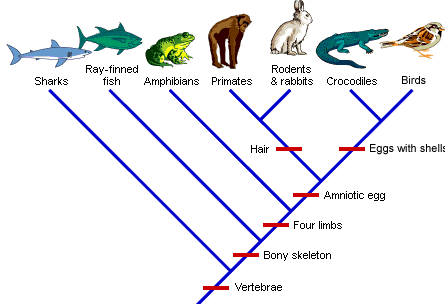
According to this cladogram, sharks are MOST closely related to which organism?
a)
Amphibians
b)
Ray finned fish
c)
Crocodiles
d)
Birds
20.
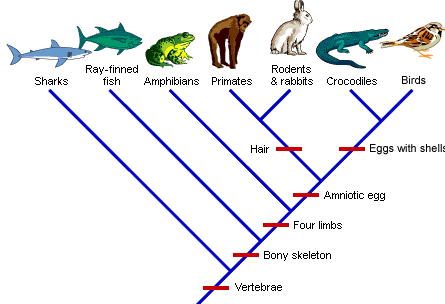
According to this cladogram, birds are LEAST related to:
a)
Amphibians
b)
Sharks
c)
Ray Finned Fish
d)
Crocodiles
21.
fossil and their location in the sedimentary layer provide info. about living in the past
a)
ancestry
b)
fossil record
c)
limiting factor
d)
vestigial structure
22.
What are the most studied animals in the galapagos?
a)
Finches
b)
Tortoises
c)
Turtles
d)
Lizards
23.
Survival of the Fittest and Evolution were proposed by what scientist?
a)
Charles Darwin
b)
Albert Einstein
c)
Steven Hawking
d)
Isaac Newton
24.
What was the result of the Miller-Urey Experiment?
a)
amino acids
b)
nucleotides
c)
lipids
d)
glucose
25.
The apparatus in the experiment was used to mimic what?
a)
proteins
b)
Earth's present conditions
c)
early Earth's conditions
d)
they didn't mean to mimic anything in particular
26.

Which question were the scientists trying to answer with this experiment?
a)
Where do cells come from?
b)
What came first the chicken or the egg?
c)
How are biomolecules formed?
d)
What gave rise to the Eukaryotic cell?
27.
What was the product of the Miller-Urey Experiment?
a)
Simple amino acids
b)
Simple nucleotides
c)
Simple lipids
d)
Simple monosaccarides
100 %

