wayground logo

Free Printable Worksheets

Font size

S
M
L
XL
Worksheets

Enzymes Foundation

Total questions: 24

Worksheet time: 8mins

Name
Class
Date
1.

Enzymes are an example of

a)

Lipids

b)

Carbohydrate

c)

Protein

d)

Nucleic Acid

2.
What is the purpose  of an enzyme?
a)
give permission for the reaction
b)
raise activation energy
c)
speed up reactions
d)
control how many reactions occur
3.
Enzymes are capable of increasing the rate of a chemical reaction within a living cell.  Enzymes accomplish this through which of the following means?
a)
reducing the number of products   
b)
reducing the activation energy
c)
increasing the temperature of the cell
d)
increasing the concentration of reactants 
4.
What 3 letters do enzymes typically end in?
a)
-ose
b)
-ase
c)
-ese
d)
-tic
5.
Any substance that is acted upon by an enzyme is called a(n)?
a)
Coenzyme
b)
Substrate
c)
Vitamin
d)
Polypeptide
6.
After the enzyme and substrate bind together and perform the reaction, what does the substrate become?
a)
a substrate
b)
an enzyme
c)
a product
d)
an active site
7.
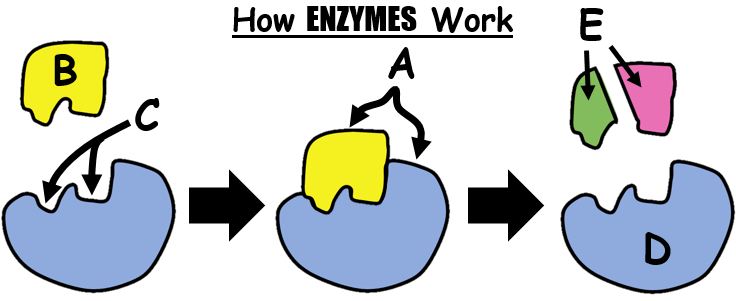
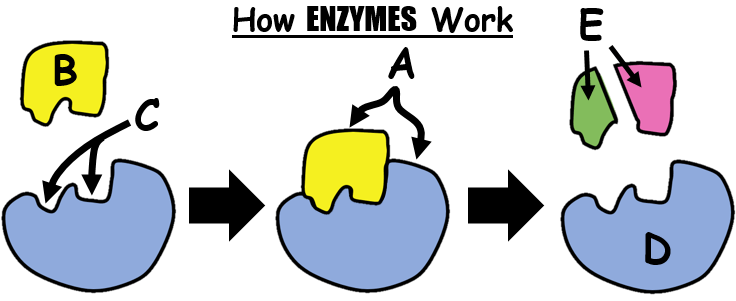
In the diagram, what is letter A? 
a)
product
b)
substrate
c)
enzyme-substrate complex
d)
active site
8.
Letter C...
a)
active site
b)
enzymes
c)
substrate
d)
products
9.
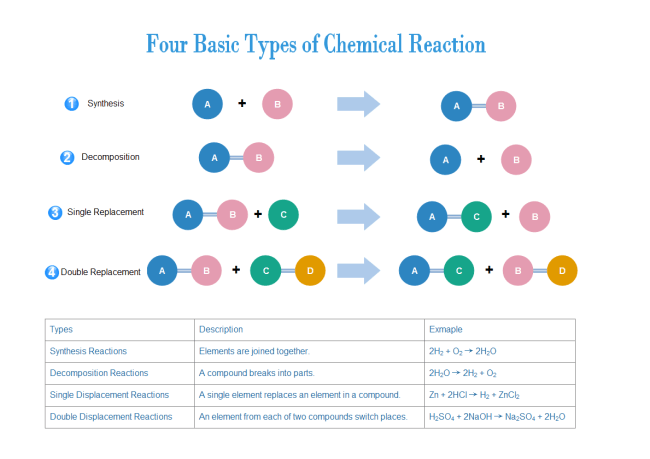
Chemical reactions always involve
a)
the breaking of bonds in reactants.
b)
the formation of new bonds in products.
c)
the breaking of bonds in reactants and the formation of new bonds in products.
d)
enzymes. 
10.
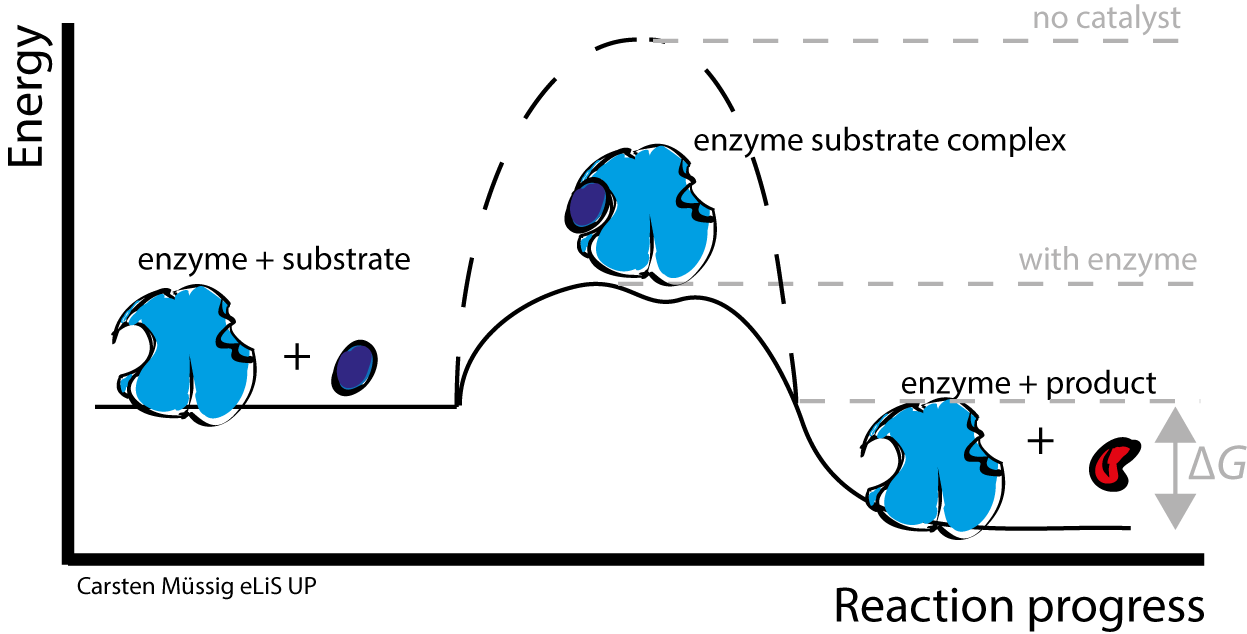
An enzyme speeds up a reaction by
a)
lowering the activation energy.
b)
raising the activation energy.
c)
releasing energy.
d)
absorbing energy.
11.
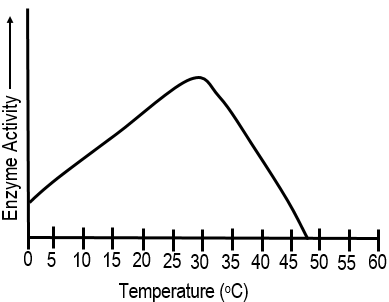
Based on the graph, what is the optimal temperature for this enzyme? 
a)
15oC
b)
40oC
c)
30oC
d)
35oC
12.
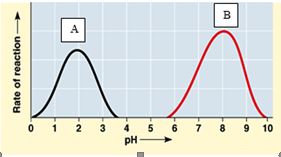
What is the optimum pH of pepsin which is found in the stomach gastric juice of humans?
a)
pH 5
b)
pH 2
c)
pH 7
d)
pH 9
13.
Which of these is NOT true?
a)
Enzymes can denature (change shape) when the temperature gets too high
b)
Enzymes can only be used once in a chemical reaction
c)
Enzymes can denature when the pH changes
d)
Enzymes speed up chemical reactions 
14.
What is broken down by the enzyme amylase, which is found in saliva?
a)
sugar
b)
starch
c)
oils
d)
protein
15.
Which enzyme is most efficient in a basic (alkaline) solution?
a)
A
b)
B
c)
both are equally efficeint
d)
neither are efficient in a basic solution
16.
Increasing substrate concentration increases the rate of reaction. This is because....
a)
less substrate molecules will be colliding with enzyme molecules, so less product will be formed
b)
more substrate molecules will be colliding with enzyme molecules, so more product will be formed
c)
the temperature will increase, resulting in faster reactions
d)
the rate of denaturation of enzymes will decrease
17.
Venus flytraps produce chemicals that break down insects into usable compounds. These chemicals are most likely.....
a)
hormones
b)
lipids
c)
enzymes
d)
carbohydrates
18.
The enzyme known as ‘catalase’ is involved in the breakdown of hydrogen peroxide molecules into separate water and oxygen molecules. During this reaction, what happens to the ‘catalase’?
a)
the enzyme would become products: O2 and H2O
b)
the enzyme would be fully used up and discarded
c)
the enzyme would remain unchanged in any way
d)
the enzyme would become a new type of enzyme
19.
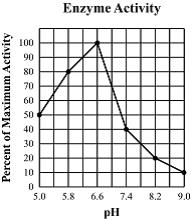
Which of the following conclusions can be drawn from this graph?
a)
The optimum pH of the enzyme is 6.6.
b)
The optimum pH of the enzyme is 5.8
c)
The enzyme’s activity increases as pH increases 5.0 to 9.0
d)
The enzyme’s activity is greater around pH of 8.0 .
20.

What happens when enzymes are heated to a high temperature?

a)

The enzymes die.

b)

The shape is altered and they denature

c)

The enzymes' amino acid sequence changes.

d)

The enzymes remain the same

21.

An individual who is able to digest milk products is called

a)

lactose persistent

b)

lactase persistent

c)

lactose intolerant

d)

lactase intolerant

22.

Catalase is found in

a)

liver and yeast

b)

liver and tomato leaves

c)

yeast and tomato leaves

d)

yeast and tulip roots

23.

Catalase is an enzyme that catalyzes the conversion of _________ to _________.

a)

Hydrogen peroxide to water and oxygen

b)

Water to hydrogen peroxide and oxygen

c)

Water and hydrogen peroxide to oxygen

d)

Oxygen and water to hydrogen peroxide

24.

The variable in an experiment that is measured is considered the

a)

Dependent variable

b)

Independent variable

c)

Controlled variable

d)

Uncontrolled variable