Wayground logo

Free Printable Worksheets

Font size

S
M
L
XL
Worksheets

IB Bio D1

Total questions: 59

Worksheet time: 1hrs 7mins

Name
Class
Date
1.
The sequence of DNA below is part of a gene. How many amino acids are coded for by this segment? 
a)
4
b)
8
c)
12
d)
20
2.
Which of the following carries amino acids to the site of protein synthesis? 
a)
mRNA
b)
rRNA
c)
tRNA
d)
nRNA
3.

What is the order for Protein Synthesis?

a)

Transcription -> Translation -> Protein

b)

Translation - > Transcription -> Protein

c)

Protein -> Transcription -> Translation

d)

Translation -> Protein -> Transcription

4.
What is the location in the cell for translation?
a)
nucleus
b)
mitochondria
c)
ribosome
d)
chloroplast
5.

Which sequence could be found in RNA?

a)

ACCTGT

b)

CGCATT

c)

AUGCUU

6.
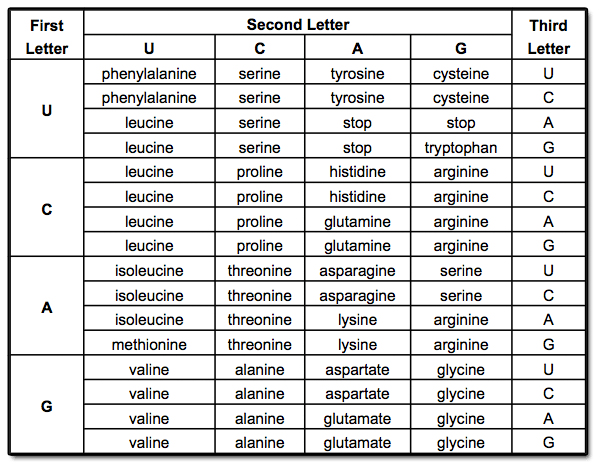
What amino acid is represented by the codon UUA?
a)
Phenylalanine
b)
Tyrosine
c)
Leucine
d)
Stop codon
7.
The codon CCU codes for what amino acid?
a)
Isoleucine
b)
Stop
c)
Methionine
d)
Proline
8.

The picture below shows the steps of DNA replication beginning with step one and ending with step three.


​Because you are reusing the old, or parent, DNA strand DNA replication is said to be

a)

Semi- Conservative

b)

Semi-discontinuous

c)

Continuous

d)

Fully-Conserveative

9.

The picture below shows an enzyme unwinding and unzipping DNA.

​

​What is the name of this enzyme?

a)

DNA Helicase

b)

DNA Ligase

c)

DNA polyermase

d)

RNA Polymerase

10.

Okazaki fragments appear on which strand of DNA during DNA replication?

a)

lagging

b)

leading

11.

DNA replication runs from ______' to _____' and is said to be ______________________

a)

5, 3, antiparallel

b)

3, 5, antiparallel

c)

5, 3, parallel

d)

3, 5, parallel

12.
If a strand reads:
3' A A A T T T C 5'
The matching strand would read...
a)
5' T T T A A A G 3'
b)
3' T T T A A A G 5'
c)
5' A A A T T T C 3'
d)
3' U U U A A A G 5'
13.
The central dogma of biology states that information flows in one direction from 
a)
nuclei to RNA to cytoplasm
b)
ribosomes to proteins to DNA
c)
genes to nuclei to ribosomes
d)
DNA to RNA to proteins
14.
Choose the nucleotide sequence of the RNA strand that would be complementary to the following strand: 
GTAGTCA
a)
UATUAGA
b)
ACGACTG
c)
CAUCAGU
d)
CATCAGT
15.
The main function of tRNA is to...
a)
carry a message that, when translated, forms proteins
b)
form a portion of ribosomes
c)
string together complementary RNA and DNA strands
d)
bring amino acids from the cytoplasm to the ribosomes
16.
What is the term for a three-nucleotide sequence that codes for an amino acid?
a)
base
b)
codon
c)
amine
d)
serine
17.
Which phrase best describes translation?
a)
converts mRNA into a polypeptide
b)
catalyzes bonds between amino acids
c)
produces RNA from DNA molecules
d)
recycles tRNA molecules for reuse
18.
Which of the following is the site of transcription?
a)
vacuole
b)
lysosome
c)
nucleus
d)
ribosome
19.
Which of the following is the site of translation?
a)
vacuole
b)
lysosome
c)
nucleus
d)
ribosome
20.
Which of the following is created in the nucleus and carries the genetic code to the cytoplasm?
a)
DNA
b)
tRNA
c)
mRNA
d)
rRNA
21.
What molecules do both DNA and RNA contain?
a)
uracil
b)
nucleotides
c)
thymine
d)
deoxyribose
22.
Which of the following best describes how DNA and RNA are similar?
a)
they both contain A and T
b)
They both have a double helix
c)
They are both composed of 5 different nucleotides
d)
they both have C and G
23.
The DNA sequence ATCAGCGCTGGC is part of a gene. how many amino acids are coded for by this message?
a)
4
b)
8
c)
12
d)
20
24.
The DNA nucleotide is composed of three parts. Which two components make up the nucleotide backbone?
a)
ribose sugar and base
b)
ribose sugar and phosphate group
c)
nitrogen base and deoxyribose sugar
d)
deoxyribose sugar and phosphate group
25.
Which choice describes DNA after replication has taken place?
a)
one molecule with two original strands and one molecule with two new strands
b)
two molecules, each with one original and one new strand
c)
two molecules, each with two new strands
d)
 two molecules, each with two old strands
26.
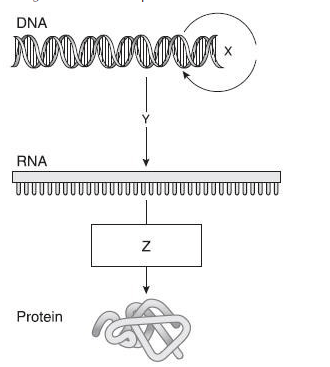
 A diagram of a cellular process is shown below. Which of the following identifies the process shown at point Z?
a)
Translation
b)
Translocation
c)
Replication
d)
Transcription
27.
A portion of mRNA is coded CUG. The corresponding DNA is coded
a)
GAC
b)
GTC
c)
CTG
d)
CAG
28.
A portion of DNA reads GAG. The corresponding mRNA would be
a)
GUG
b)
GTG
c)
CTC
d)
CUC
29.
DNA polymerase and RNA polymerase are similar in that they
a)
are both enzymes
b)
both are involved in making new polymers
c)
both can be found doing work in the cell nucleus
d)
all of these things are true
30.
The process shown in this image
a)
is called replication
b)
results in a new copy of the DNA
c)
does not happen during mitosis
d)
All of these apply
31.

A small section of RNA that transports amino acids

to the ribosome for synthesis into proteins.

a)

tRNA

b)

mRNA

c)

rRNA

d)

DNA

32.
The diagram shows the structure of an amino acid. Which type of molecule is formed from amino acids?
a)
lipids
b)
proteins
c)
carbohydrates
d)
nucleic acids
33.

What does PCR stand for?

a)

Polymer change reaction

b)

Polymerase train reaction

c)

Polymerase chain reaction

34.

Which of the following types of enzymes are added to the thermocycler during PCR?

a)

Restriction endonuclease

b)

DNA polymerase

c)

DNA ligase

d)

DNA helicase

35.

Which of the following terms refers to bacteria adapted to living in high temperature habitats?

a)

thermophilic

b)

halophilic

c)

hydrophilic

d)

xerophyte

36.

Which of the following processes involves digesting DNA into a number of fragments?

a)

gel electrophoresis

b)

polymerase chain reaction

c)

genetic engineering

37.

What word(s) links DNA primers, DNA replication and 'sticky ends'

a)

complementary base pairing

b)

denaturation

c)

restriction enzyme

d)

electrophoresis

38.

In a gel electrophoresis tank, will the DNA move towards the positive or negative electrode?

a)

Positive

b)

Negative

39.

In a gel electrophoresis tank, what will move furthest - smaller fragments of DNA or larger fragments?

a)

Smaller

b)

Larger

40.

Which enzyme hydrolyses phosphodiester bonds of the DNA backbone

a)

DNA polymerase

b)

restriction endonuclease

c)

DNA ligase

d)

reverse transcriptase

41.

Which feature of DNA is DNA fingerprinting dependent on?

a)

It's double stranded

b)

It's very very long

c)

Presence of VNTRs within and between species

d)

It is positively charged

42.

Approximately what temperature is used in a thermocycler to denature dsDNA?

a)

45oC

b)

55oC

c)

75oC

d)

95oC

43.

At approximately what temperature do primers anneal to the ssDNA in the thermocycler during PCR?

a)

35oC

b)

55oC

c)

85oC

d)

95oC

44.

Which of the following is a feature of prokaryotes but not eukaryotic cells?

a)

Single circular chromosome

b)

single stranded DNA

c)

mitochondria

d)

protein coat

45.

Which is smallest?

a)

Primer DNA

b)

Bacterial plasmid

c)

Human genome

46.

Which of the following have been genetically modified?

a)

Rice

b)

Goats

c)

Humans

d)

All of these

47.

What is the main reason genome sequencing has become faster?

a)

Improved sequencing technologies

b)

More people are working in gene technology

c)

More investment

48.

Which enzyme can be used to isolate a gene from some mRNA?

a)

reverse transcriptase

b)

DNA ligase

c)

DNA helicase

d)

restriction endonuclease

49.

During PCR, the amount of fragments of DNA duplicates each cycle. How do you work out the number of fragments after 5 cycles?

a)

2 x 5

b)

25

c)

5 + 2

d)

(5 x 2) + 2

50.

Which of the following cellular processes is PCR most similar to?

a)

Transcription

b)

Translation

c)

DNA replication

d)

Mitosis

51.

Which species has the most DNA in common with species A?

a)

B

b)

C

c)

D

52.

Which two techniques could be used by a scientist to compare the DNA of two varieties of wheat?

a)

gene therapy

b)

gel electrophoresis

c)

genome sequencing

d)

chromatography

53.
What happens during the Anneal step of PCR?
a)
Primers are created.
b)
The primers attach to the target DNA region.
c)
Primers copy the new DNA strand.
d)
Primers sequence DNA
54.
At what temperature does the Denature step of PCR occur?
a)
94-96° C
b)
50-65° C
c)
72° C
d)
Any temperature
55.

What is the denaturation step?

a)

mutating RNA polymerase

b)

Cooling DNA to allow primers to form

c)

separating DNA helix in a cold environment

d)

separating DNA helix with using heat

56.

What is the Extension step?

a)

DNA polymerase adds nucleotides to the 5' end

b)

RNA polymerase adds nucleotides to the 5' end

c)

DNA polymerase adds nucleotides to the 3' end

d)

RNA polymerase adds nucleotides to the 3' end

57.
What is the purpose of the Extension step of PCR?
a)
To create the primers.
b)
To extend the time it takes to produce DNA.
c)
To allow polymerase to create the complementary strands of DNA.
d)
To allow substrates to copy DNA sequences.
58.

A split gene includes non-coding introns that are ____________ during post-transcriptional modification.

a)

capped

b)

removed

c)

retained

d)

methylated

59.
What structure of this molecule binds with the mRNA molecule?
a)
Amino Acid
b)
tRNA
c)
Anticodon
d)
Codon