
 Worksheets
Final Exam Review Ch 10, 12-15
Total questions: 55
Worksheet time: 55mins
What happens to a molecule when it absorbs a photon?
It moves to a lower energy state.
It remains in the ground state.
It is raised to an excited state and gains more energy.
It releases a photon.

What is the primary role of ATP synthase in the process of photophosphorylation as depicted in the diagram?
Transport of electrons through the thylakoid membrane
Splitting of water molecules to release oxygen
Coupling the formation of ATP to the movement of protons back into the stroma
Transfer of energy from photon to electron

Which molecule acts as the final electron acceptor in the electron transport chain shown in the diagram?
Oxygen
ATP
NADP+
Carbon dioxide
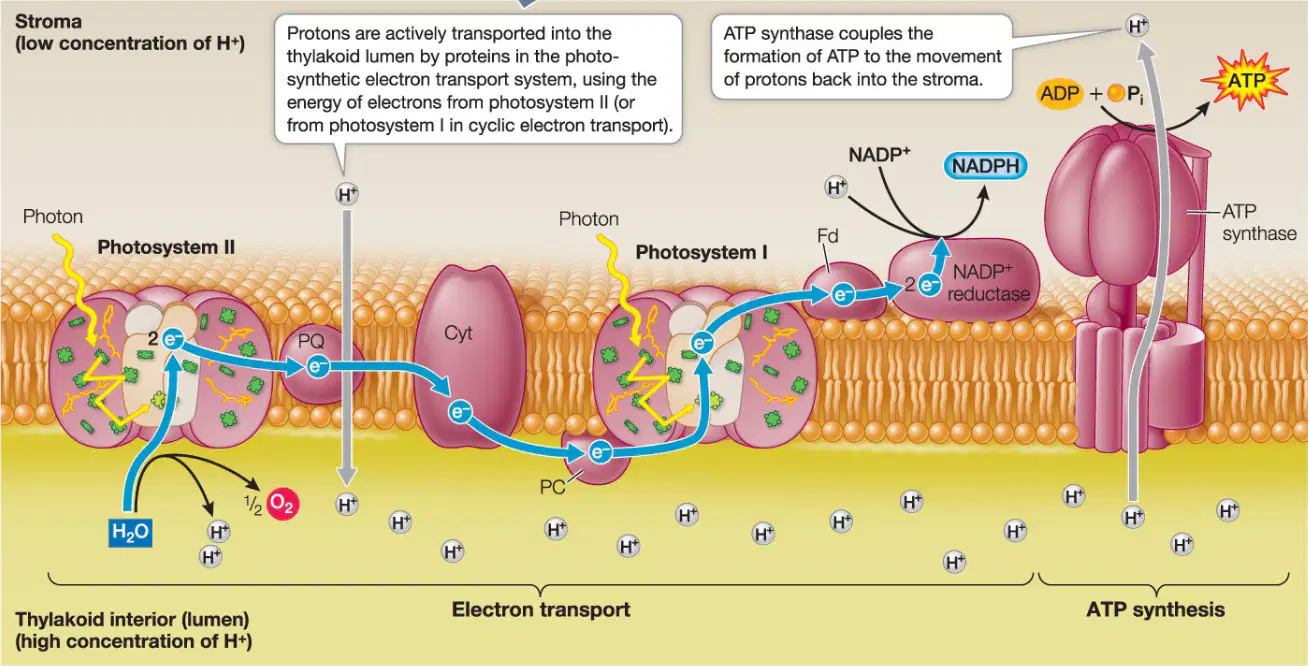
According to the diagram, what is the source of the oxygen (O2) released during photophosphorylation?
Carbon dioxide (CO2)
Water (H2O)
NADPH
ATP
What is the function of the proton gradient across the thylakoid membrane in photophosphorylation?
It helps in the synthesis of sugars
It drives the synthesis of ATP from ADP and Pi
It assists in the transport of electrons to photosystem I
It facilitates the reduction of NADP+ to NADPH
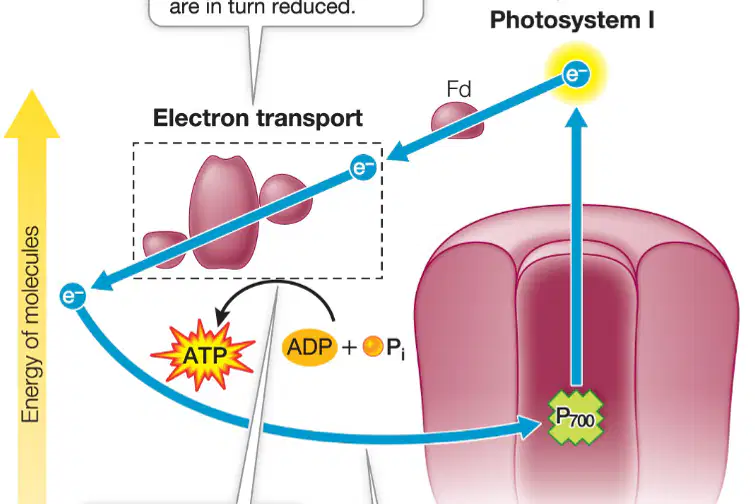
What is the final outcome of the cyclic electron transport process as shown in the diagram?
Production of NADPH
Reduction of oxygen
Synthesis of ATP
Release of carbon dioxide
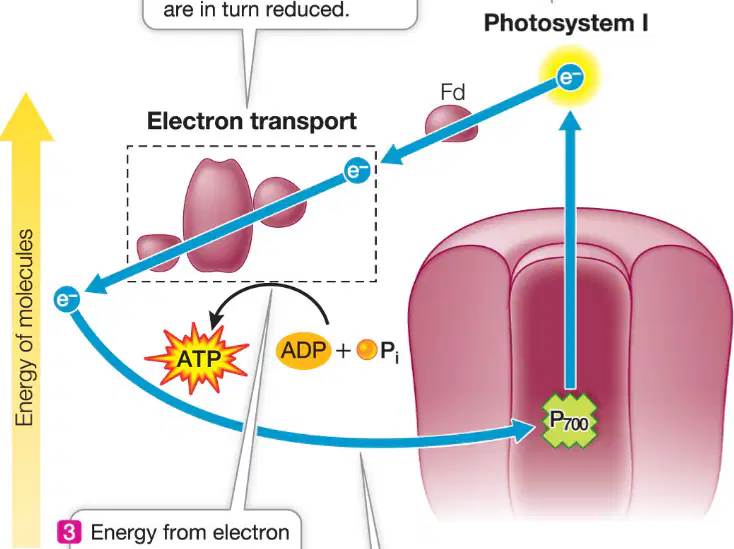
According to the diagram, what allows the cyclic electron transport reactions to start again?
The absorption of light by chlorophyll
The reduction of ferredoxin
The electron flow to photosystem II
The last reduced electron carrier passing electrons to electron-deficient chlorophyll
What is the primary function of the Calvin Cycle?
Synthesis of ATP from ADP and Pi
Conversion of light energy into chemical energy
Synthesis of sugars from carbon dioxide
Breakdown of glucose into carbon dioxide and water
In the Calvin Cycle, what molecule acts as the initial acceptor of CO2?
3PG
G3P
RuBP
ATP

What happens to the G3P molecules in the Calvin Cycle?
All are used to regenerate RuBP.
All are converted into sugars.
One-sixth are used to make sugars, and the rest help regenerate RuBP.
They are all released as CO2.
What is a characteristic feature of model organisms used in genetic studies?
Difficult to grow in the laboratory
Long generation times
Easy to manipulate genetically
Produce a small number of progeny
Why are model organisms with short generation times preferred in genetic studies?
They are more complex genetically
They require less laboratory space
They allow for faster experimental results
They are harder to manipulate genetically
What does Mendel's law of segregation state about the copies of a gene during gamete formation?
Each gamete receives two copies of a gene.
Each gamete receives only one copy of a gene.
Each gamete receives no copies of a gene.
Each gamete randomly selects copies of a gene.
What does Mendel's second law, also known as the law of independent assortment, state about the behavior of genes during gamete formation?
Genes located on the same chromosome segregate together.
Copies of different genes assort independently.
All genes are linked and do not assort independently.
Genes assort randomly without any specific pattern.
In the context of meiosis, how is Mendel's second law interpreted?
Chromosomes duplicate and remain linked.
Chromosomes align randomly at the metaphase plate.
Chromosomes segregate independently during the formation of gametes.
Chromosomes do not undergo crossing over.
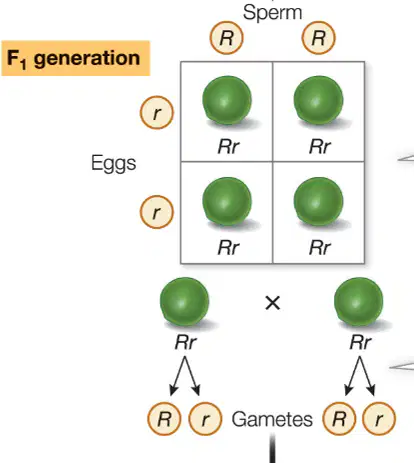
What is the genotype of the gametes produced by the F1 generation plants in Mendel's explanation of inheritance?
RR, Rr, rr
R, r
RR, rr
Rr, rr
According to Mendel's explanation, what phenotypic ratio appears in the F2 generation?
1:1
2:1
3:1
4:1
What is the result when a plant homozygous for R is crossed with one homozygous for r?
All offspring are Rr
All offspring are RR
All offspring are rr
Offspring are either RR or rr
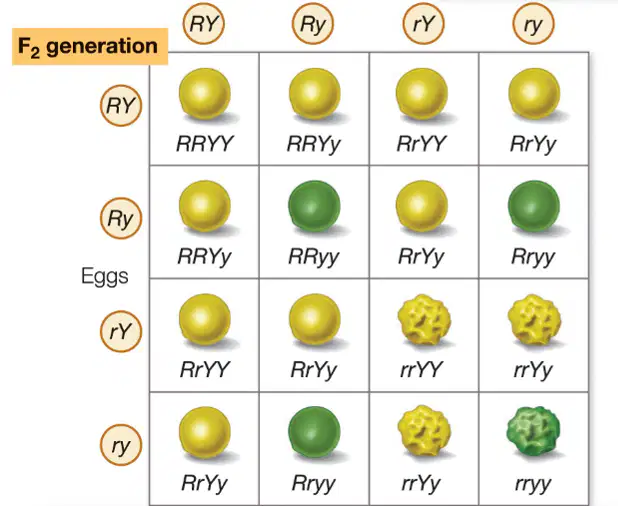
What is the phenotypic ratio of the F2 generation in a dihybrid cross as shown in the diagram?
1:2:1:2:4:2:1:2:1
9:3:3:1
3:1
1:1:1:1
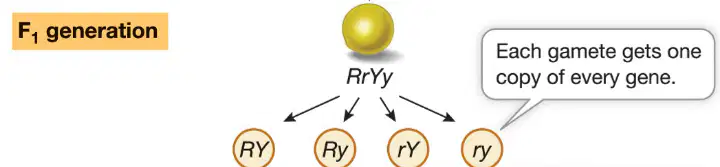
What process allows F1 plants to produce different gamete types in equal frequencies?
Mutation
Independent assortment
Segregation
Recombination
What is the concept of codominance in genetics?
A) A single allele being responsible for a trait
B) Alleles producing phenotypes only present in homozygotes
C) Alleles producing phenotypes that are both present in the heterozygote
D) Alleles that do not produce any observable phenotypes
How many different alleles are involved in the ABO blood group system?
A) Two
B) Three
C) Four
D) Five
What does a filled symbol (square or circle) typically represent in a pedigree chart for dominant inheritance?
Unaffected individual
Affected individual
Heterozygous individual
Individual not included in the study
In a pedigree chart, what does a half-filled symbol represent in the context of dominant inheritance?
Unaffected individual
Affected individual
Heterozygous individual with an unaffected phenotype
Mating between relatives
Who prepared crystallographs from DNA samples that suggested the structure of DNA as a double-stranded helix?
James Watson
Francis Crick
Maurice Wilkins
Rosalind Franklin
What did Rosalind Franklin's images suggest about the structure of DNA?
Single-stranded helix with 10 nucleotides per turn
Double-stranded helix with 10 nucleotides per turn
Triple-stranded helix with 15 nucleotides per turn
Double-stranded helix with 15 nucleotides per turn
According to Rosalind Franklin's findings, what must be on the outside of each DNA strand?
Nitrogenous bases
Sugar-phosphate backbone
Hydrogen bonds
Amino acids
What component of the DNA molecule attaches to the 5' carbon of the sugar in the sugar-phosphate backbone?
Base
Phosphate group
Hydrogen
Nitrogenous base
What is the function of DNA polymerase in the pre-replication complex?
It unwinds the double helix.
It synthesizes a primer.
It elongates both DNA strands.
It keeps the template strands separated.
Which enzyme is responsible for unwinding the double helix in the pre-replication complex?
DNA polymerase
Primase
DNA helicase
Single-stranded binding proteins
What role do single-stranded binding proteins play in DNA replication?
They elongate the DNA strands.
They synthesize RNA primers.
They unwind the DNA helix.
They keep the template strands separated.
Where are Okazaki fragments found in the pre-replication complex?
On the leading strand
On the lagging strand
On both strands
Outside the replication fork
What are the repetitive sequences at the ends of eukaryotic chromosomes called?
Centromeres
Telomeres
Histones
Nucleosomes
What is the sequence of the telomeres in human chromosomes?
ACGT-5'
TTAGGG-3'
GATC-3'
CCGG-5'
What role do the proteins bound to the repeats in telomeres play?
They help in DNA replication
They add nucleotides to the DNA strand
They prevent the DNA repair system from recognizing chromosome ends as breaks
They facilitate chromosome pairing during meiosis
Where in a eukaryotic cell does transcription occur?
In the cytosol
Inside the nucleus
On the ribosome
Within the mitochondria
What is the primary product of transcription?
DNA
Protein
mRNA
Polypeptide
Where does translation take place within a cell?
Nuclear envelope
Cytosol
Inside the nucleus
Golgi apparatus
Which molecule is responsible for carrying amino acids to the ribosome during translation?
mRNA
rRNA
tRNA
DNA
What is the role of ribosomes in protein synthesis?
DNA replication
Transcription
Translation
Lipid synthesis
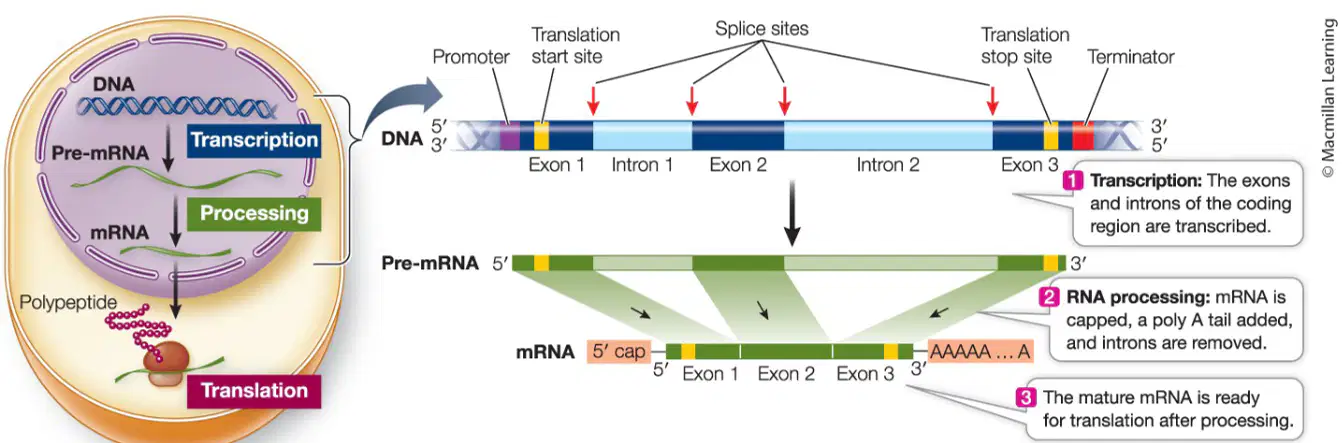
What happens to pre-mRNA during RNA processing as shown in the diagram?
It is translated into a polypeptide
It is transcribed from DNA
It undergoes capping, poly A tail addition, and intron removal
It binds to ribosomes
Where does translation occur in the process of gene expression?
Inside the nucleus
At the promoter region
At the splice sites
Outside the nucleus
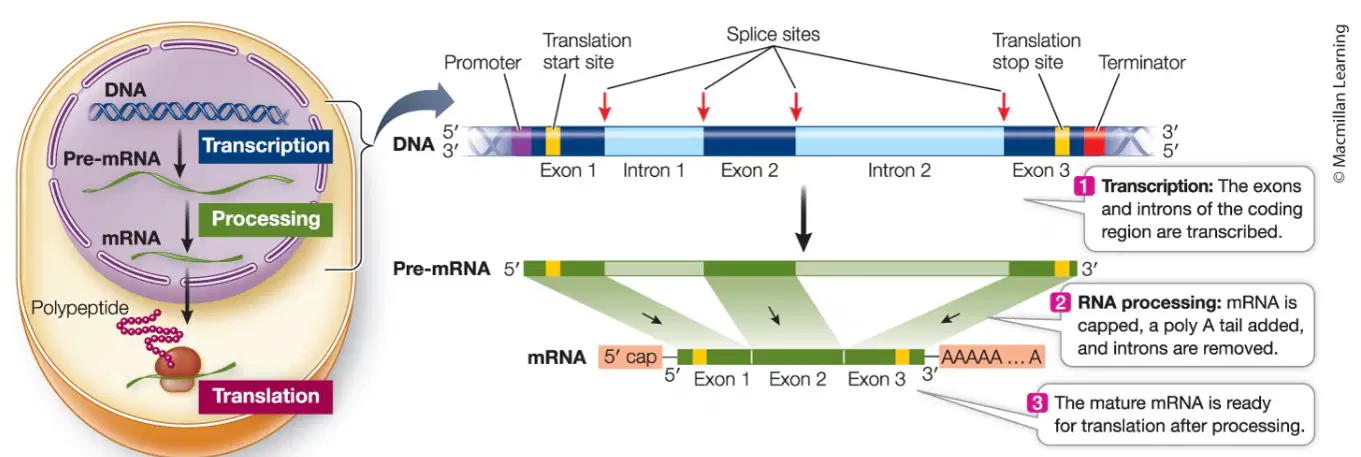
What is the role of the promoter in the transcription of a eukaryotic gene as depicted in the diagram?
It adds a poly A tail to mRNA
It signals the start of transcription
It removes introns from pre-mRNA
It terminates transcription
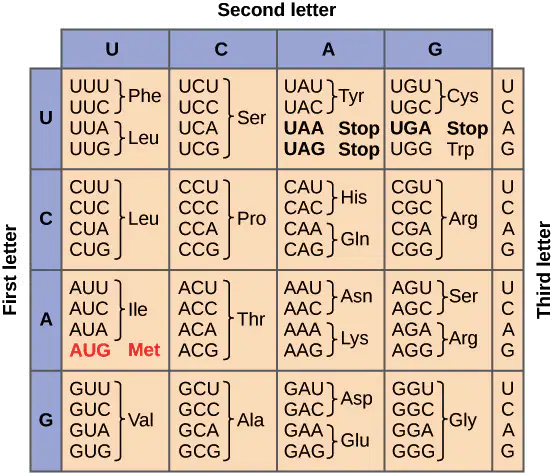
What is the amino acid encoded by the codon AUG?
Methionine
Leucine
Valine
Serine
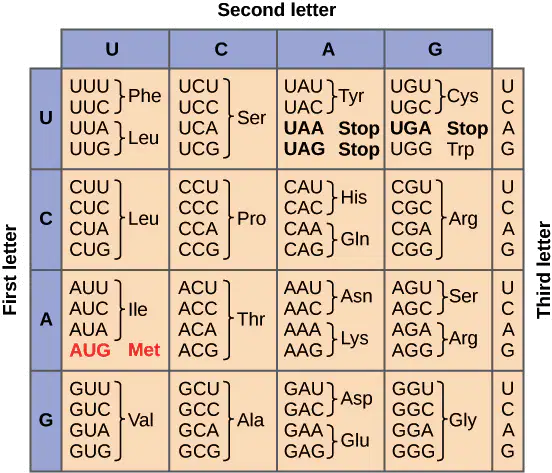
Which codon acts as a stop codon?
UAA
CCG
GUC
AAG
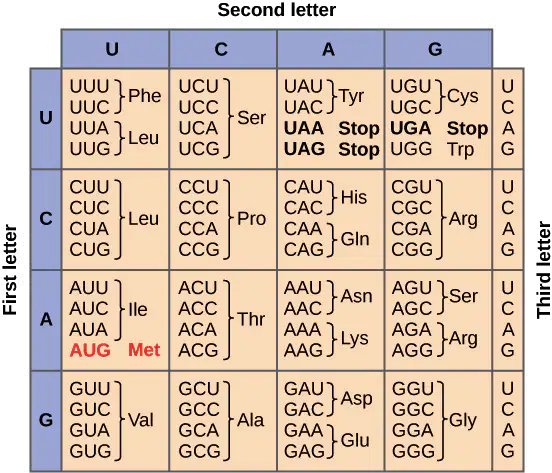
What amino acid is encoded by the codon GGA?
Glycine
Alanine
Glutamine
Arginine
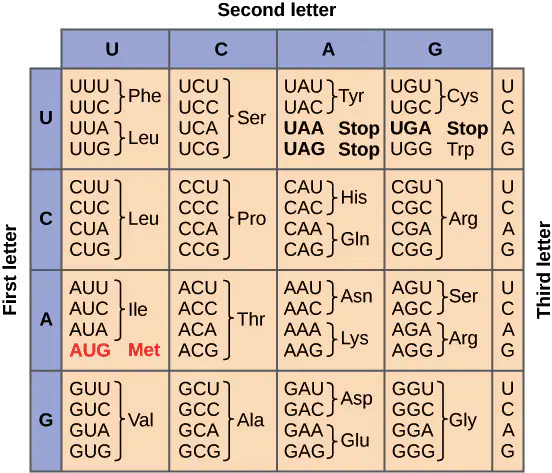
Which of the following codons encodes for Tyrosine (Tyr)?
UAU
UAC
UAA
UAG
What type of chromosomal rearrangement is characterized by the loss of a chromosome segment?
Duplication
Inversion
Deletion
Reciprocal translocation
Which chromosomal rearrangement involves the swapping of segments between two non-homologous chromosomes?
Duplication
Deletion
Inversion
Reciprocal translocation
In which chromosomal rearrangement is a segment reversed before being reinserted into the chromosome?
Duplication
Deletion
Inversion
Reciprocal translocation
What occurs in a duplication chromosomal rearrangement?
A chromosome segment is lost
A chromosome segment is reversed
A chromosome segment is repeated
Segments are swapped between non-homologous chromosomes
What is a transition mutation in DNA?
Substitution of a purine for a pyrimidine
Substitution of one purine for another or one pyrimidine for another
Substitution of a pyrimidine for a purine
Removal of a purine and addition of a pyrimidine
What is a transversion mutation in DNA?
Substitution of a purine for a pyrimidine or vice versa
Substitution of one purine for another
Substitution of one pyrimidine for another
Removal of a pyrimidine and addition of a purine
Which of the following is a correct example of a transition mutation?
Adenine (A) to Guanine (G)
Adenine (A) to Thymine (T)
Cytosine (C) to Adenine (A)
Guanine (G) to Thymine (T)
Which of the following is a correct example of a transversion mutation?
Thymine (T) to Cytosine (C)
Guanine (G) to Adenine (A)
Adenine (A) to Cytosine (C)
Cytosine (C) to Thymine (T)

