
 Worksheets
Boyles and Charles Law
Total questions: 20
Worksheet time: 30mins
Name
Class
Date
1.
What is the formula for Boyle's Law?
a)
P1V1=P2V2
b)
P1V1/P2V2
c)
P1V2=P2V1
d)
P1/V1=P2/V2
2.
When Pressure increases then the Volume must...
a)
Increase
b)
decrease
3.
When Volume increases then Pressure must...
a)
Increase
b)
Decrease
4.
What type of relationship do pressure and volume have?
a)
direct
b)
indirect
c)
no relationship
d)
I don't know
5.
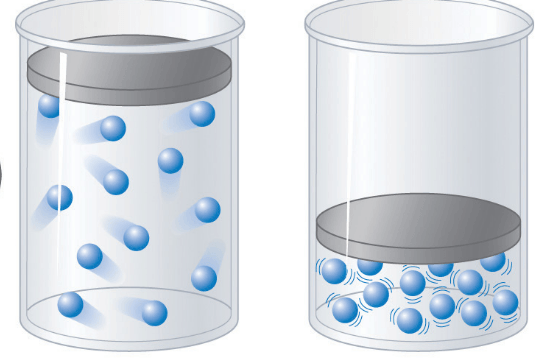
Which container will have a lower pressure?
a)
left
b)
right
c)
they both have the same pressure
d)
I don't know
6.
The relationship of which two variables are compared in Boyle's Law?
a)
pressure & volume
b)
volume & temperature
c)
temperature & pressure
d)
volume & moles (amount of gas)
7.
True or False: Gases can be compressed.
a)
True
b)
False
8.

What happened to the volume between the two steps?
a)
volume increased
b)
volume decreased
c)
volume stayed the same
9.
What is the new volume of the gas if the pressure on 350 L of oxygen at 720 mm Hg is decreased to 600 mm Hg?
a)
420 L
b)
29.16 L
c)
4200.0 L
d)
291.6 L
10.
A gas occupies 4.98 L at 2.6 atm of pressure. What volume does it occupy at 1.8 atm pressure?
a)
12.9 L
b)
0.72 L
c)
7.2 L
d)
3.44 L
11.
Which two variables must be held constant for Boyle’s Law to apply?
a)
pressure & volume
b)
volume & temperature
c)
temperature & moles (amount of gas)
d)
volume & moles (amount of gas)
12.
LeGarrette Blount decides to go scuba diving while on vacation in Mexico. As he swims deeper into the ocean, the pressure pushing on him increases. Based on the relationship in Boyle’s law, what would happen to the volume of LeGarrette’s lungs with this increase in pressure?
a)
volume of the lungs would increase
b)
volume of the lungs would have no change
c)
volume of the lungs would double
d)
volume of the lungs would decrease
13.
What type of relationship is Charles' Law?
a)
Inverse
b)
Direct
c)
Not enough information
d)
Indirect
14.
In order to solve gas law calculations, temperature must be measured in:
a)
Fahrenheit
b)
Celsius
c)
Kelvin
d)
It doesn't matter
15.
What is the formula for Charles' Law?
a)
V = T
b)
VT = VT
c)
T1 / V1 = T2 / V2
d)
V1 / T1 = V2 / T2
16.

If a balloon is cooled what will happen to the volume?
a)
Volume will increase
b)
Volume will decrease
c)
Volume will not change
17.
In Charles' Law the pressure remains constant.
a)
True
b)
False
18.
Which is not a unit of pressure?
a)
mL
b)
torr
c)
Pa
d)
mmHg
19.
How is pressure measured?
a)
kPa, mmHg, L
b)
kPa, mmHg, s
c)
kPa, mmHg, torr
d)
kPa, mmHg, torr, atm
20.
Boyle's law : When _______ is held constant, the pressure and volume of a gas are ________ proportional
a)
temperature, equally
b)
mass, inversely
c)
temperature, inversely
d)
mass, equally
100 %

