
NEW
Font size
S
M
L
XL
 Worksheets
Ecosystem Populations Dynamics
Total questions: 20
Worksheet time: 16mins
Name
Class
Date
1.
To measure population density, you must divide the number of individuals living in a defined space by the
a)
area of the space
b)
birth and death rates
c)
carrying capacity
d)
height of the space
2.
Nesting birds often space themselves evenly from other nests. This pattern is called
a)
clumped dispersion.
b)
uniform dispersion.
c)
random dispersion
d)
scatter dispersion
3.
Which of the following will increase the size of a population?
a)
emigration and births
b)
immigration and deaths
c)
immigration and births
d)
emigration and deaths
4.
Which of the following is a density-dependent limiting factor?
a)
human activities
b)
unusual weather
c)
competition
d)
natural disaster
5.
Which of the following statements about primary succession is true?
a)
It begins with a climax community
b)
Small mammals are the first to live there
c)
It begins with bare rock
d)
It begins with rock and soil
6.
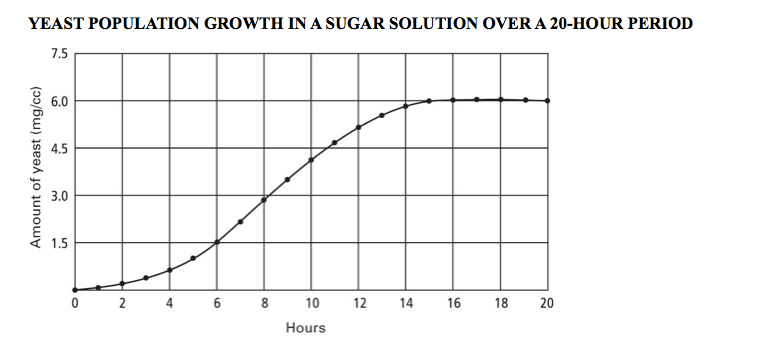
What type of growth is shown on this graph?
a)
logistic
b)
exponential
c)
average
d)
density-independent
7.
Which of the following is a density-independent limiting factor?
a)
natural disaster
b)
predation
c)
disease
d)
parasitism
8.
The way in which individuals of a population are spread out is called
a)
population density
b)
survivorship
c)
population dispersion
d)
logistic curve
9.
The movement of a single caribou into a herd is an example of
a)
population
b)
immigration
c)
emigration
d)
predation
10.
What pattern of growth will a population with limited resources show?
a)
density-dependent
b)
exponential
c)
logistic
d)
logical
11.
Diseases may spread more rapidly when an area is crowded, so disease is considered to be a
a)
type I survivorship curve
b)
population crasher
c)
density-dependent limiting factor
d)
population enhancer
12.
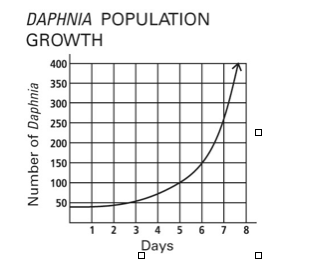
What type of population growth is shown in the graph?
a)
logistic growth
b)
logical growth
c)
exponential growth
d)
density-dependent growth
13.

A sequence of biotic changes that regenerate or create an ecological community is known as
a)
factors
b)
erosion
c)
succession
d)
progression
14.

Lichens and mosses that first live in uninhabited areas are examples of
a)
secondary species
b)
non-native species
c)
pioneer species
d)
climax species
15.

Secondary succession is most likely to occur
a)
on a volcanic island
b)
after a rainstorm
c)
after a Thanksgiving Turkey dinner
d)
after a forest fire
16.

At what amount of yeast does the population in Figure 14.3 level off?
a)
3.0 mg/cc
b)
1.5 mg/cc
c)
6.0 mg/cc
d)
4.5 mg/cc
17.
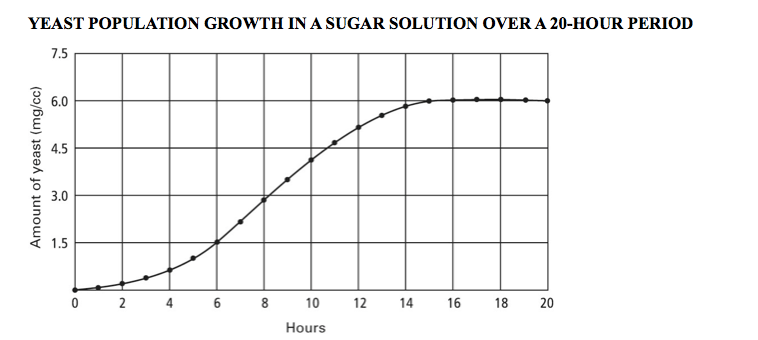
What is the name for this leveling off shown in the graph?
a)
logistic line
b)
carrying capacity
c)
climax point
d)
mediocre
18.
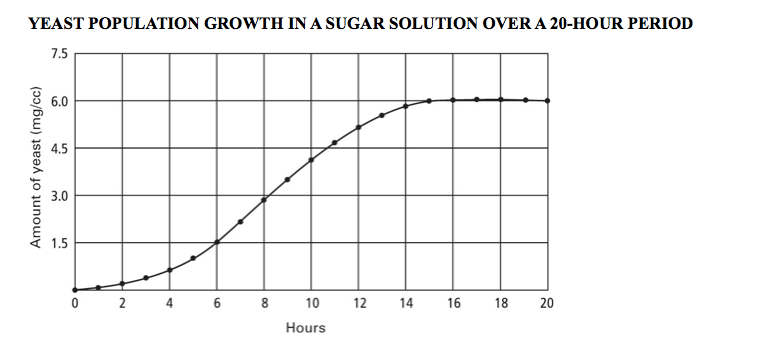
After how many hours does the yeast population shown in the graph reach its carrying capacity?
a)
15 hours
b)
10 hours
c)
6 hours
d)
At the start
19.

What is the amount of yeast shown in the graph at the 6-hour mark?
a)
6.0 mg/cc
b)
3.0 mg/cc
c)
1.5 mg/cc
d)
10 mg/cc
20.
What 2 factors decrease population size?
a)
Immigration, Births
b)
Emigration, Births
c)
Emigration, Deaths
d)
Immigration, Deaths
Reset

